"The person who possesses for simple, wholesome foods the same relish that the epicure has for unwholesome foods is on the highway to real and lasting health."
The Royal Road to Health
THE average dinner begins with a tasty, highly seasoned soup, and ends with a sweet in the form of a pudding or some kind of pastry. The meal begins and ends with a pleasurable sensation, which stimulates the appetite centers, and causes a copious flow of appetite juice.
While it is unwise to use harmful and highly seasoned foods, we are forced to recognize the need of providing suitable and wholesome substitutes that are pleasing both to the eye and to the palate. When a person sits down to a meal without any appetite, a spoonful or two of tasty soup, a little fruit, or something else that is relished, will often create an appetite that will lead to the enjoyment of the entire meal. There can be no harm in taking a little innocent relish to improve the appetite.
Of course, the danger exists in making the exception the rule. Soups were at first employed chiefly as a relish, only two or three spoonfuls being taken at the beginning of the meal. Later its use became more common, the meal being composed largely of liquids. This proved an injury to healthy digestion.
Learn to Eat Like an Epicure
Each one possesses likes and dislikes that must be respected as far as is consistent with true science and good sense. Gradually the appetite should be educated to relish the simplest and most wholesome foods. The person who possesses for simple, wholesome foods the same relish that the epicure has for unwholesome foods is on the highway to real and lasting health. For those who are ill it is especially important not to make eating too mechanical. It is more important for them to eat foods that are relished — foods which stimulate the secretion of a good quality of saliva and gastric juice — than to eat foods even more wholesome, which are unrelished, and therefore poorly digested because of the absence of appetite juice.
When the mind rebels against food, the stomach rebels against it as well. Often, owing to a diseased condition of the stomach, about all the juices formed are those which are produced by the stimulation of the appetite. Therefore for the dyspeptic, nutritious and wholesome foods should be attractively and tastily prepared, so as to tempt the appetite, and lead to real enjoyment of what is eaten.
Mechanical eating always creates dyspepsia, even if the food is wholesome, and the greatest precaution is taken in the combination. Worry and anxiety also cause indigestion, and are frequently responsible for dyspepsia.
Intoxicated by Drugs
Apparent benefit from the use of drugs, patent medicines, and narcotic poison, as alcohol, tea, coffee, and tobacco, is sometimes obtained. They stupefy or partially paralyze the mind, making it less sensitive, so that business cares, anxieties, sorrows, and other depressing influences, are for the time forgotten. The difficulty is that such artificial exhilaration is followed by a corresponding state of depression, which calls for another and often an increased dose of the same narcotic. To keep from worry and other depressing influences by the use of narcotics, it is necessary to remain in a continuous state of mild intoxication. Many who seem to be in the pink of health are in this condition, which is ruinous both to health and to morals.
While these narcotic poisons appear to perform marvels, sooner or later it will be found that they are poor substitutes for the real remedy, which is found by an actual and permanent change of mind, that will lead to a cheerful reformation of all wrong habits of life, and create a relish for simple foods. The apostle, in contrasting the false and the true, says, "Be not drunk with wine, wherein is excess; but be filled with the Spirit." Eph. 5:18.
Peace and contentment of mind must exist in order to enable the digestive organs to do their best work, for the quality of the impulses sent forth from the mind determines the quality of the work done by the digestive organs.
Complicated Modern Mixtures
The lower creatures do not require delicacies or narcotics. They are content with their simple fare. The horse is well satisfied with his meal of oats or corn. In fact, all these animals, if left to select their own food, prefer to take it direct from the bosom of nature; and from the simple foods thus obtained, they derive their great energy, and the elements out of which to construct bones and muscles.
Uncivilized nations or tribes live in the same simple manner. They do not always have the most suitable foods, it is true, and therefore their example cannot be followed by intelligent men and women; but their habits are simple and their wants few. They have none of the complicated mixtures, puddings, pastries, etc., used among civilized races.
The peasants of various civilized countries subsist on simple foods, and are content with one or two kinds at a meal. The Irish peasant has milk and potatoes; the Italian and French, macaroni and chestnuts; the German, black (rye) bread. In fact, the heartiest, healthiest, and happiest people are to be found among those whose wants are not greater than their needs, and who are content with simple foods.
Dr. Pawlow, in his experiments upon dogs, discovered that when meat was fed to an animal, the gastric juice formed was highly acid, and especially adapted for the digestion of meat. When bread was fed in place of meat, an entirely different gastric juice was formed, much less acid, and especially adapted for the digestion of bread. Milk produces a gastric juice different from both of the others.
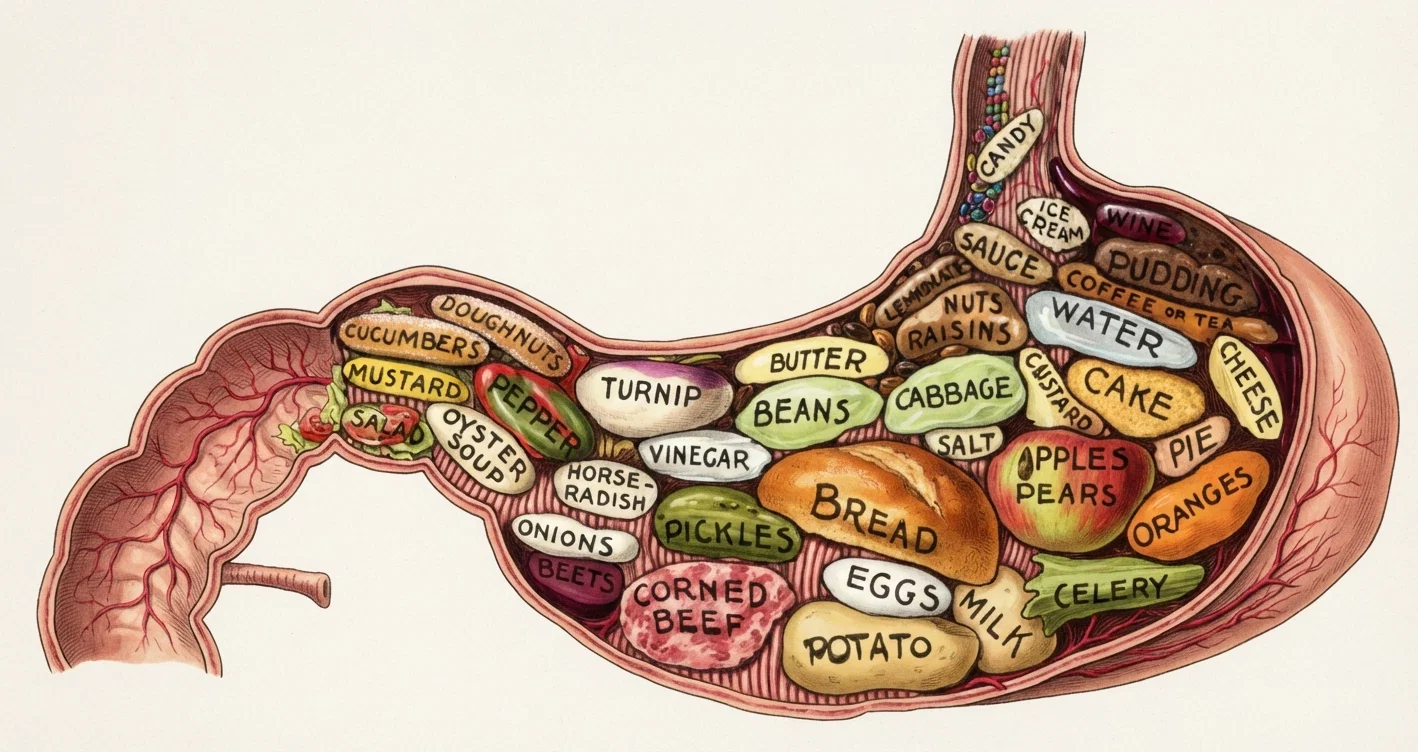
This shows clearly that the normal stomach should experience no inconvenience or difficulty in digesting one or even two kinds of food at one meal. But when meat, milk, bread, butter, puddings, cabbage, potatoes, jam, and fruit are all taken at the same meal, is it any wonder that the stomach becomes confused, and indigestion, fermentation, and auto-intoxication result?
From merely a health standpoint, it would be better to eat a simple meal composed of bread and meat, if meat could be obtained from a healthy creature, than to eat so large a variety of these complex messes. The simpler the foods, the fewer and less complicated the dishes, the better the health. Sensible men and women will discover that it is better to have less cooking of the complex dishes and dainties. The foods that require little or no preparation aside from mouth preparation — that is, fruits, nuts, and cereals — are in every way the best adapted for man's needs.
The Blight of Prejudice
SOME of the Jewish priests, and many of the common people, cherished the teachings of Christ; and these were among the thousands who, upon the day of Pentecost, were converted in a day. The disciples were all united, and the Spirit descended in great power, "and they were all filled with the Holy Ghost." See Acts 2:4. The message relative to Christ's resurrection and ascension was given in no uncertain manner. Every nationality heard the wonderful news of the risen Saviour in their mother tongue. "Cloven tongues like as of fire" descended upon the heads of the apostles, attesting that Jesus had broken the bands of death and ascended to His Father.
This visible manifestation of the Holy Spirit was a great perplexity to many of the Sadducees, who believed in neither the Spirit nor the resurrection. "They were all amazed, and were in doubt, saying one to another, what meaneth this?" Verse 12. A spirit of inquiry was awakened in the minds of some; but "others mocking said, These men are full of new wine." Verse 13. What a terrible misjudging of the work of the Holy Spirit, shed forth in such great power, to enlighten and save sinful men!
Is it not somewhat the same to-day? Are not the plain teachings of our Saviour, which, if received into the heart, would eradicate prejudice, cast out malice, and bring peace and joy to the soul, rejected because preconceived ideas and the traditions of men are enthroned within?
Those who yield to bigotry are under the influence of Satan. Such will misapprehend the truth of God, and persecute its advocates. But the same Jesus who defended His Pentecostal people will care for His faithful followers to the close of time. All the demons of darkness, reinforced by sinful humanity, cannot overthrow the work of God, nor destroy one of His little ones; for the promise to His people is, "Surely the wrath of man shall praise Thee: the remainder of wrath shalt Thou restrain." Ps. 76:10.
E. HILLIARD.