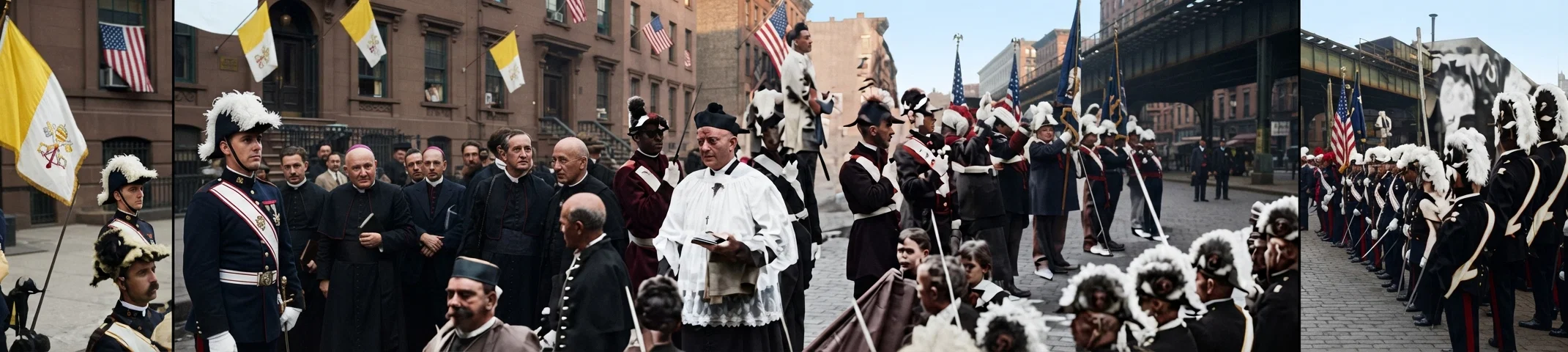
WHAT was considered the most notable gathering of Roman Catholics in the history of this country assembled in the city of New York during the week beginning August 20. It was occasioned by the meeting of the American Federation of Catholic Societies. The multiplicity of societies and activities represented by the federation would in themselves call together a very select group of Catholic spirits. But apart from this large delegation of prelates, priests, and prominent laymen, there were brought together for the first time on one platform, the three American cardinals and the papal delegate to this country.
It was known as “Catholic week” in the city, and was prominently kept before the public through the press as well as by the many flags decorating buildings throughout the metropolis. A feature of these decorations was an extensive use of the papal flag, with the tiara and the keys standing out strongly upon the background of yellow and white. While the American Federation of Catholic Societies was the chief body of the assemblage, representing, as it does, more than three million members, three other large organizations were represented by numerous delegations. The three societies that were associated with the American Federation in this convention were the German Catholic Central Verein, the National Conference of Catholic Charities, and the Catholic Press Association.
These various societies met in order to come to a better understanding of the problems confronting the Catholic Church, and how to coöperate more successfully in their solution. The plan proposed, and toward which the convention worked, was that the four societies not merely coöperate, but coalesce under the leadership of the American Federation. This would unite the activity of the laymen of the Catholic Church along the lines of social, charitable, press, educational, and propaganda work. The plan embraces the using of the Catholic press as a central clearing house and disseminator of Catholic ideas, and the creation of a national Catholic Chautauqua.
Among other things, Cardinal Farley, of New York, told the Catholic Press Association that he believed a daily Catholic newspaper should be founded. In this connection, he made use of the following language:658"The first great gun against the calumniators of the church was fired here in New York years ago, when the Catholic World was started. At that time, newspapers had the habit of attacking Catholics, from the pope down, with a violence and a bitterness that they would not employ toward even the most insignificant sect. Things have changed since then, owing to the activities and abilities of the editors in Catholic publications. During this time, those opposed to us have become more respectful in their opposition. Let us not cease, in season and out of season, to contradict calumny after calumny, even at the risk of being thought monotonous. Don't care what is said; keep at it."
A pontifical mass opening "Catholic week" was celebrated at St. Patrick's Cathedral on Sunday morning. A procession was formed at Cathedral College, in which members of the convention, together with many of the New York parishes, participated, and marched to the cathedral. The apostolic delegate, John Bonzano, surrounded by his staff, was followed by Cardinal O'Connell, of Boston, and his staff, Cardinal Gibbons and his staff, and Cardinal Farley and his staff. These prelates were the chief attractions of the procession. As they passed, men and women knelt in the street. With such a coterie of church dignitaries present, the mass assumed a somewhat similar appearance to the big functions in Rome.
Delivering the Fatal Blow
But the really important meeting of the convention was held on the evening of the same day, in Madison Square Garden, the largest hall in New York City. The newspapers put the number present as twenty thousand, but that is probably a little over the capacity of the hall. However, the place was jammed, and thousands of persons turned away for lack of room. It was the occasion around which everything else circled. It was made exceptionally prominent in the press and before the public, as the Catholic Church of America had a pronouncement to make, which it wanted the whole country to hear. It was the church's great effort to convince the country that it stood for America and Americanism undiluted.
In keeping with this idea, the hall was decorated and draped extensively with American flags. The spirit of patriotism was made the order of the day. While there were three cardinals and the apostolic delegate present, the telling speech was evidently assigned to Cardinal O'Connell, of Boston, as the one most likely to stir the large audience and the country.
There had been bitter denunciations of the papers that were attacking Catholicism, during the Catholic Press Association meetings. "Scurrilous," "mendacious," and similar words were favorites with Catholic speakers in denouncing opposition journals. Strong pleas were repeatedly made for laws to be enacted by the government for the suppression of these attacks upon the Catholic Church. With these fiery speeches and denunciations as a background, the stage was set for Cardinal O'Connell amid ecclesiastical splendor calculated to give the active opposers of Catholicism such a blow as he hoped would ever after discredit them in the eyes of the public.
The following description of the manner in which the speech was given and the impression produced is especially interesting, as it comes from an unbiased source, the New York Times:
"It seemed, when Cardinal O'Connell, of Boston, in slow and solemn tones, and speaking, as he said, out of his acquaintance with the minds and purposes of three popes and the whole American hierarchy, had denounced 'once and for all' those who asserted that the church conspired for temporal control, the highest pitch of enthusiasm had been reached.
"But a moment later, Cardinal O'Connell struck even closer to the hearts of his hearers as he warned America of her need of her 20,000,000 loyal Catholic citizens, and demanded that she keep her side of the contract in return for their readiness to bleed and die for her. Seldom has a New York audience been more deeply affected than was the multitude in the garden when the cardinal, in a voice that reached every man, woman, and child, said:
No Whispers of Plotting
" 'Oh, yes, we know very well the whole litany of accusations against us. We give only a divided allegiance. We are scheming for government. These are all lies so patent that they need no answer. Indeed, those who fling them out will never listen to any answer. But I am going to answer them once and forever here to-night.
" 'As a cardinal, I may be supposed to know what I am saying on this subject. And, on my word as a gentleman of honor, I am speaking the simple, absolute truth. I have known intimately, personally, and officially three sovereign pontiffs — three popes of the Catholic Church. I am a priest now thirty-two years; I am a bishop fifteen years, and a cardinal five years. I have had the closest relations with not only the pope, but the whole Roman curia; I know well every priest in my diocese and every bishop in this country. Yet never, never, in all that experience, have I ever heard spoken, lisped, or whispered, or even hinted, by any or all of these, anything concerning America and American institutions but words of affection, of tender and kindliest solicitude for her welfare; never a syllable that could not be printed in the boldest type and distributed throughout the land; neither plot nor scheme nor plan, but only sentiments of admiration and love. If there is plotting, I ought to know it. Yet, absolutely and honestly, of such things I have never heard even a whisper. . . .
" 'If you stand by inactive, while under your very eyes, yes, through your very mails, which we pay for, we are insulted, scurrilously maligned, and openly vilified, in filthy journals, and nasty, indecent literature, unfit to be printed or read, spread broadcast, that dupes and bigots may be poisoned against us, so that we may be robbed even of our public rights — then you are not keeping your contract — this is not liberty.
" 'You are only wounding the hand, the strongest hand, held out to help you; you are spurning the aid of those who again and again you have found, in your hour of direst need, the most willing to die for you.' "
Wild Enthusiasm Results
That these words made a powerful impression upon the large audience, and put at least loyal Catholics in a frenzied state of mind, may be gathered from the following quotation taken from the same paper:
"Time and again, Cardinal Gibbons's thin hand, stretched out over the people, had stilled their tumult in an instant. This time, even his quiet authority was powerless. The Boston delegation's noisy band thumped its drum, and sent crashing chords of brass to swell the din; the somber, purple-garbed papal delegate, Archbishop Bonzano, nodded and clapped his hands; Cardinal Farley leaned out of his chair and beamed with gratification; Governor Whitman sat with his eyes glued on the heavy, lined face of the cardinal from New England; and the audience climbed on chairs, waved hats and handkerchiefs, and sent out deafening roars of 'Bravo!' and 'Long live O'Connell!"
It might be stated, however, that the plans our Romanist friends have for capturing this country for their church have not been learned from hostile papers, but are derived from Catholic sources.
Wiping Out the Reformation
That if their plans succeed, "Protestantism will be a study of the historian and antiquarian, together with Arianism," is a statement made by themselves. And the declaration that with the fall of Protestantism in America, the Reformation of the sixteenth century would be wiped out, is also from Catholic sources. What could the destruction of Protestantism mean, if not Catholic rule in the United States? It is therefore not so difficult to understand the program of Catholicism for our country.