ALL through the ages, penitent sinners have been confessing and forsaking their sins, and by faith, placing them in the hands of their Intercessor in the heavenly sanctuary. In this sense, their sins have been accumulating in the heavenly places. They have gone "before to judgment." 1 Tim. 5: 24. This constitutes the "defiling" of the sanctuary, and hence we may readily understand what the cleansing of the sanctuary means.
In Lev. 16: 30, we read, "For on that day shall the priest make an atonement for you, to cleanse you, that ye may be clean from all your sins before the Lord." Now this atonement was made by the same priest, and by virtue of the same blood, as the atonement for the sanctuary. Verses 16-19. From this, it would appear that the cleansing of the people was the thing that resulted in the cleansing of the sanctuary; for by that very means, every case that was on trial before the throne of grace was decided for life or death, and thus, in the earthly type, was removed from the sanctuary.
The same thing takes place in connection with the heavenly sanctuary. Its cleansing will be accomplished when the cases of those whose names are in the book of life have been finally and unalterably decided for life or death; when every one who has ever started in the service of God shall either have had his sins blotted out, or his name blotted out of the book of life. Acts 3: 19; Rev. 3: 5.
As will be brought out in a later article, the Bible foretold that the cleansing of the sanctuary would begin in 1844 A. D.
Must Be Born First
No one is dead to sin till he is alive to God; and no one is alive to God till he is born again. And it is inconceivable that the whole world were born again before they were born at all. Until we are born again, we do not see life, but the wrath of God abides on us. John 3: 36. Sin was not remitted from man when it was imputed to Christ; but sin is remitted when we believe on Christ. Acts 10: 36. Sin was not remitted from man when Christ bore man's sins in His own body on the tree; but in that supreme act of the cross, He opened the way for sin to be remitted when the righteousness of Christ is declared "unto all and upon all them that believe." Rom. 3: 22, 25. This is the truth. And unless our sins are remitted by faith in Christ, to stay remitted, we shall die for them, just the same as if Christ had never borne them in His own body on the tree; and our names will be blotted out of the book of life.
Atonement His Free Gift
To some, it may seem gross injustice that God should punish men for sins whose punishment has already been borne by Christ. Would any just government even on earth be guilty of punishing two persons for the very same crime? A little thought will show that the supposed difficulty is only imaginary. The government of heaven never demanded that Christ put Himself in man's place by suffering for his sins. Christ voluntarily laid down His life for the sheep that were straying. He said: "No man taketh it from Me, but I lay it down of Myself. I have power to lay it down, and I have power to take it again. This commandment have I received of My Father." John 10: 15, 18.
Christ's atonement is not one made with Him, as in the case of Satan, the scapegoat; but He makes it Himself, by the power of His own blood. His sacrifice and atonement are all His own; and is it not lawful for Him to do what He will with His own? "For," He says, "as the Father raiseth up the dead, and quickeneth them; even so the Son quickeneth whom He will." John 5: 21.
The promise of forgiveness and cleansing is only to those who confess their sins. 1 John 1: 9. This is the agreement made before the cross; and God is faithful and just in refusing to quicken—that is, to forgive and cleanse—those who hide their sins. There can be no injustice to impenitent men in punishing them according to their works. Neither can there be any injustice to Christ, who Himself inflicts the punishment. John 5: 27; 2 Thess. 1: 7, 8. No principle of justice can possibly be violated when Christ shall punish the rejectors of His mercy for the very sins which He Himself bore on the cross. In fact, they are infinitely more worthy to die for them than they otherwise would have been.
As we have seen, sins enter the heavenly sanctuary when, by confession and earnest seeking of God, they are placed in the hands of our Advocate at the right hand of God. There, by virtue of the infinite sacrifice on Calvary, He makes atonement for and forgives the sins of those who truly confess and forsake them. The Holy Spirit is given, and angels are sent forth to minister to them that shall be heirs of salvation. Everything is done to enable them to remain faithful. On the day of atonement, all cases will be examined, and a final atonement made for all those who have kept the beginning of their confidence "steadfast unto the end." Heb. 3: 14. Their sins are then "blotted out" (Acts 3: 19), and the decree is uttered, "He that is holy, let him be holy still." Rev. 22: 11.
Prepared the Gallows for Himself
This will finish the cleansing of the sanctuary. As Christ, in His capacity of Advocate, leaves the sanctuary, He bears with Him from that place forever the burden of Israel's sins. The debt of sin has been paid, and they then stand before the law as if they had never sinned. Their iniquity has been caused to pass from them, and they are fully clothed with the change of raiment. Then the shame and ignominy which their great adversary and accuser, Satan, has always tried to heap on their heads, is transferred to his own head.
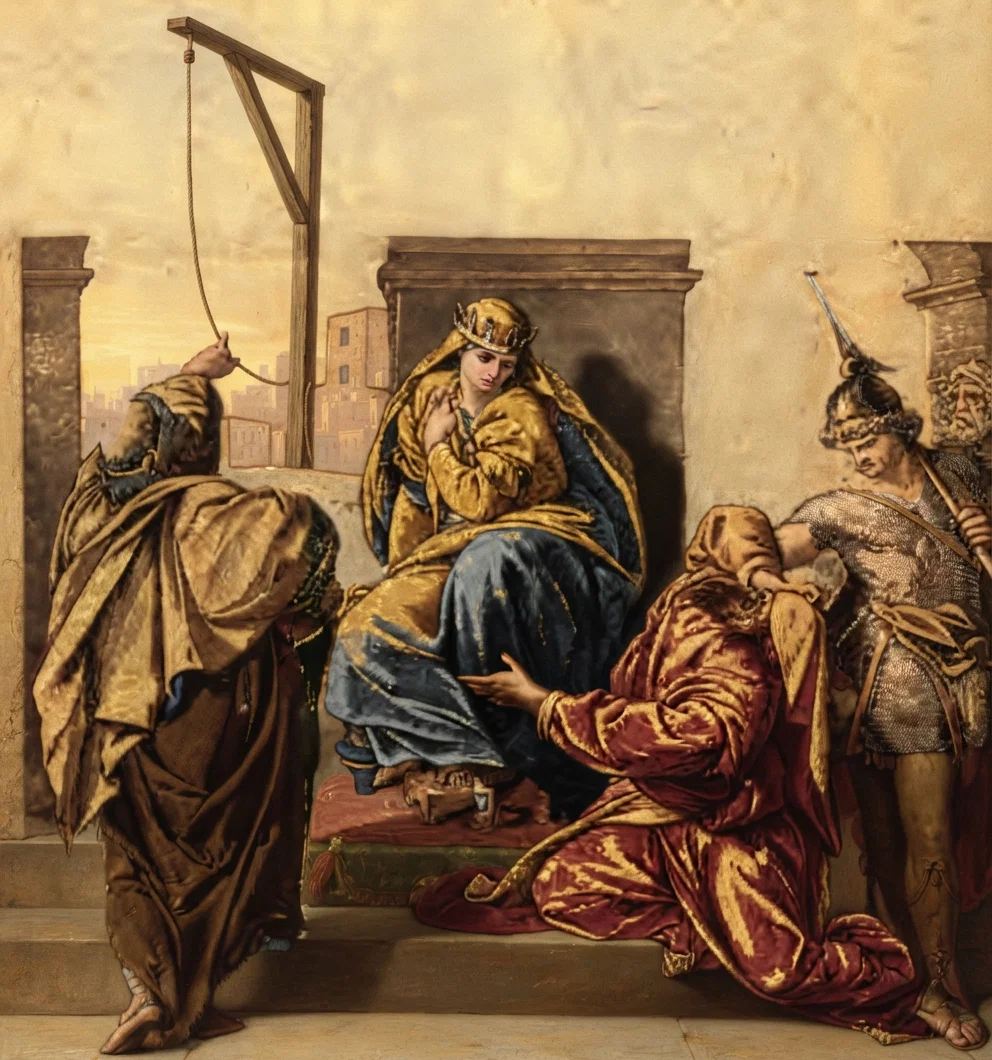
As in the days of Queen Esther, the "adversary and enemy" was hanged on the gallows he had prepared for God's servant Mordecai, so the great adversary of God's people will suffer the punishment he had hoped to see inflicted on them.
The same thing is stated in the seventh psalm: "He made a pit, and digged it, and is fallen into the ditch which he made. His mischief shall return upon his own head, and his violent dealing shall come down upon his own pate." Ps. 7: 15, 16. So Satan will not only suffer or make the atonement for his own sins, but, for his violent dealing against God's people, will suffer the punishment he has sought to bring upon them. While this is true, as seems to be indicated also by Rev. 18: 6, in the sentence pronounced against Babylon, it must not be construed as meaning that Satan's punishment is the satisfaction rendered to the law of God for Israel, or atonement for their sins; for that interpretation would deny the work of Christ, by which their sins were fully disposed of and destroyed.
The Sins Placed on Satan's Head
The sins that are placed on Satan's head are the same outwardly, or objectively, as will be blotted out in the sanctuary. He is declared guilty of them as their originator and instigator. And he is sent away to await the time when he shall pay the final penalty for them in the lake of fire. With him will go those from whom Christ withholds His atonement. Their names are blotted out of the book of life, and to them He will say: "I never knew you: depart from Me, ye that work iniquity." "Depart from Me, ye cursed, into everlasting fire, prepared for the devil and his angels." There they will be burned up root and branch; and from the purifying fires will come forth "new heavens and a new earth, wherein dwelleth righteousness." 2 Peter 3: 13.
When the Test Comes
IT is very easy and natural to think that if we were placed under certain circumstances, we would do great things; but the facts are that we would do just exactly what we are in the habit of doing. The actions of men who are counted great are simply the doing of that which they were accustomed to do, and in most cases, without even knowing that it was of any great importance whether they did it or not.
Of Daniel, when the decree was signed that no one should ask a favor of any king or of any God for thirty days, except of King Darius, we read: "Now when Daniel knew that the writing was signed, he went into his house; and his windows being open in his chamber toward Jerusalem, he kneeled upon his knees three times a day, and prayed, and gave thanks before his God, as he did aforetime." Dan. 6: 10. In this case, Daniel did just what he had been accustomed to do. The few words at the close of the verse express the whole thing,—"as he did aforetime."
When a person has established a habit of doing the things which he knows to be right, he will do them, no matter what the circumstances may be. But if he has not formed this habit, when the test comes, he will be found wanting. G. W. CAVINESS.