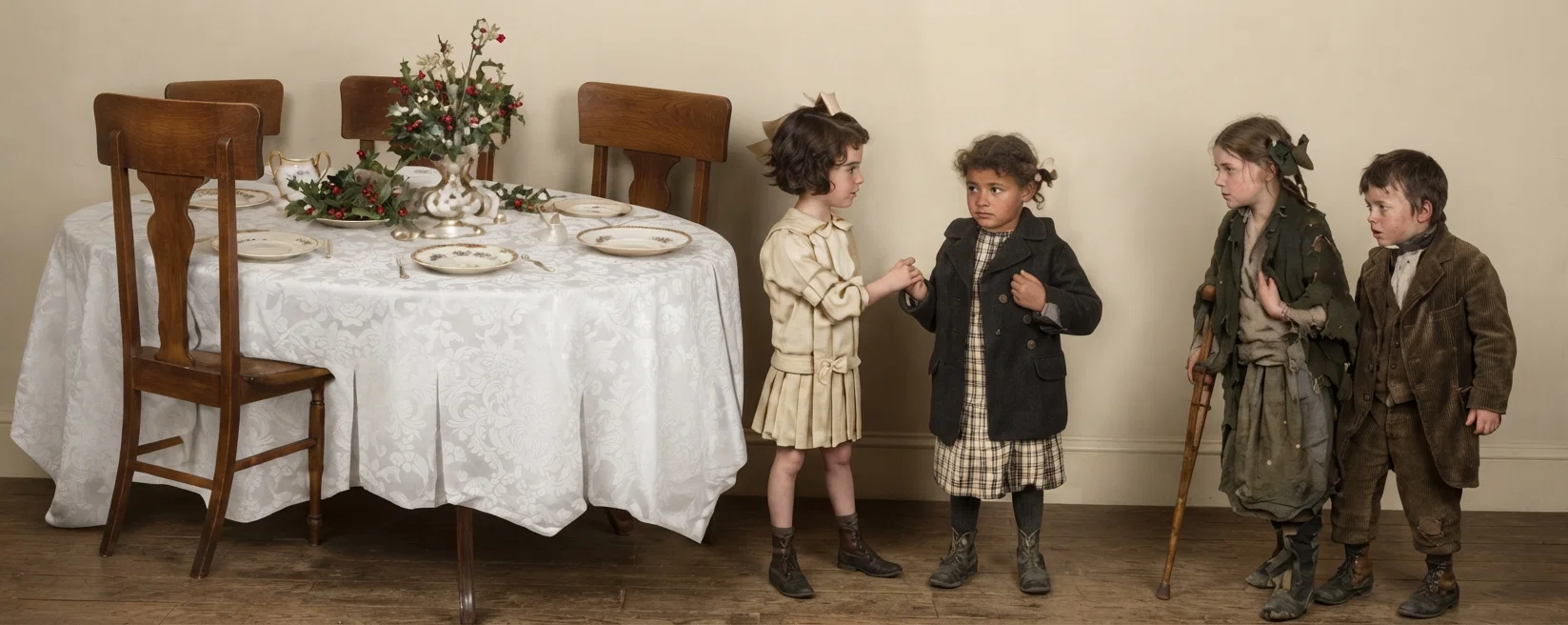
COLD December had come, and the suburban winter scenes amid which Mabel Dodge dwelt were especially welcomed by her, to whom the fleecy drapery of nature's robes was a vivid reminder that Christmas joys and festivities were drawing near.
Mabel's mother believed implicitly in the blessed principles of the old-fashioned Bible, and it was her custom each week to choose some practical text for her little daughter to commit to memory.
Mr. and Mrs. Dodge had been accustomed to entertain lavishly at Christmas time, always taking care also to remember the poor; but this year, they had told Mabel that she might have just her own little company, whomever she might choose.
There remained but one text to be learned before Christmas week. The brisk breezes were swaying the naked boughs which in summer had spread an inviting shade about the large veranda. Mabel drew her little cane rocker in front of the cozy fireplace, and turned to her appointed task. She was somewhat puzzled as she read the words found in Luke 14: 13: "But when thou makest a feast, call the poor, the maimed, the lame, the blind." With a troubled expression on her usually bright face, she asked,
"What does it mean, mother?"
"What do you think it means, Mabel?"
"Well, does 'feast' mean a Christmas dinner?"
"I suppose it does," said her mother, without further comment; and seeing Mabel's perplexity, she promised to talk with her again about it at another time.
Mabel did not forget her task; and by the end of the week, she had learned the text perfectly. Her mother well knew that a struggle had been going on in the child's young heart, so she took occasion to explain further the meaning. She did not want Mabel to get the idea that it is not perfectly right to entertain our own special friends sometimes, but she desired her to know also the joy of giving happiness to those who have little of the sunshine of life.
Mabel had thought much about the coming Christmas, and how delighted she would be to have Katherine Swan and Elizabeth Bailey and Dorothy Smith take dinner with her; for she had been a guest at all their homes on various occasions.
"Well," said Mabel, "if I do as that text says, I suppose I can't have any good time on Christmas except just our tree on Christmas eve."
"Would my little Mabel like to entertain Jesus on Christmas day?"
"Oh, yes," said Mabel; "but He has gone to heaven, and I can't do that now."
"Let us see about it," said her mother. "We read in Matt. 25: 40, 'Inasmuch as ye have done it unto one of the least of these My brethren, ye have done it unto Me.' So if Mabel will invite to her Christmas dinner little lame Susan Snow and poor Bennie and Matie Brown, she will be doing just the same as if she should entertain Jesus Himself; that is, He counts it just the same."
"O mother, is that what it means — that we may entertain Jesus at our feast?"
"Yes," said her mother, "that is our privilege. The Bible always means just what it says. And would you like to try it on Christmas day?"
"Yes," said Mabel sweetly, "and I can have Katherine and Elizabeth and Dorothy some other time."
"Surely," said her mother, "you may have them any time you wish. But as they have so much to make them happy, I am sure you will never regret sharing your Christmas joys this year with those who have little to vary the monotony of a cheerless existence."
It was a bright morning, and the snow glistened like diamonds in the sunlight when Mabel set out upon her mission of love to invite her poor little acquaintances to her Christmas feast, as she had called it. As she tripped gayly along, a snatch of a little gospel song was ringing in her heart:
"Shout the glad news to each one you meet, Jesus loves even the waifs of the street."
She tapped softly at the widow Brown's door, and the poor woman opened it, half startled that any one should call. With a perplexed expression on her careworn face, she said:
"Come in, Miss Mabel. Is some one sick or dead, and is there washing or other work to be done?"
"Oh, no," said Mabel; "we are all quite well, thank you. I came to see if you would let Matie and Bennie come over to our house to dinner on Christmas day."
"The Lord bless you, dear; you are the first one that has ever given them such pleasure. But I fear they have nothing fit to wear on such an occasion as that."
"Oh, yes, they have," said Mabel sympathetically. "Please let them wear what they have on now; it is plenty good enough." And with a cheery good-by, away she went toward the humble cottage of poor Mrs. Snow.
She soon reached the place, and passed up the well beaten path, on either side of which the roses of springtime had long since faded. It was a tumble-down place, the home of a drunkard, who daily spent his earnings at the saloon, while his poor wife and little afflicted daughter were struggling with the woes of poverty.
In response to Mabel's soft tap, little lame Susie came hobbling on her crutches; and without waiting for Mabel's message, she said wearily: "My mamma is not at home. She has gone to wash for —"
"I didn't come to see your mother exactly," said Mabel. "I want to know if you can come over to our house on Christmas day."
"I don't know," said Susie, with a tone of deep sadness in her voice, "as I would be much help now in tending baby; for my foot is worse, and the doctor says I may never walk on it again."
"I don't want you for that, Susie dear," said Mabel sweetly. "I want you to be my company."
"Your company!" said Susie in astonishment.
"Yes, company," replied Mabel emphatically, "and eat at the first table with me and Matie and Bennie Brown."
"Oh, how delightful that will be!" said Susie. "I am sure mamma will let me go;" and while great tears of joy — such joy as she had never known before — fell softly down the pale cheeks, Mabel bade her a tender good-by, and hurried home with a heart overflowing with love for those less fortunate than herself, to tell her mother all about her morning experience.
How long the time seemed from Monday till Thursday, during which Mabel decided, with her mother's consent, to share her Christmas tree joys also with her poor little friends, by having the tree on Christmas day.
At last the day came, and Mabel's happiness knew no bounds. Tall chrysanthemums lit up the somber niches of the dining room, while in the library, amid gay festoons of evergreens and fragrant roses, stood the Christmas tree — the first tree of its kind in which the little guests of the day had ever had a share.
After the distribution of the gifts, every one being generously remembered, Mabel led the way to the dining room, where was laid a table such as her company had never before approached. Never were more delighted guests entertained at the hospitable Dodge home, than were present on this occasion. Mabel herself had never before seemed quite so happy, for on no former occasion had Jesus seemed quite so near. She was experiencing some of that inexpressible joy which comes as the result of ministering to the needs of others, and was realizing, as never before, that truly "it is more blessed to give than to receive."
The day was soon past; and the little feet that had never before pressed thornless flowers, turned to tread their familiar pathway. But it was not so dreary now. The shadows of life were spanned by the rainbow of love.
After Mabel's mother had tucked her away in her little bed that night, and the drowsy eyelids had closed in slumber, she thought she caught a faint murmur from the realm of dreams — "Inasmuch as ye have done it unto one of the least of these My brethren, ye have done it unto Me."