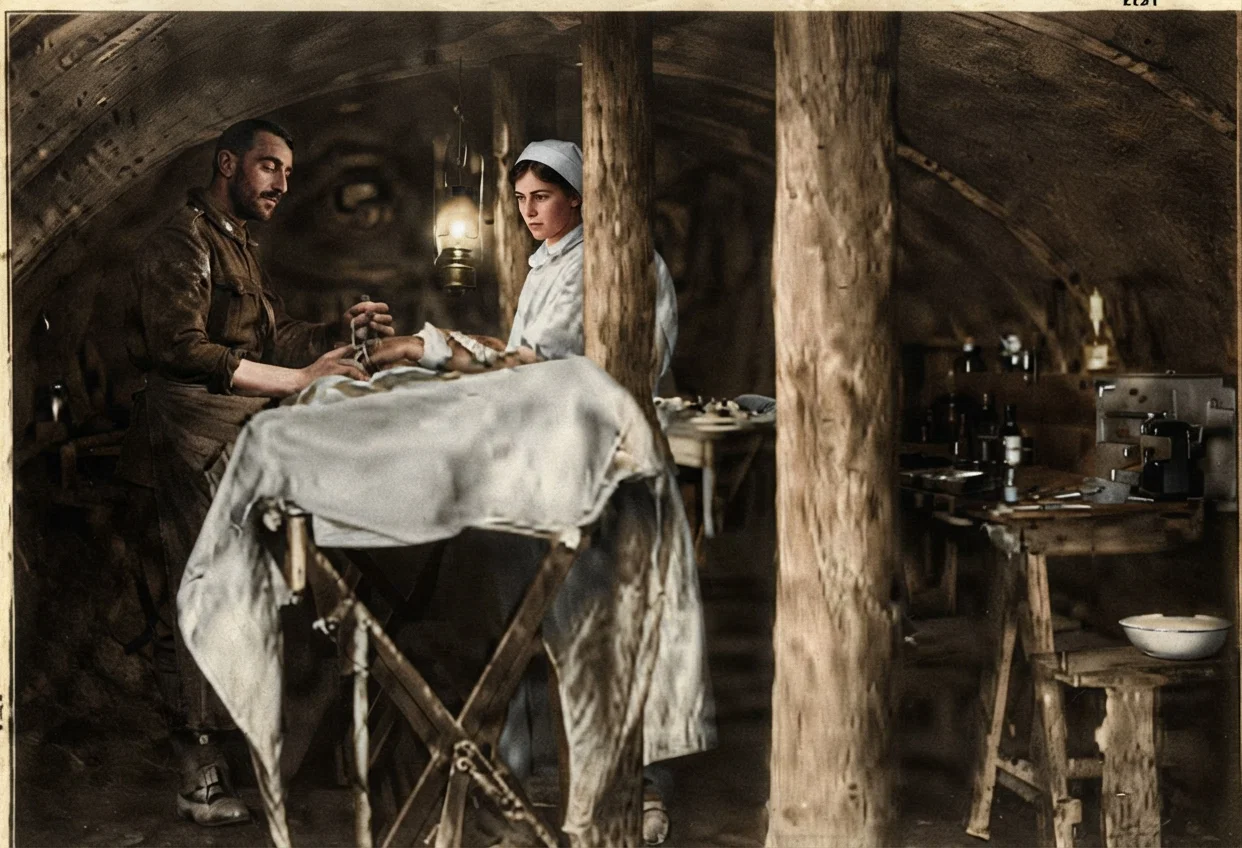
“The world will soon become one vast battle field. Shall we train our youth to take life, or to save it?”
By Newton Evans, M. D.
President of College of Medical Evangelists
Courtesy "Illustrated London News"
WE are all informed only too well regarding the outstanding features of the great world war that has now been in progress for more than two years, and that shows no signs of abating in fury, but rather is growing worse.
But we are not all so well informed as to the remarkable conditions in the medical world which necessarily accompany this titanic struggle. From week to week, there appear in the great medical journals of this country articles and letters dealing with the medical and health conditions of the countries at war. In these articles, one is continually impressed with the importunate demand for doctors and nurses, not only on the field of battle, and in the field hospitals and base hospitals, but also to look after the sick and afflicted in private life.
This insistent and imperative demand is shown in many ways, especially as related to the conditions of medical education. In England and other of the countries at war, medical students are hurried through their courses, and are put into practice after three or four years of study, instead of five, as usually required. In Austria, the education required for entrance into medical schools is reduced by several years.
Not Enough Doctors to Go Around
MANY of us are more or less acquainted with the commendable and heroic work of the great numbers of American physicians, surgeons, and nurses in the war zones, and particularly those who are organized into the American Hospital corps, especially in France.
The following, taken from four news items in a New Zealand newspaper, is illustrative of many similar items, and portrays actual conditions:
“The minister of internal affairs . . . has additional burdens laid on his shoulders just now, by the scarcity of doctors. . . . The Wellington doctors are so dreadfully overworked. . . . The war has decreased the supply without lessening the demand. . . . Doctors are wanted for the back blocks, for county hospitals, and for similar institutions, and they cannot be got in the numbers required. Mr. Russell is deluged with correspondence on the subject, and is giving it his sympathetic attention, but there are simply not enough doctors to go around.”
To Slay or to Save?
THESE conditions serve to call to the minds of Christians the question of their personal attitude toward the problem of bearing arms and slaying their fellow men in time of war. Certainly, in view of the basis of our belief—the law of God and the faith of Jesus Christ—no Christian should enter lightly into a course of action which demands the deliberate and direct destruction of the lives of our fellow men. In those countries where it is necessary to take an active part in the war, Christians should seek a place in the medical corps. There the only work would be to save life, and not to take it.
The question is still before us, Should our young men be prepared to save life, or must they be forced into service behind the guns in this war and those that are to follow? There are so many hundreds of thousands in training to take human life, should there not be hundreds and thousands in training to save life, and in this service, to minister also the word of God?
Believing that these war conditions will become more and more general, and that the demand for medical men will accordingly increase, would it not be well for many scores of young men to prepare themselves to minister to these thousands who are wounded every month? Just as great is the demand for women physicians to labor among the women and children who, under the straitened circumstances of war and the attendant lack of proper food and protection, are falling easy prey to disease.
Exempting Religious Objectors
A LETTER from an anxious mother in California came to my desk some time ago. This mother has three sons. She wants them to get such a training that their efficiency as medical men will make it unnecessary for them to serve in the army except as savers of life and ministers of light.
A mother in another state recently sent a plea for us to send some “literature along the medical missionary line” to her son, “who is now on the Mexican border.” She explains that “he chose public school work. . . . While there, he drilled with the National Guards. . . . He was at the normal in — for the summer studying, and was rudely summoned to report for duty on the Mexican border.” Do you know what this means? If your son should be summoned, would he go to save life, or to take it?
In the British countries, the question of “religious objectors” is receiving much attention. A member of the New Zealand Parliament, in discussing the matter of exempting the Quakers and other “religious objectors” from military service, on the grounds that such service is contrary to their religious belief, recently said that “religious objectors” had for many years not been allowed to escape military service in England. “Though I cannot understand their views,” he said, “I recognize these people are consistent, and have in past generations suffered untold miseries rather than forego their principles.”
“These people,” he further said, “are not shirkers.” He referred to valuable noncombatant work done by them in France, they being exempted from active service, on condition that they perform equivalent noncombatant work.
Another member, Mr. Poole, “recorded his recognition of the splendid efforts of the Quakers in humanitarian work. He saw difficulties, but hoped the government would do no injustice to a worthy class.”
What does all this discussion in the Wellington Parliament mean?—Every man’s service is needed by his country. If, because of “religious scruples,” he will not go and fight, he must be able to render “valuable noncombatant service.” What service could be more valuable than that of a physician or a nurse? Hospital physicians, surgeons, sanitation officers, and nurses will be greatly needed when this country of ours becomes involved.
In homes bereft of fathers and sons, there is great need for the comforting word of God. Where could a more needy field be found than among the perishing soldiers or in the sorrowing homes? Who could more appropriately speak to these of the love and care of the heavenly Father than the physician or nurse who ministers to their physical needs? The world will soon become one vast battle field. Shall we train our youth to take life, or to save it? Which?