Gems Fit for a King

5%

Pacific Press Publishing Association · Mountain View, California · Sep 19, 1916

FromSigns of the Times, Vol. 43, No. 37.

Read the full edition

Gems Fit for a King

From Lusterless Masses to Brilliants of Great Purity

Jewel Cutting for the Diadems of Royalty

By LUCAS ALBERT REED
CARBON is one of the blackest, we might say, most defiling things, for color at least, in the world. Its black will endure for ages. For example, in the form of India ink or printer's ink, it will lie on the white page of the book until that carbon, changed in nature, though still carbon, becomes one of the most precious things we know.
This change takes place through the action of two great factors, pressure and heat, applied at the same time. While nature can apply both pressure and heat at the same instant, for man to do this is almost impossible; for when he has the requisite amount of heat to bring about the change in the carbon, that which the scientist employs for pressure relaxes its force through the undermining agency of the temperature. Hence diamonds cannot be made by man except upon a small scale. But nature can build her Kohinoor, and her Regent, and her Florentine, and her Orloff.
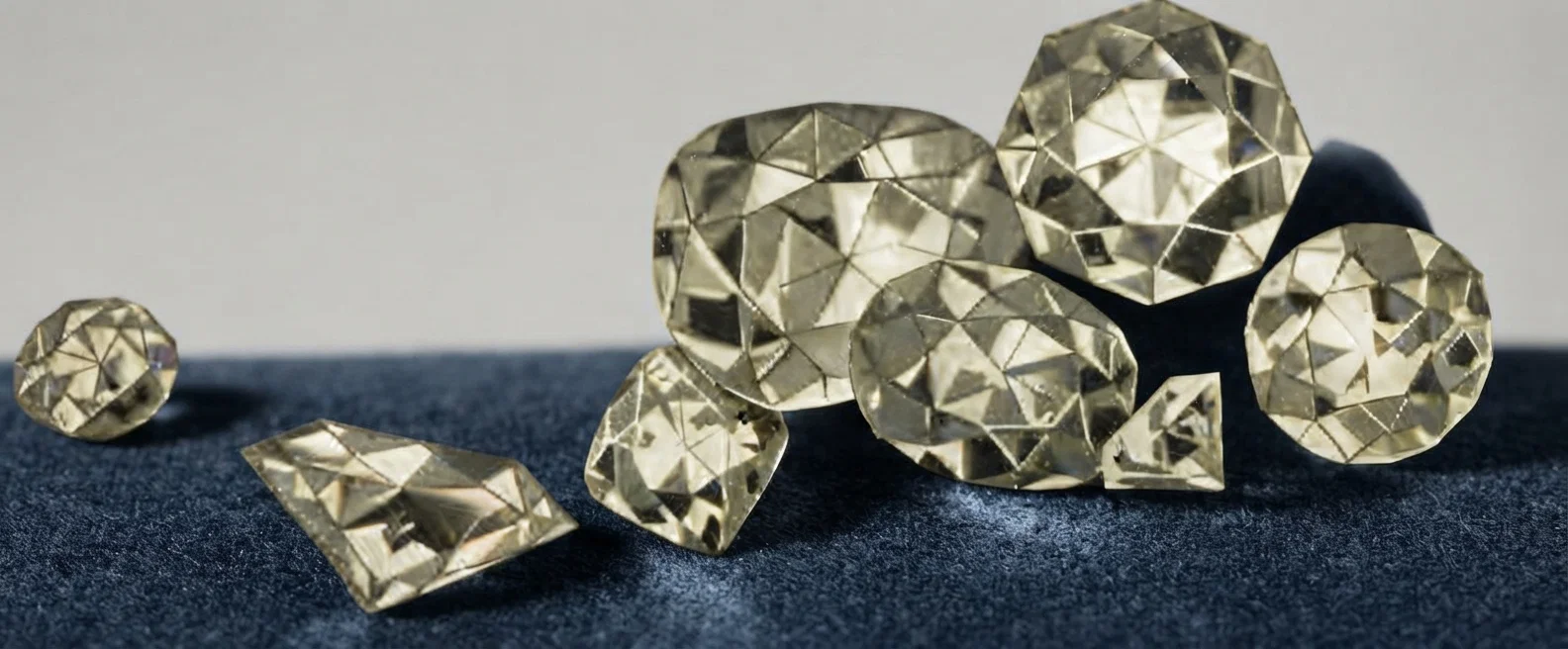
When the diamond once has been made, it must receive some of the most skillful work, and lose greatly in its substance, in order to become really valuable, and fit for the diadem of royalty. For example, the Kohinoor diamond, which came from the Golconda district, by unskillful cutting by Hortensio Borgio, lost in weight from 793 carats down to 186. When, in 1851, a decision was made to recut this diamond, its weight was brought down to 106 carats; but even so reduced, its value increased. The recutting improved it from a lusterless mass, scarcely better than rock crystal, to a brilliant of great purity and fire, whose value is estimated at seven hundred thousand dollars. It is now a part of the crown jewels of England.
The Regent or Pitt diamond, when it was found by a miner of Parteal, Golconda, India, in 1702, weighed in the rough 410 carats. Its cutting and polishing cost six hundred thousand francs. This work was done by the most expert workmen in France, and took two years. When finished, it weighed 136¾ carats, losing, as you see, two thirds of its weight; but it is now valued at nine hundred thousand dollars.
Then there is the other instance of the Orloff diamond, which in its rough state weighed 779 carats, and by cutting, in order to bring out its beauty and brilliancy, was reduced to 195 carats; but it is now valued at five hundred thousand dollars. It seems like a great waste of a valuable gem to destroy two thirds or three fourths of its substance in cutting it down to the finished gem; but if the cutting is well planned and wisely and skillfully done, every stroke increases the value of the diamond, because it changes it from a lusterless stone to a crystal that can send forth the most brilliant, solid shafts of light that anything on earth can reflect. While it loses much of its uninteresting self, it gains mightily in receiving the glow of reflected light. The light is not its own, but its ability to reflect that light and to shoot it forth lies within its own nature.
So it is with man. Of himself, he is a dull, uninteresting mass of selfishness; but if the work upon him is wisely planned and skillfully done — if, in fact, he is under the tutelage of the greatest Teacher of the universe — he comes to the place where he reflects the light of heaven. It is not his light; but the ability to reflect that light and send it forth lies within the nature which, through God, he has acquired. He becomes a partaker "of the divine nature, having escaped the corruption that is in the world through lust."
A diamond, to become valuable, must lose in size, must lose its roughness, and must take the shape best adapted for it, as determined by its original condition. Much depends, in this, upon the designer and the cutter. In the case of man, however, an unerring God takes him under His direction. With an absolutely accurate eye, He not only sees all that is in man, but all that may be developed or brought out through that which God shall work in; and thus He can make a man more precious than gold or gems.
This ability to see what lies in man, and to produce it in his life, may be illustrated by a block of marble. Perhaps it lies upon a hillside. There it is, ugly and uninteresting. It is blasted out of the quarry; it is brought into the shop of the sculptor.
He looks upon it. No one else can see in it anything more than a great,rough mass of stone; but as he gazes upon it, and contemplates its form and possibilities, it stirs his imagination. He becomes interested, then filled with wonder. Almost reverently he at last prepares for his great task. He has not touched it yet, or at best only rudely blocked out its outlines; but looking at it with the eye of a master artist, he sees the angel within the stone. Then as that angel begins to take form, even the common bystander becomes interested, loses his disesteem, and begins to realize the possibility of the great block of stone from the hillside.
So also is it with man. God looks down upon His creatures; He sees what we are; but, oh, infinitely above all this, He sees what we may be; and when we have yielded to Him, He begins to bring out these qualities and powers. After feeling for a time the molding hands of God upon us, even we begin to see that there is a great purpose taking shape in our lives. More than ever before, we begin to respect that purpose, and we begin to coöperate and labor, that the great Master hand may be unhindered in shaping His grand and benevolent design.
True enough, He will cut away and rub and polish until every corner is gone, and every feature assumes its beautiful line in the great plan. But what shall we care for that? The "light affliction, which is but for a moment," works for us. Yes, it is our workman, our servant; it works for us "a far more exceeding and eternal weight of glory." 2 Cor. 4:17.
The time spent in cutting away the substance of the diamond or the marble is not lost. The material that is gone is really gain. Thus with man. He loses self, that he may receive Christ. He loses his dullness, that he may reflect heaven's brilliancy.
There is no time lost with God. Moses was in the wilderness forty years. The world would have said, perhaps, if it had been asked counsel, that this was a great waste of time; but it was not. It was some of the most valuable time spent by Moses in all his career. He went into the wilderness a failure, a blunderer; but there, amidst the mountains and the plains, he was cut by the Master Workman to reflect the light of God. And when he came forth, he was invincible. His very face shone with the light of heaven; and only once in all that trying, terrible forty years with the rebellious people — only once did he fail. He had become the meekest man that ever lived. Time lost? — No, no more lost than the time spent in making a dull mass of crystal shine with the beauty of a Golconda diamond.
But man is not a dead mass, unyielding, inert. He can, if he will, work against the will of his Maker; but we are admonished to let the mind be in us which was also in Christ Jesus; to work out our own salvation with fear and trembling, for it is God that works within. Man may be a prince, to rule with Christ, or he may become the most despicable character one can possibly conceive of.
The poet has well expressed the need of man's giving himself to this work, coöperating with God. We would heed the lesson so rhythmically told:
"I hold it the duty of one who is gifted, And royally dowered in all men's sight, To know no rest till his life is lifted Full up to his great gift's height." "He must mold the mass into rare completeness, For gems are set but in gold refined; He must fashion his thoughts into perfect sweetness, Cast folly and pride from out his mind." "For he who drinks from God's gold chalice Of art, music, or rhythmic song, Must sift from his soul the chaff of malice, And weed from his heart the roots of wrong." "I think the wrath of an outraged heaven Should fall on the chosen and dowered soul That allows a lump of selfish leaven, By slow fermenting, to spoil the whole." "Great gifts should be borne like a crown befitting, And not like gems on a beggar's hand; And the toil must be constant and unremitting That lifts up the king to the crown's demand."