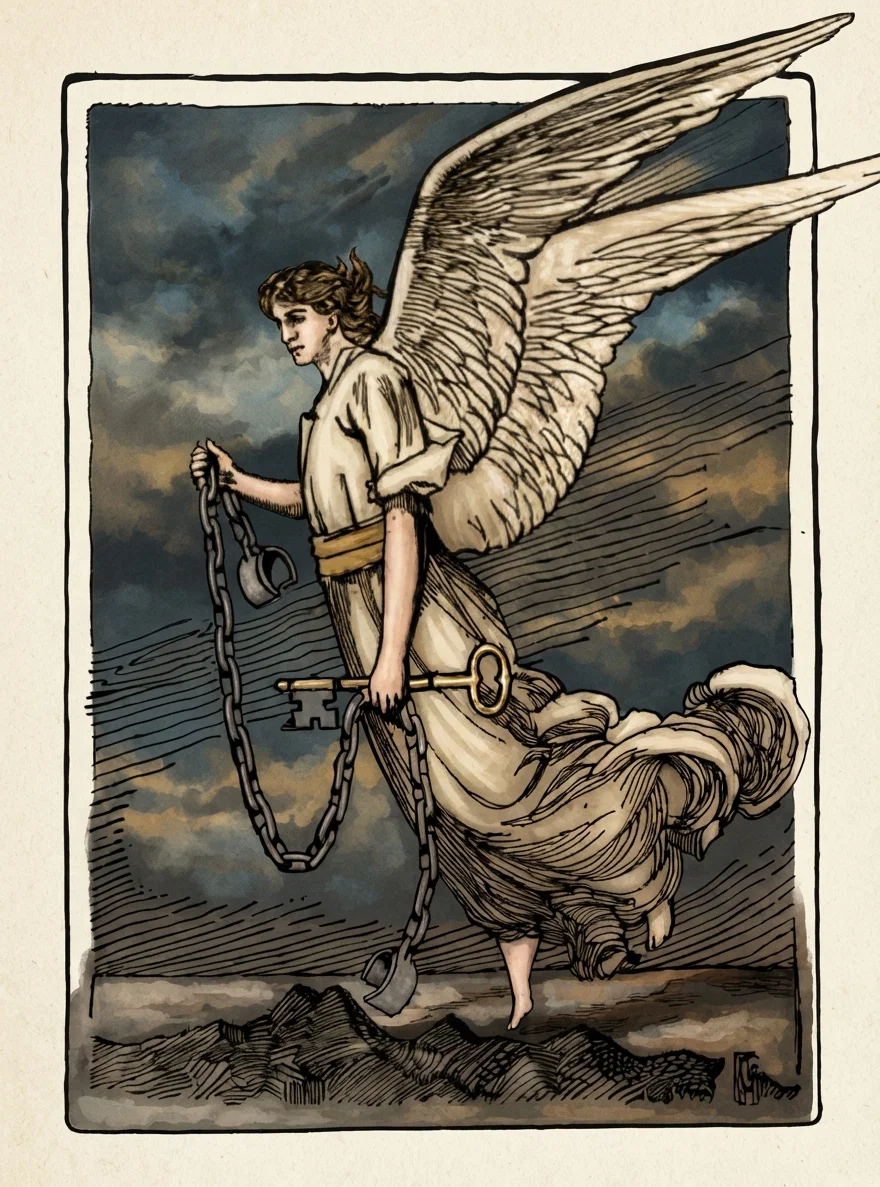
Chained amid Earth's Ruins—Doors of the Tomb Rolled Back
By Benjamin G. Wilkinson
The first of five strong articles by Dr. Wilkinson on the events of the millennium era appeared in last week's issue. This series is worthy of earnest study. Never in the history of the universe has there been anything like that era; never will there be afterwards. Where we spend the thousand years determines where we shall spend eternity. Next week the terrific devastations that will precede the millennium will be delineated.
The millennium is bounded on this end by the old earth rejected; on the other end, by the heavens and the earth newly created; on this side, by the resurrection of the just (as says John, "Blessed and holy is he that hath part in the first resurrection," "but the rest of the dead lived not again until the thousand years were finished"); on that side, by the inauguration of the new Jerusalem as the capital city.
With the opening of the millennium, the devil changes position. He loses his freedom. "And he [the angel] laid hold on the dragon, that old serpent, which is the devil, and Satan, and bound him a thousand years." Rev. 20: 2. The time has been long during which the peace of God's home has been disturbed. But with the opening of the millennium, the domestic unhappiness fomented by the incarnation of selfishness comes to an end with a large section of God's family.
Three Setbacks to Satan
The millennium opens with a decided shock to the devil's operations, and it is the third of a series of steps culminating in his downfall. First, at the creation of the earth, he was cast out of heaven. "I beheld Satan as lightning fall from heaven," said Christ. Luke 10: 18. Secondly, at the cross, he was hurled back from free range throughout the spheres, and from influencing other creations. "Therefore rejoice, ye heavens, and ye that dwell in them. Woe to the inhabiters of the earth and of the sea! for the devil is come down unto you, having great wrath, because he knoweth that he hath but a short time." Rev. 12: 12. Lastly, during this millennial era, he is so imprisoned that he shall "deceive the nations no more."
But this does not astonish the righteous; long ago, they had cast him out of their hearts.
Just now his time is growing short; then it will be run out. His existence will be prolonged through another thousand seasons, but his power to deceive will be removed. The instigator of all evil lies chained amid the ruins of his rage. Blessed millennium!
The hours of probation are few. The chances of salvation are diminishing. As the hours of the millennium draw on, there are not many more seats left for passage to eternity. Make your calling and election sure before it is too late.
Doors of the Grave Thrown Back
The bridge that spans the chasm of the millennium is a thousand arches long. One end rests on these old hills of sin, the other is thrown over to the heights of the new earth. On this side, one of the great pillars is the second coming of Christ. "For the Lord Himself shall descend from heaven," says Paul, "and the dead in Christ shall rise first." 1 Thess. 4: 16.
At His first coming, no widespread resurrection took place. He did not come for that. Then He came to confirm the promise made to the fathers. But so many lives, from Abel until now, have been hid in Him, that the hour which brings His return will also bring again from the dead those from whom transgressions have been turned away.
The doors of the grave will be thrown back, and the just will come forth. From all over the earth they will rise, clad in robes of fadeless immortality. Resplendent among them all, lighting up with streams of glory the caverns of infinity, will be the figure of Christ. The carnival of carnivals opens, and the millennium begins.
Their Position Unrivaled
THOSE among the living who approach the millennium with their eyes open hold a position unrivaled in history. First they are in the dark, then they are in the day. They pass through the transition period — days when they live in the agony of expectation. They will not be in the resurrection of the just, but already alive. With their own eyes they will see themselves, as mortals, put on immortality.
They have walked the streets of Boston, Chicago, Denver, New York — cities as they are now. Then they will behold a mystery. After having seen the devastating plagues sweep the earth, they will witness the glorious coming of Christ. Standing where once modern life swarmed, they will see the opening of the graves, and the resurrection of the righteous dead. Like so many tornadoes, as cataclysms and revolutions, the plagues sweep around them. How gladly can they hail the millennium! What valuable witnesses they will make forever of those days never to be forgotten! Therefore "we which are alive and remain shall be caught up together with them [the resurrected ones] in the clouds, to meet the Lord in the air." 1 Thess. 4: 17.
"Behold, I show you a mystery; We shall not all sleep, but we shall all be changed." 1 Cor. 15: 51.
"And I looked, and, lo, a Lamb stood on the Mount Sion, and with Him an hundred and forty and four thousand, having His Father's name written in their foreheads. . . . These were redeemed from among men." Rev. 14: 1-4.
Witnessed the Resurrection
"AND I saw as it were a sea of glass mingled with fire: and them that had gotten the victory over the beast, and over his image, . . . stand on the sea of glass." Rev. 15: 2. In chapter 13, John had seen this company, just prior to Christ's coming, in conflict with the beast and his image.
The twelve witnessed Christ's ascent to heaven; His descent from glory the one hundred forty-four thousand behold. In the final efforts of the prince of the air, they saw the invasion of death; in the immortal trump of Christ, they behold the millions resurrected to life. How glorious to belong to that noble band, that last great chosen company! No surrender can be too great; any price is cheap that will win us a place therein.
Let Him begin a good work in you. "He which hath begun a good work in you," says Paul, "will perform it until the day of Jesus Christ."
We Never Know
Two friends were driving along an avenue in a beautiful city. As they were admiring the fine homes surrounded by lovely trees and flowers, one man turned to the other, and said, "Every house in that row has its tragedy." Then followed a recital of some of the saddest of stories.
We never know. If we knew, we would not envy, and would be far gentler in judgment. We do not know the sorrowing heart, or perhaps the silent endurance of physical pain, that lies back of the cold, repressed manner of our friend. We do not see the tragedy of disappointed hopes and ambitions in the face of the man who asks for work. We do not comprehend the unspoken pleading for love and patience in the apparently incorrigible child whose attitude defies us.
We do not know the shame and despair of the drunkard, nor the brave fight he makes in his moments of freedom, when his hope springs up anew.
We never behold the secret sorrow of the girl who has given herself to shame, when the purity of her womanhood asserts itself, and with buried face and bitter tears she sits in the presence of her God.
We seldom realize the heroism of the old man who is forced to earn his bread in extreme age, facing, in pain and weariness, daily toil, the passing of his strength, and the grim presence of the angel of death.
We never know until we too have suffered; until sorrow, pain, mortification, and defeat have claimed us for their own. And in the battle, we sometimes reach that place of divine compassion and understanding of the hearts of others, where we would never willingly cause another pain, and would gladly help a fellow being in his hour of need.