SYNOPSIS.—This interest-gripping prophecy of the seven trumpets portrays the downfall of nations during the Christian era. The first article of the series, in our issue of August 29, gave a general view of this desolation as it began to unroll before the ancient prophet. The trumpets were shown to be the symbols of war, referring definitely to the mighty irruptions from the barbaric hordes that swept over the Roman Empire, dethroning her from the position of proud mistress of empires. The first trumpet symbolized the wars waged by the renowned Alaric and his victorious Goths. Hail, fire, and blood falling upon the earth is the prophetic description. Rome was pillaged, was humbled in the dust. The fulfillment of the second trumpet is found in the conquests of Italy and Africa by the Vandals under the terrible Genseric. His ravages were indeed like a mighty stone cast into the waters, causing wave after wave to beat upon the defenseless shore.
"AND the third angel sounded, and there fell from heaven a great star, burning as a torch, and it fell upon the third part of the rivers, and upon the fountains of the waters; and the name of the star is called Wormwood: and the third part of the waters became wormwood; and many men died of the waters, because they were made bitter." Rev. 8: 10, 11.
This language implies that the next judgment upon Christendom would be of short duration, like that of a meteor, but that it would bring untold suffering upon the populations of the empire.
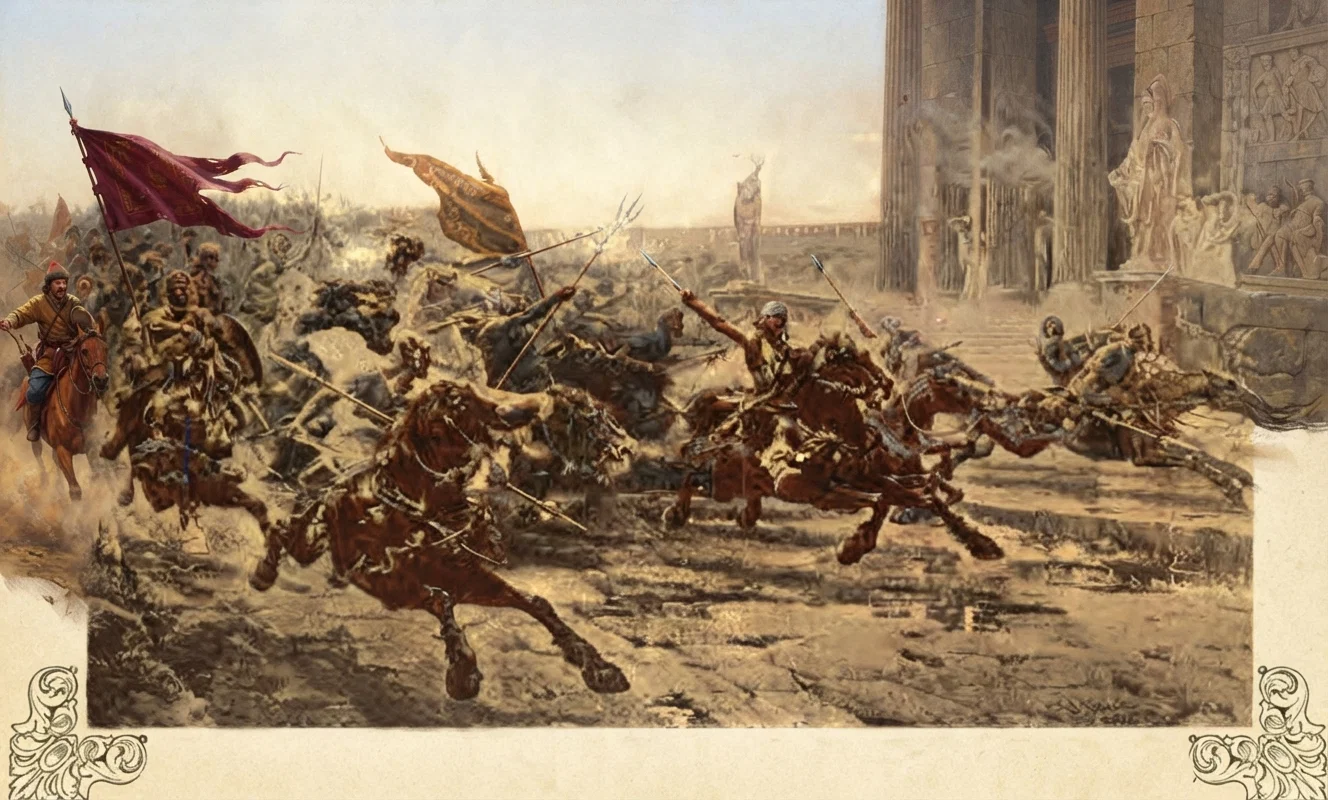
Toward the end of the fourth century, a nation unknown in Europe—the Huns—leaving the borders of China, and crossing the whole northern portion of Asia, a distance of nearly four thousand miles, dashed suddenly toward the northern shores of the Black Sea. The Goths, who were living there peacefully, fled in terror while the Huns were burning their villages and their harvests, and killing the men, the women, and the children.
Their language no one understood. Their name had never been pronounced in Europe. Says Jornandes, the Gothic historian, probably with the exaggeration of an enemy: "They put to flight, by the fear born of their ugliness, those whom they could not conquer by their courage. The yellowish color of their skin was repelling. Their face was a mass of flesh in which two dark holes marked the place of the eyes. They purposely defaced their own children in infancy, and their body was as hideous as their face."
Conquered by Ugliness
THEIR king Attila was short, with a large head, small, round, sunken eyes, and a flat nose. It is said that he was horrible to behold, and that he gloried in inspiring terror. "This man came to this earth to set his nation in motion and to make the earth tremble," says Jornandes again. "Frightful rumors preceded him, and scattered dismay all around." Attila called himself the scourge of God. He claimed that grass grew no longer where his horse had trodden.
In the very words of prophecy written four hundred years before, he said of himself: "The star is falling, the earth is trembling. I am the hammer of the universe." (Chateaubriand.) Disdaining royal pomp and comforts, he lived in a large wooden house, ate and drank in wooden utensils, while kings and ambassadors around him took their meals in silver and golden plates and cups.
"The kings and nations of Germany and Scythia, from the Volga perhaps to the Danube, obeyed the warlike summons of Attila," says Gibbon. "Day and night," says Ammien Marcellinus, quoted by Raffy, "the Huns seem to live on horseback. There they buy and sell, eat, drink, sleep, and hold council. . . . They give the charge or escape with the speed of lightning, and spread death all around. None of them know how to plow. They roam about space without home or hearth." "The Huns," says Chateaubriand, "were the last great nation summoned for the destruction of Rome; the other nations made a halt to wait for them."
Constantinople Ransomed
AND now the "great star, burning as a torch," is ready to fall "upon the third part of the rivers, and upon the fountains of the waters." A fearful shock, as that of a heavenly body striking the earth, awaits the fruitful valleys watered by the Rhine, the Danube, the Moselle, the Seine, the Loire, and the Po.
Deciding to punish the emperor Theodosius II, Attila crossed the Danube on all points at once with his innumerable army. Marching south, he defeated the Romans three times, took and razed seventy cities, burned the villages and the harvests, and either killed all the inhabitants or took them prisoners. Reaching Constantinople, he consented to withdraw for a ransom of six thousand pounds of gold and the promise of a yearly tribute of about two thousand pounds. This was in 447.
But the sorrows of Christendom had only begun. Four years later, in 451, leaving his "royal village in the plains of Hungary, Attila turned his face toward the West"; and after a march of seven or eight hundred miles, his myriads poured tumultuously across the Rhine and the Moselle. All the cities of lower Germany and Belgium were plundered, wrecked, or starved. Basel, Kolmar, Strasburg, Speyer, Worms, Mainz, and Treves fell into the hands of the invaders. Reaching Gaul, this "tempest of nations" overwhelmed every city, with the exception of Troyes and Paris.
The Unequalled Scourge of the Huns
THE vast army of Attila spread to the Atlantic coast, plundering and destroying everything. Besancon, Metz, Auxerre, Rheims, Langres, Toul, Laon, Tongres, Arras, were left in ruins. In Metz, the Huns killed everybody, including the children that the bishop had hastened to baptize. The city was set on fire. Salvian saw cities filled with corpses. The dogs and birds of prey, glutted with the putrid flesh of the dead, were the only living creatures to be seen.
The Thuringians, serving under Attila, hung up the children on the trees by the leg. They barbarously killed two hundred young girls, tying them by the arm to the neck of horses, which tore them to pieces. Others were bound on the ground and run over with chariots.
Where the Huns passed, famine remained to such an extent that fathers and mothers ate their own children. "The Huns," says Gaussen, "lived on cruelty." Nothing in this whole century equalled the scourge of the Huns led by Attila. Indeed, "a burning comet had fallen on the West," and was drying up all its beautiful "rivers" and "fountains of waters."
At Orleans, a Roman army, gathered by the clever general Aëtius, and composed of Visigoths, Burgundians, and Franks, forced the Huns to retreat, and a memorable battle took place on the large plains near Chalons on the Marne. The fate of Europe seemed6to tremble in the balance. For a while, the victory fluctuated, but finally it turned on the side of the Romans, or rather on the side of the Goths, the Franks, and the Burgundians, thus saving Europe from the enslaving rule of the Tartars.
Delivered the Death Blow
ALTHOUGH defeated, Attila was not conquered. The following year (452), he invaded Italy. Milan, Pavia, Verona, Turin, Aquileia, Padua, Treviso, Mantua, Cremona—in short, all the cities of Lombardy—opened their gates, and were plundered, and their population was massacred. Like Constantinople and Paris, Rome was saved from the anger of Attila. He threatened to return on the following year; but he died suddenly on the night of a wedding feast, 453.
The Huns were not intended to establish themselves anywhere on the ruins of the Roman Empire, but only to give it its death blow. As foretold by prophecy, this terrific meteor was to vanish in the night. "The inheritance left by the king of the Huns," says Chateaubriand, "had nothing tangible; it was only a sort of fiction or enchantment produced by his sword. The emblem of his glory once broken, everything vanished [italics ours]. The nations disappeared with the whirlwind which had brought them. . . . The reign of Attila was only an invasion," or, as Attila himself and the prophecy expressed it, "a falling star."
The third trumpet had sounded through Europe the peals of its thunder. Well might the godly survivors in those days have inquired, "What next?". An echo from the island of Patmos would have answered, "Four more trumpets are coming."