CHURCH history warrants us in stating that at least ninety per cent of all theological discussions have been a mere wrangle about words. Often the parties debating used the very same word in a different sense, and thus never came to any agreement. "Gentlemen, define your terms," said an old judge to two young lawyers who thought they disagreed when they didn't. It would be well if preachers too would define their own phrases.
In answering the question, "When was the atonement made?" we must consider what the term "atonement" signifies. If by the atonement we mean the entire plan of redemption, we will have to say that the time of the atonement is at least as long as probationary time. If we consider the term to mean the ransom price for sinners, given in the death of Christ, then the atonement was made and completed on the cross. If we use the word to designate the mediatorial work of our Saviour, then the atonement was not made on the cross, but is going on now in the heavenly sanctuary.
To atone is "to set at one," "to reconcile," "to expiate"; and the noun "atonement" is defined as "satisfaction or reparation made by giving an equivalent for an injury." The word "atonement" occurs but once in our New Testament, and then with a marginal correction; but in the Old Testament, it is found over fifty times. In the Greek, the same verb is rendered, in our Bible, "to make an atonement" and "to make a reconciliation."
Jesus Christ gave His life as a ransom for the whole human family. Matt. 28:20. The death of Christ on the cross is the price by which we are redeemed; and that price is full and complete for every man. If any one chooses to call the death of Christ, and this only, the atonement, then this atonement was of course made and finished on the cross. As the death of Christ is the foundation of the whole plan of redemption, to speak of this event as the atonement is proper.
However, the Bible uses the word "atonement" to designate the mediatorial work of Christ as our High Priest in heaven, and this is the most common use of the term in the Scriptures. Any one who will look up the word "atonement" as it occurs in the divine Word, will agree with us in this statement.
Made in the Sanctuary
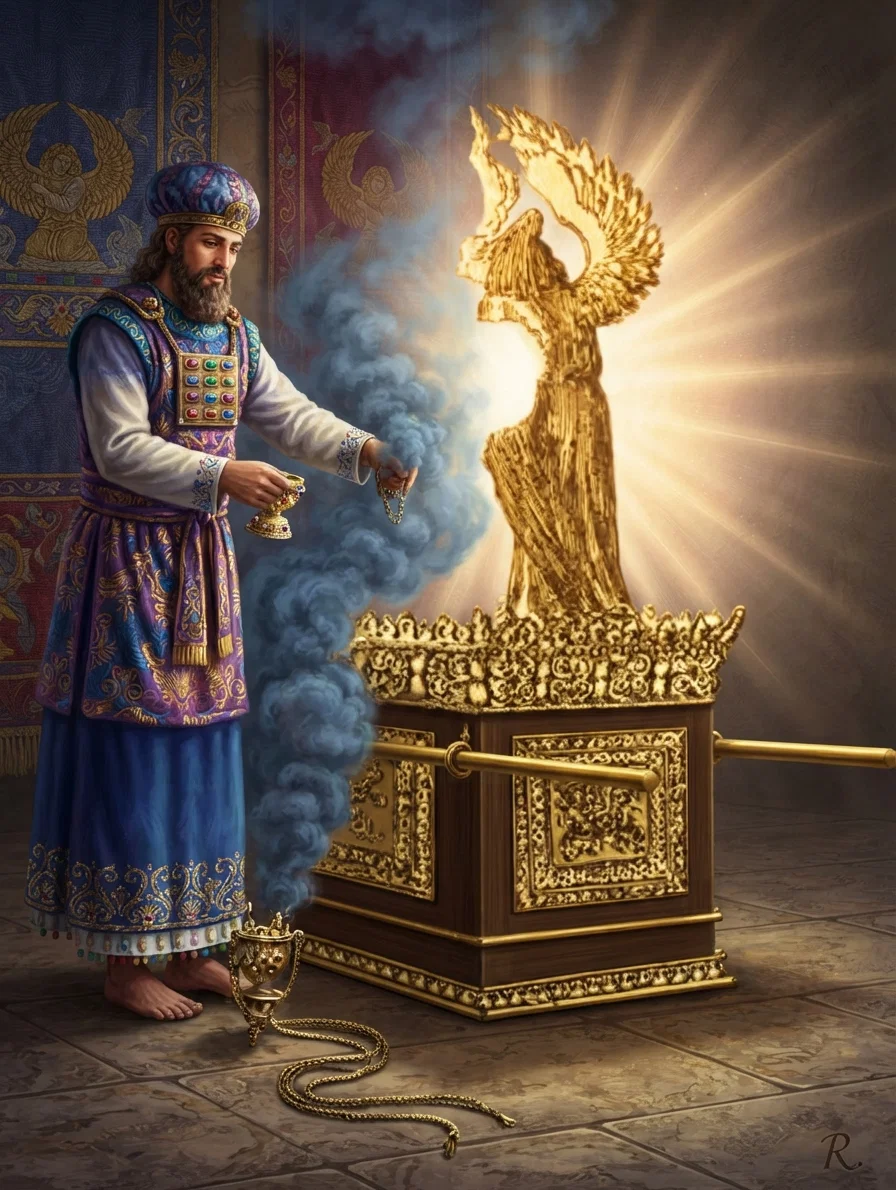
IN the Jewish sanctuary, there was a daily and a yearly service for sin. When a man had transgressed against the words of God, he brought a sin offering to the sanctuary. He himself placed his hands on the head of the animal to be sacrificed, and slew it. The priest took the blood, and sprinkled it upon the altar, and in so doing, made an atonement for sin. Over and over again in Leviticus, chapters four and five, we read, "The priest shall make an atonement for him." The priest did not slay the sacrifice, and surely he himself was not the sin offering; but he took the blood of the offering, and with it he made an atonement in the sanctuary. If this is a type of the work of Christ, it proves very conclusively that Christ makes the atonement for sin, not by dying as the sin offering, but in His office as Priest in the heavenly sanctuary.
This point becomes even clearer when we consider the annual services in the typical sanctuary on the day of atonement. A sin offering was slain, and its blood was carried into the most holy by the high priest. The high priest made an atonement with this blood. He made this atonement not by slaying the sin offering, but with the blood in the most holy place. "And there shall be no man in the tabernacle of the congregation when he goeth in to make an atonement in the holy place, until he come out, and have made an atonement for himself, and for his household, and for all the congregation of Israel." Lev. 16:17.
Notice carefully that the high priest made an atonement in the most holy place of the sanctuary. This day was called the day of atonement, and is the type of the great antitypical day of atonement in the heavenly sanctuary. In harmony with this, we read: "Wherefore in all things it behooved Him to be made like unto His brethren, that He might be a merciful and faithful High Priest in things pertaining to God, to make reconciliation for the sins of the people." Heb. 2:17. The word which in the foregoing verse is translated "reconciliation," is the same that is so often rendered "atonement" in other scriptures. This verse states that Christ was to make reconciliation, or atonement, not in His death, but as our merciful and faithful Priest. Jesus was not a priest on earth, but in heaven. Consequently He makes the atonement in the sanctuary.
Priesthood Belittled by Many
WE would not diminish the merits of the death of Christ; but we are convinced that His work as High Priest is misunderstood and even belittled by many. Without His work as our Mediator, His sufferings as our Sin-bearer would have been in vain. We are "saved by His life," and there would be no forgiveness of sins for us if we had no Advocate with the Father. We need to look to Christ as our High Priest, and have a living and daily communion with Him. He pleads our cases before His Father, and He is our peace. His work of atonement for His people will cease when this work in the heavenly temple ends. At that time, and not until then, will the atonement be finished.