Paul—

3%

Pacific Press Publishing Association · Mountain View, California · Aug 8, 1916

FromSigns of the Times, Vol. 43, No. 31.

Read the full edition

Paul—

"The introduction of Sunday observance into the Christian church is of later origin than the times of the apostles, and authority for it cannot be found in the Bible."

Paul—

the Sabbath Keeper

By CARLYLE B. HAYNES
WHILE considering the attitude of the apostles toward the Sabbath, it will be interesting to notice that they were accustomed constantly to preach on that day, to congregations sometimes of Jews, and sometimes of gentiles. One such instance is given in the book of Acts:
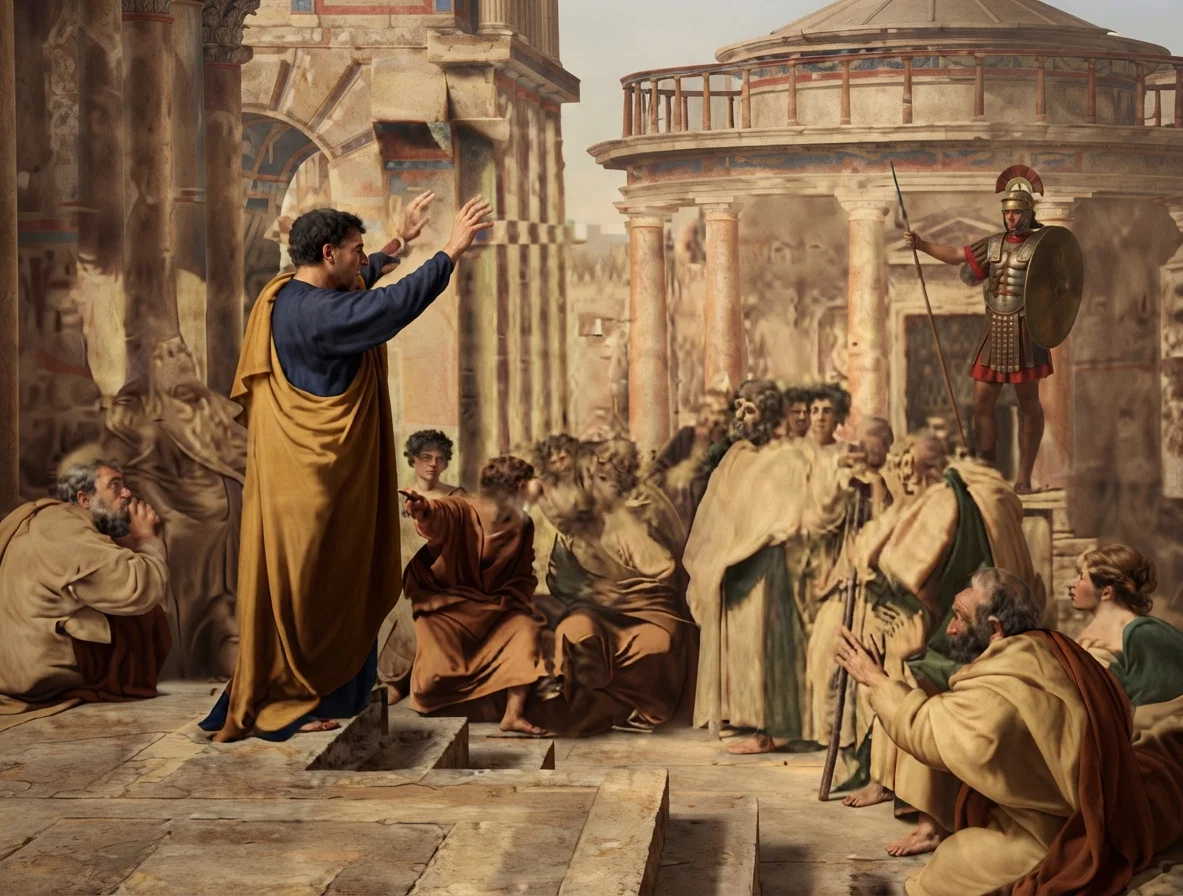
"But when they departed from Perga, they came to Antioch in Pisidia, and went into the synagogue on the Sabbath day, and sat down. And after the reading of the law and the prophets the rulers of the synagogue sent unto them, saying, Ye men and brethren, if ye have any word of exhortation for the people, say on. Then Paul stood up, and beckoning with his hand said, Men of Israel, and ye that fear God, give audience." Acts 13: 14-16.
Then Paul's sermon on this Sabbath day is recorded, being contained in verses 17 to 41. The assertion has been made, that the only reason for Paul's holding these synagogue meetings on the Sabbath was the opportunity thus afforded him of reaching the Jews with the gospel, and that he was not observing the seventh day.

Preached to Gentiles Sabbaths

THIS is a mistake. Paul preached to gentiles on the Sabbath, as well as to the Jews. Of this very occasion, we have the statement that "when the Jews were gone out of the synagogue, the gentiles besought that these words might be preached to them the next Sabbath." Acts 13: 42.
Here was an exceptional opportunity for Paul to explain to these gentiles that the seventh day was not the Sabbath for the gentiles, but the first day was. How easy it would have been for him, and what a splendid opening this was, to inform these gentiles that while he found it necessary to meet with Jews on their Sabbath, in order to bring them the gospel, yet as Christ had abolished the old Sabbath, and instituted a new one to take its place, gentiles ought now to keep that new Sabbath, which was the first day of the week, and therefore he would preach to them the next day instead of waiting for the next Sabbath!
Why did Paul not tell these gentiles this? — The main reason is, because it was not true. "And the next Sabbath day came almost the whole city together to hear the word of God." Acts 13: 44.
So here is mention of at least two Sabbaths on which Paul conducted religious services, and not at all exclusively for the Jews.

Additional Apostolic Sabbath Observance
ANOTHER Sabbath observed by Paul and his companions will be found in the following scripture: "Therefore loosing from Troas, we came with a straight course to Samothracia, and the next day to Neapolis; and from thence to Philippi, which is the chief city of that part of Macedonia, and a colony: and we were in that city abiding certain days. And on the Sabbath we went out of the city by a riverside, where prayer was wont to be made; and we sat down, and spake unto the women which resorted thither." Acts 16: 11-13.
Additional apostolic Sabbath observance is noted in the following passage: "Now when they had passed through Amphipolis and Apollonia, they came to Thessalonica, where was a synagogue of the Jews: and Paul, as his manner was, went in unto them, and three Sabbath days reasoned with them out of the Scriptures, opening and alleging, that Christ must needs have suffered, and risen again from the dead; and that this Jesus, whom I preach unto you, is Christ." Acts 17: 1-3.
Paul preached to gentiles on the Sabbath, as well as to the Jews.
It begins to seem very clear that instead of observing the first day of the week, the apostles were consistent observers of the seventh day, the Sabbath of the Lord.

Preached Every Sabbath

NOR are these passages the only ones we have that tell of the observance of the Sabbath by the apostles. We are informed that when Paul went to Corinth, "he reasoned in the synagogue every Sabbath, and persuaded the Jews and the Greeks. And when Silas and Timotheus were come from Macedonia, Paul was pressed in the spirit, and testified to the Jews that Jesus was Christ. . . . And he continued there a year and six months, teaching the word of God among them." Acts 18: 4, 5, 11.
How many Sabbaths he conducted services in the synagogue in Corinth, it is impossible to say, as in the course of the year and a half, he left the synagogue, and opened services in a private home near the synagogue; but be that as it may, this passage is a report of faithful Sabbath observance.
Thus the New Testament reveals that it was the custom of both Christ and His apostles to observe the seventh day as the Sabbath, while it contains not one single intimation that they ever observed Sunday.

"On the Lord's Day"

IT is claimed, by some, that Rev. 1: 10 affords evidence of Sunday sacredness. The verse reads, "I was in the Spirit on the Lord's day, and heard behind me a great voice, as of a trumpet."
The expression "the Lord's day" is thought to refer to Sunday. This is an assumption which it is easier to make twice than to prove once. The verse says nothing as to which day of the week is meant by "the Lord's day." Therefore we must go to other parts of the Bible to learn what day the Lord claims as His own.
We are told by Christ that "the Son of man is Lord also of the Sabbath." Mark 2: 28. From this, it seems plain that if Christ is Lord of the Sabbath, then the Sabbath is "the Lord's day."
Again we read, in the Lord's message to Isaiah: "If thou turn away thy foot from the Sabbath, from doing thy pleasure on My holy day; and call the Sabbath a delight, the holy of the Lord, honorable; and shalt honor Him, not doing thine own ways, nor finding thine own pleasure, nor speaking thine own words: then shalt thou delight thyself in the Lord; and I will cause thee to ride upon the high places of the earth, and feed thee with the heritage of Jacob thy father: for the mouth of the Lord hath spoken it." Isa. 58: 13, 14.
Notice that God calls the Sabbath "My holy day." Therefore the Sabbath, which is the seventh day, is clearly "the Lord's day."
But all doubt about it is cleared away by the Sabbath commandment itself: "Remember the Sabbath day, to keep it holy. Six days shalt thou labor, and do all thy work: but the seventh day is the Sabbath of the Lord thy God: in it thou shalt not do any work." Ex. 20: 8-10.
If, as the commandment says, "the seventh day is the Sabbath of the Lord thy God," there need be no difficulty in discovering what day is "the Lord's day." The Lord's day is not Sunday; it is the Sabbath, the seventh day, "My holy day," the day of which Christ is Lord.

Sunday of Later Origin

IN giving His disciples instruction concerning the destruction of Jerusalem, which took place about forty years after the crucifixion of Christ, the Lord said, "But pray ye that your flight be not in the winter, neither on the Sabbath day." Matt. 24: 20.
So far, then, from the Sabbath's being abolished by Christ, He gives instruction to His disciples to pray that they may be able to keep it forty years after His resurrection, even in the troublous times of the downfall of the Jewish nation.
It will be seen that there is much evidence in the New Testament for the observance of the seventh day, and absolutely no evidence for the observance of the first day. The introduction of Sunday observance into the Christian church is of later origin than the times of the apostles, and authority for it cannot be found in the Bible.