The Proposed International Court to Induce the Recognition of Justice by Concerted Military Action
By M. ELLSWORTH OLSEN
DURING the League to Enforce Peace Congress in Washington, May 26 and 27, Prof. John Bates Clark, of the Carnegie Endowment for International Peace, called attention, in his speech, to the fact that a world league to enforce peace is what we may naturally expect as the outcome of the present war.
"Three alternatives," he said, "are within the limits of possibility; namely, a draw, a crushing victory by one side, and a moderate victory by one side, leaving its opponent strong. The last is by far the most probable outcome; and if it occurs, the successful league will become, ipso facto, the league of peace which the nations need, and the only one they can get. . . . A world court can be established by their coöperation. The neutral powers will readily join in maintaining it. International law can, in a like way, be developed and made exact. Economic activities can be resumed on an international scale, and, as the years advance, with fewer hindrances and causes of irritation. Conferences of all the powers can be held with greater frequency, till they become periodic and increasingly influential. In the end, let us hope, a single League of Nations can be established, as nearly as may be akin to the one foreshadowed by the programs of our own organization.
"Out of one of the fighting leagues must evolve the union that will convert Dreadnoughts into cargo carriers, huge guns into engines of industry, and the fighting instinct of men into strenuous rivalry in the activities of peace."
Would Bring Swift Retribution
THE possibility of the members of the proposed league getting into war was discussed by Theodore Marburg, former minister to Belgium. "The only contingency," he pointed out, "which binds the league to make war, is an overt act of war committed by one of the signatories without a previous hearing of the dispute. The certainty that such an act would bring swift retribution at the hands of a league representing practically the civilized world, would cause any nation to pause. It is not claimed that the plan would prevent all wars. Nations bent on aggression might go through the form of a hearing and afterwards proceed to war. But the demand for a hearing, leaving the nation free to make war afterwards, is such a reasonable demand, and the penalty of ignoring it is so heavy, that it is almost inconceivable that any nation, however powerful, would ignore it; and therefore the league, as such, would seldom, if ever, be called upon to make war upon a recalcitrant member. But this result cannot be brought about without great preponderance of military strength on the part of the league. And we must face the fact that the United States, as a signatory, would be called upon to make its proper contribution to this military strength."
Other speakers, as well as Mr. Marburg, were not backward in admitting that the United States needs an adequate army and navy. Even the adoption of the program of the league does not mean disarmament.
Armaments to Maintain Reign of Law
"LET us not deceive ourselves," urged Oscar S. Straus, former ambassador to Turkey, and member of the Hague Court, "by failing to see that this war has let loose throughout the world the spirit of conquest, the hunger for territory, and the rivalry for domination on land and sea. Even our efforts to maintain our neutrality, instead of making for us friends, have made us envied, distrusted, and, by some nations, hated. But entirely apart from the menace of foreign attack, if we are to be an effective influence, either now or hereafter, in the promotion or maintenance of the peace of the world, the measure of our influence will certainly not be in proportion to our weakness, but in proportion to our available strength. It is said by some that to enlarge our naval and military forces will of itself be a provocative of war, in that it will prompt the spirit of militarism. This is true where armaments are piled up for the sake of domination or of conquest; but armaments for defense—subordinated, as they always must be under our form of government, to the civil power—are not the promoters of militarism, but a bulwark for the maintenance of the reign of law and of justice, and for the security of all those ideals which constitute the elements of enlightened and progressive civilization."
He went on to show, however, that while the pacifists who encouraged their governments to participate in the peace conference at the Hague have met disappointment in the events that have since occurred, it is also true that the militarists have come woefully short of accomplishing what they expected.
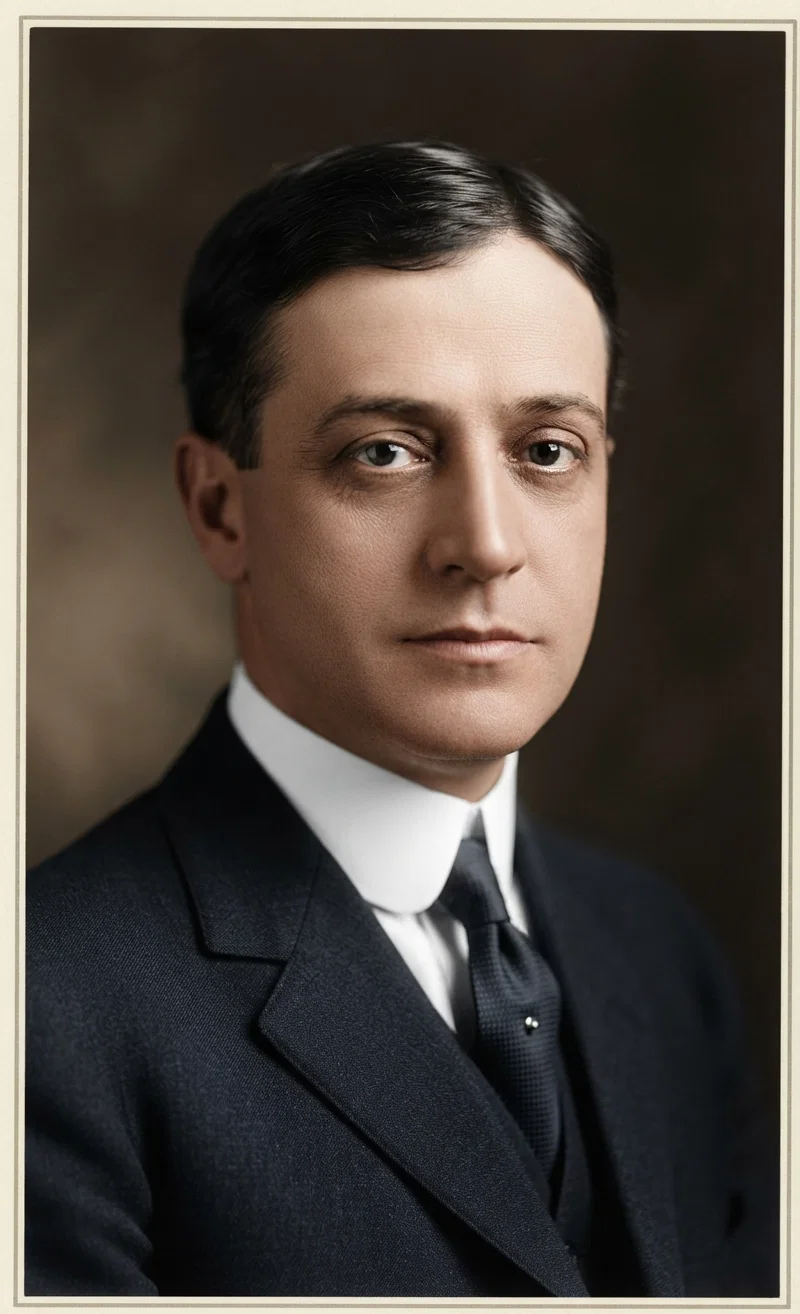
HON. NEWTON D. BAKER
Secretary of War
"This world war," as the speaker summed the matter up, "is a distinct proof that neither pacifism without might, nor might—unless dominated by right—can be effectual in securing a permanent peace."
Induce the Recognition of Justice
THE possible effect of a world league upon the Monroe Doctrine was considered by George Grafton Wilson, professor of international law at Harvard University. He admitted that the United States might have to relinquish some of its older interpretations of the doctrine in case of a dispute with European powers, but said we should have to do that anyway under the peace treaties signed during the present administration.
Ex-president Taft, who presided at the meetings, discussed certain constitutional objections which had been raised, showing that there is nothing in the program of the league that calls for any change in the constitution. Congress would still have, as it does to-day, the power to declare war. The relations with other nations into which this country would enter as a member of the league, would correspond to the relations we have already entered into by means of various treaties which have been signed.
Benjamin Ide Wheeler, in opening the discussion in the afternoon of the second day, emphasized the fact of the prevalence of force in the world as constituted at present. "To undertake," he said, "the automatic and unerring production of peace—all kinds of peace, at all times and everywhere—is an inspiration of folly."
"Our optimism," he added, "may have led us too far in tempting us to use the word 'peace.' The associations which come to us from the hopeless and light-winged use of that word in organization, movements, and orations warn us that what we perhaps meant to say was, League to Enforce the Recognition of Justice. It is a delusion and a snare to speak or think of peace as a normal status of human affairs, to which we must seek return. It is a delusion to think out our problem in that order—a delusion of the same cast as the old-time argument from 'the state of nature.' This argument from the state of nature finds no standing in anthropology, nor, for that matter, in zoölogy. Man438is by anthropology and zoology a homicidal mammal. He kills and often eats his enemy. The normal status of human affairs involves competition, contention, strife. With that he starts; from that he must seek to advance. . . . What we need to find is some form of expressible innate power in human society which will induce the recognition of justice."
Stage Tricks for Arousing Patriotism
SPEAKING for the American workingman, Samuel Gompers, president of the American Federation of Labor, said: "No class has more to lose and less to gain in war than the workers. No class renders such sacrificial service during war, and bears such staggering burdens after war, as does labor. In war, labor sees the results of years of struggle for wider justice swept away. In one mad moment, the clock of industrial progress may be turned back for a generation. War diverts the mind of peoples from the constructive work of humanizing and democratizing the relations of men. Recognizing them, workingmen the world over have avowed their allegiance to the cause of peace, and have sworn undying opposition to the forces that make for war."
He recurred sadly to the way the workingmen of all the warring countries had been brought into the struggle.
"Before the present war, the working people of the several countries now in conflict sincerely gave international pledges that they would not fight each other. I confess that I banked strongly upon these pledges; but in an hour of crisis, brought about by forces over which workingmen had little control, their pledges were shattered by the hurried ultimatum of kaiser and king, of president and czar. Secret diplomacy and arbitrary autocracy lifted the battle standards, raised the cry that the integrity of the fatherland was at stake, and placed the workingmen of all the nations in a position where adherence to their pledges and to the larger interests of humanity would have branded them as traitors. Under the urgency of the situation, with autocracy and militarism resorting to their accustomed stage tricks for arousing patriotic emotions, instinct prevailed over reason, and the laboring men of the nations rushed into the paths that had been marked out by the diplomatic and ruling classes."
Points at Issue Not Yet Determined
IN expressing general approval of the proposed league, he summed up, under five heads, what he understood to be the program of the new organization:
"1. That the nations shall band themselves together in a federation, and agree to delay, in every instance, the actual declaration of war until the dispute at issue has been thoroughly examined by an international tribunal, and the public opinion of the world given a chance to express itself.
"2. There shall be an International Court to consider questions that can be decided upon established law and evidence.
"3. That there shall be a Council of Conciliation to consider questions that are not ordinarily regarded as justiciable, such as questions of national honor.
"4. That in addition, there shall be, at stated intervals, international conferences for the progressive amendment of international law.
"5. That the nations of the league shall agree to turn their united strength — first in the form of a business and economic boycott, and finally in concerted military action if the boycott is not effective — against any one of their number that wages war without first submitting its dispute for complete examination to one of the International Tribunals created."
"The league's program," he continued, "wisely refrains from attempting to stop the present war. Hating war as I do, I am free to confess that if I could stop this war now by a turn of my hand, I would not do it. I hold that something must be determined by this war; and that something is, whether the future belongs to autocracy and militarism, or to democracy, liberty, and humanity. These are the points at issue, and they have not yet been determined."
No Man Lives to Himself
THE Hon. Newton D. Baker, secretary of war, spoke on "American Ideals and the League Program." The ideals of America, he said, were not some fixed and unchanging thing, but a growing and expanding principle. In general, America stands for "the opportunity of the man in the world as against things."
"American history, for the first century of it, was a struggle to preserve a kind of individualism which was ideal under the conditions which civilization had then assumed. But we have outlived all that. We have come to a time now when no man lives to himself, when the artisan at his bench in this country is dependent upon some producer of raw material in the antipodes. There has come a situation in the world in which, whether we want to or do not, whether it is good business or just ordinary idealism, we are obliged to take a planetary view of the human race."
Hamilton Holt, of New York, editor of the Independent, who has been prominent in advocating the league idea, gave a stirring address, in which he showed very clearly the practical working of the proposed federation of nations. He said in part:
"When our forefathers established the United States, the state of New York and the state of Virginia each had a separate navy; but by the constitution, they abolished their separate navies. They guaranteed home rule and local autonomy. But more than that, the taxes which the states paid for protection were less than they had paid to the state treasuries for state protection separately, their pro rata share by pooling forces were less, and they disarmed. Further than that, they created these machineries for doing interstate business, and with less expense.
A Proposed Internationalism
"THE same thing could be done between nations. Let them have a court to settle justiciable questions, a legislative body to make rules, and let them disarm, as our forefathers did down to the point where in Congress assembled they agreed that the forces of the Union were strong enough to preserve it from enemies from within or without. Let them reduce armaments to the point where the combined armaments are a little larger than any one nation's. . . .
"The object is, to substitute for the competitive theory the collective theory of armaments. Instead of one nation being against all, it is to be all against one; and that means a change in the whole theory. When you have all against one, the combination will be greater than the so-called English navalism or German militarism, and it will gradually go down until we get to the international police.
"It seems to be the destiny of the United States to lead. The United States itself is the greatest league of peace known to history. The demonstration of that is that all peoples can come and live under one form of government. Every president of the United States has advocated peace through justice, and none has grasped this idea more directly than the president of this League to Enforce Peace, Mr. Taft. Every president, from the first great Virginian, George Washington, to the last great Virginian, Woodrow Wilson, has upheld that idea. Another great Virginian, Thomas Jefferson, called war the greatest scourge of mankind. Is it too much to suppose, therefore, that the man who happens to be president when this war is over, can do, if he has the courage and vision and world statesmanship, something analogous to what George Washington did for our states after the Revolutionary War? Stranger things than that have happened. So let us add to the Declaration of Independence, a Declaration of Interdependence, when, as Victor Hugo prophesied, the only battlefield will be the market open to commerce, and the mind open to new ideas."
The closing of the League to Enforce Peace Convention with its memorable banquet, and its speeches by President Wilson and President Lowell of Harvard, forms the subject of the concluding article of this series, which will appear next week. EDITOR.