APPALACHIA, the mountain land of the South, is the Switzerland of America. Its people, though speaking the same language, adhering to the same government, and worshiping the same God, as the rest of America, are in the popular mind and partly in their own consciousness set off from “the nations round about.” “The mountains” and “the lowlands”—in these two phrases the mountaineer comprehends the world. And to “the lowlands” he exhibits both that dignity and that courtesy due from one whose lot is cast in the superior hemisphere.
WORSE THAN FOREIGN — OUTLANDISH
In our mountain society, if any of you should be our fortunate guests, you would find us too polite to name directly your foreign extraction; yet take you notice, that if born outside the mountain country, you would be to us in private “the furriners.” Puzzled by this seemingly cold and distant term, Kephart, author and “furriner” in the mountains, ventured to ask some of his friends, “But if people from the lowlands of our own country are foreigners, then what would you call a German or a Frenchman?” And the response came, “Oh, them’s the outlandish!”
Now I venture to assert that the mountaineer is logical in his use of these terms. For if my neighbor is outlandish to me, I also am outlandish to him; and if I were to take a vote of my readers, I believe I should find the majority with an idea of the Southern mountaineer as being, if not exactly foreign, then worse, outlandish. We are all prone to feel, with Boston, that we are the hub of the universe. And taking ourselves as the standard of comparison, we count all who differ from us, in speech, in dress, in habit, as being off-class, as being outlandish.
We ourselves may change; but as we change, our standard changes with us. And so it comes about that what was once representative of our life, grows strange and ridiculous; and they who maintain that ancient standard, become to our minds foreign, or at the best, as Dr. Frost so aptly phrases it, “our contemporary ancestors,” with the garb and the habits of a bygone age.
WERE THE PIONEERS OF CIVILIZATION
The average American citizen has a smattering of knowledge about the mountaineer—a smattering gained chiefly from newspaper accounts of feuds, and murders, and raids on “moonshine stills,” and from the works of fiction writers who love to portray the strange and the grotesque. The common idea of the Southern mountaineer is that of a tall, gaunt figure standing guard with rifle in arm, or with hand reaching for the pistol behind.
But I state it for a fact that if your errand is a peaceable and a legitimate one, there is no place in all America where you can be so safe, so free from molestation, so sure of protection and hospitality, as in our Southern mountains. Yet, especially in the back districts, it behooves you early to make your business known; for the frontier habit of watchfulness and suspicion of the unknown still has its home in the mountains.
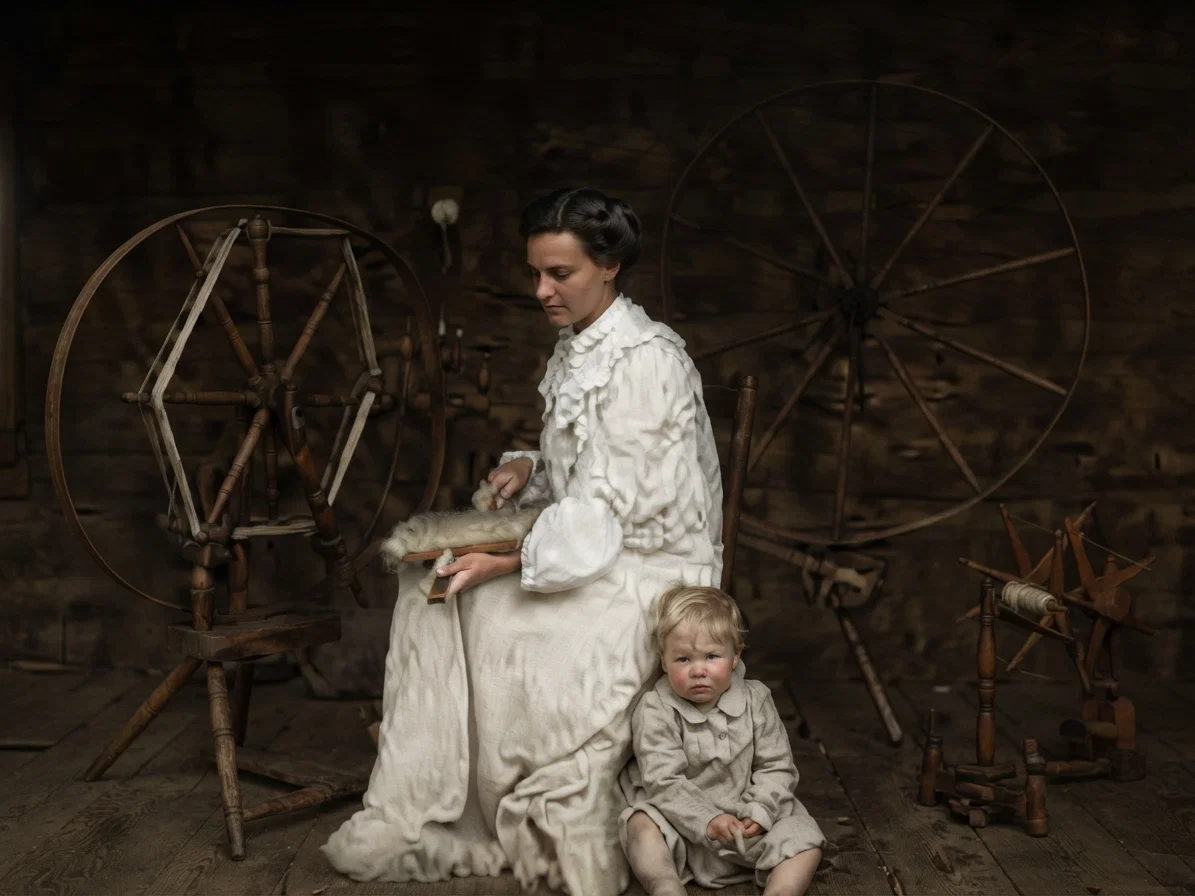
The spinning wheel has kept its place.
The people are made up chiefly from two stocks: one, the great, solid, middle English class; the other, the daring, liberty-loving Scotch-Irish. They have the old-time English virtue of making large families; they are nation builders; and they have borne no mean part in the history of the nation, particularly in its early history.
They went in the van of America’s great westward drive. They were the pioneers of civilization. They conquered the wilderness, they swept the land from savage life into a place of homes, and they fought the earliest battles of the republic. Gilmore has called them “the rearguard of the Revolution”; for they defended the frontier against the Indian foe whom the English stirred up; and when the South lay almost wholly at the feet of the British, they answered the challenge of Ferguson, and sweeping back over their mountains, struck the critical blow of the Revolution at King’s Mountain. There the tide of British success was turned back, and the way paved for the successes of Greene and for Washington’s final coup at Yorktown.
That people who struck their hard and stinging blows at King’s Mountain, and later at New Orleans under “Old Hickory,” and who still later thrust the long arm of their free mountain land deep into the vitals of the slave-holding power, and helped with their three hundred thousand volunteers to win that great struggle for freedom, giving at the same time to the nation, as the flower of their manhood, the greatest figure of the nineteenth century, Abraham Lincoln—that people remain to-day the same self-reliant, dauntless, independent, hardy race that first peopled the wilderness.
RUGGED TRAITS OF CHARACTER
Their character is deeply influenced by their surroundings. From the banks of the Potomac in the North to the brows of Kennesaw and Lookout in the South, stretches the long mountain domain, six hundred miles in length, and averaging two hundred in breadth. It is a land of beauty and grandeur, of rugged mountains and deep gorges, of far views and wonderful contrasts in valley and hill, in field and forest, in blue skies and clear waters of stream and fountain and lake, of fertile valleys, and thin, rocky soils of the uplands. And the people who live therein are a people of rugged traits, whether for good or for ill, with the souls of mystics, and the direct, resistless action of their own mountain torrents.
A majority of the mountaineers make a profession of religion at some time in their lives, under the soul-stirring influence of the protracted meeting, conducted by their self-supporting preachers. These self-sacrificing, earnest men, often uneducated and almost illiterate, yet fervent and sometimes deeply spiritual, for the most part support themselves upon their little farms, receiving nothing more for their services than the small voluntary contributions of their people in the collections taken up on preaching days. One day at Locust Grove, I remember, the collection was seven cents—seven cents for a week’s salary! And yet that might be more cash than many a member of the flock received that week. Preacher and people alike, they were dependent for a living upon the hominy and the hog meat they themselves produced.
AFTER THE STRAY SHEEP
The overwhelming proportion of the people are of either the Baptist or the Methodist persuasion, the church membership in the mountains being forty-eight per cent of the former and thirty-one per cent of the latter. Some Disciples there are—about five per cent; and latterly an increasing number of Presbyterians, who nevertheless so far can count themselves only six per cent. Roman Catholics are unknown, except in a few of the cities; and the Episcopalians, who are doing a noble work of evangelism and education in some parts of the mountain country, are yet so few as to give point to this tale, told me with the gusto of a great laugh, by a mountaineer in whose home I stayed one night up on the French Broad:
A clergyman in clerical garb, he said, was seeking far back in the mountains for any possible stray members of his flock. Coming one day to a cabin where dwelt an old woman, he addressed her, “Mother, do you know if there are any Episcopalians hereabout?”
She puffed meditatively for a few moments on her pipe, pondering the strange name, and then, “Hain’t never heerd tell of none,” she said; “but I tell ye: My old man’s hung up yander the skins of all the varmints he’s ever kilt. Ye might go thar an’ look.”
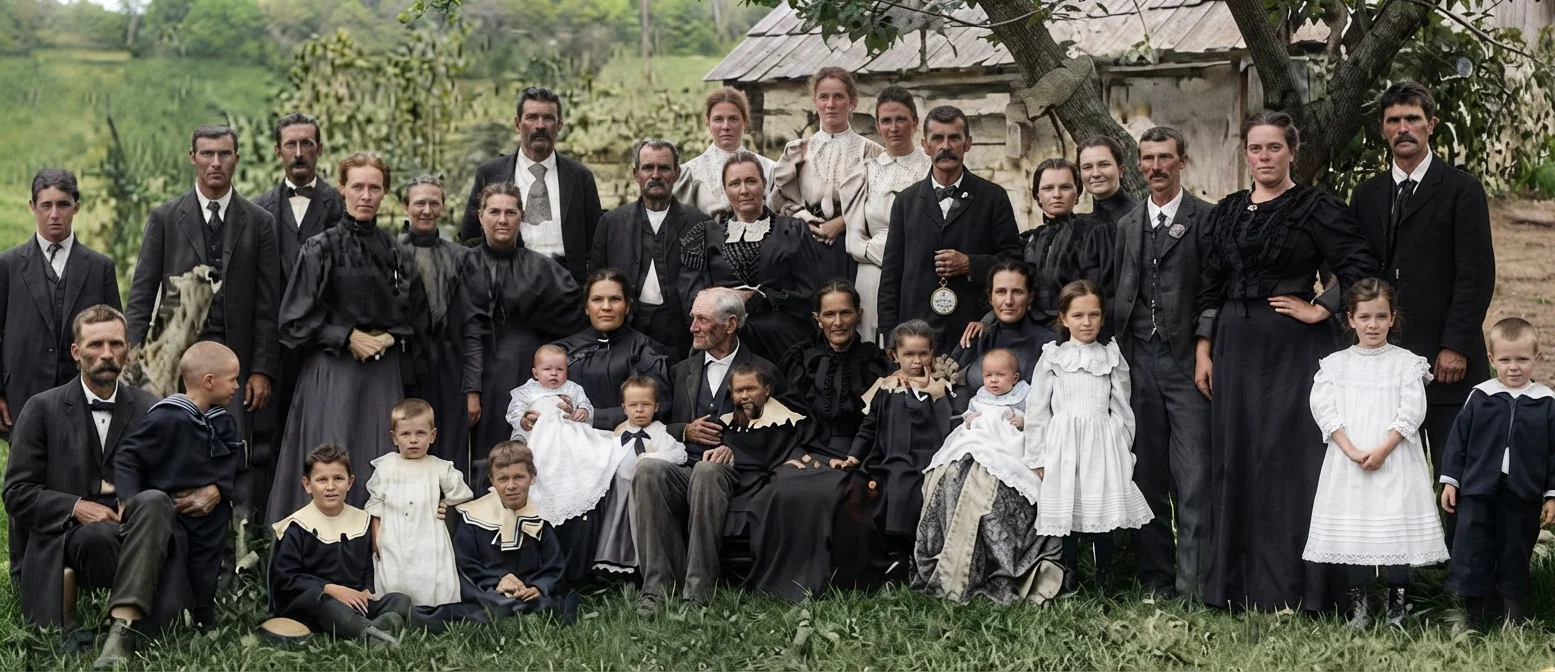
But I should be at fault if I left you with the impression that there is only poverty and302ignorance in our glorious Southern mountains. The fact is that our four million mountaineers are of several classes. For convenience, I may divide them into three groups, though a hundred could as easily be made, so graduated are the differences between them. In the first class I will place the progressive and prosperous people of the valleys, the better of the table-lands, and the cities,—men who are in no way behind the most advanced of America's citizens in wealth, in enterprise, and in culture. In the great valleys and the plateaus lie such cities as Staunton, Roanoke, Bristol, Knoxville, Asheville, and Chattanooga, where the pulse-throb of the world is felt in its fullness.
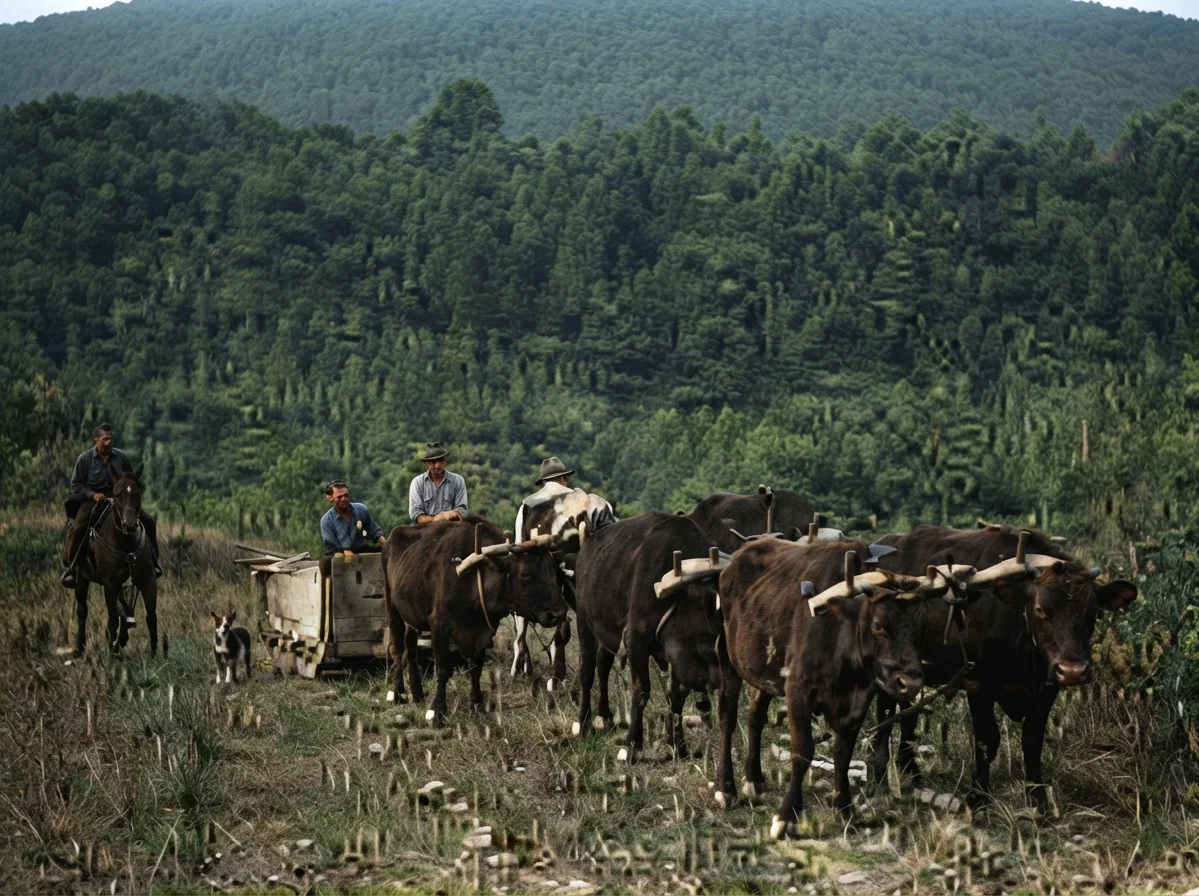
Ox teams and home-made sled
In the country, we see evidences of prosperity and progress in well kept farms, with comfortable houses and good barns and new silos. Fruit raising is a considerable industry in some parts, and dairying is increasing. This first class of mountaineers are, for the most part, keenly interested in the progress of their less fortunate fellows, and not only second the efforts of would-be helpers, but unostentatiously give a great deal of private effort to the same cause.
The second or middle class of the mountaineers are to be found chiefly up in the little valleys and coves and on the plateaus — a people who, if they had access to good markets and to the advantages of a broader life, would be not at all behind the rest of the world; but who, because they have not such access, live to a great extent in their own world, comfortable, easy, though usually hard-working, shut in to a live but rather narrow world, that has little knowledge of things outside, and not much concern for them.
Many of these are fairly well-to-do, not perhaps according to the standards of our modern extravagant world, but after the mode of life our fathers lived. They may own "a beast," which means a horse or a mule; but more likely their dependence for plowing and hauling is a jinny or an ox. Some may own a number of "cattle," as they speak of their oxen; or for community work they may join their neighbors in logging operations that require several yoke.
The one-horse wagon is coming to be very common everywhere; and the two-horse wagon, on the rough, muddy, and gullied roads, sometimes requires four mules to pull it and its load of apples or cabbages or potatoes to the markets in the lowlands. Yet beyond the land of roads, the home-made sled, with runners hewed from the tough sourwood, is the burden of team or ox, or even sometimes of man power.
THE PLACE OF HOMESPUN
The ancient arts of the home still live in the mountains, among this class; for though "store clothes" have almost wholly taken the place of homespun, there is yet need of yarn for stockings and mittens. The spinning wheel has kept its place far more widely than the loom, yet in many a mountain home the autumn days still see the beginning of a web of linsey-woolsey or jeans for skirts and trousers — a fabric, by the way, that usually has ten times the wear of factory goods.
This second class make up the bulk of the mountaineers outside the cities and the great valleys. And it is this class who at once appeal to us by their needs and by their promise of development. Brave, hardy, daring, hospitable to the farthest limit, with a natural reverence that in the godless can be hardened into brazen defiance, they are a race of whom heroes have been made and are being made to-day. Their educational and religious advantages are not overgreat.
In most communities, the minister may come once a month to preach in the little frame or log church, and with others of his brethren, to hold protracted meeting once or twice a year. Yet there are isolated places in the mountains where the full story of Jesus is actually unknown.
'ONLY JEST LOVED 'EM'
John Fox tells the story of a minister visiting for the first time one of these homes far back in the mountains, and there to a little family telling the story of the cross. They followed him with rapt faces; and when he had concluded, the mother, leaning toward him, whispered hoarsely:
By courtesy of Berea College
"Stranger, you say all this happened a long time ago?"
"Yes," he said, "almost two thousand years ago."
"And they nailed Him to that thar tree when He hadn't done nothing to hurt 'em, only jest loved 'em?"
"Yes."
She leaned farther, and placed her hand impressively upon his knee. "Wal, stranger," she said, the tears standing in her eyes, "let's hope hit ain't so."
As for the public school, it may run for three or four months of the year, beginning after the corn is "laid by," taking vacation during fodder-pulling time, and closing about Christmas time, when both bad weather and diminishing county funds demand. It is often only a log schoolhouse, but the log schoolhouse is not so bad if you haven't a log teacher. Seven presidents of these United States came out of the log schoolhouse, and four of them were mountaineers.
THE LOWER GRADE OF HUMANITY
Of the third class, I will say no more than that it may be understood as composed of that lower grade of humanity, not by any means confined to the mountains, who are the hangers-on and the wards of society. We find them everywhere, their circumstances varying only as the general tone and condition of their communities raise or lower them. In the mountains, they live generally in a ragged relative of the log house, with its mud-and-stick chimney, though sometimes housed more forlornly in a plank cabin. A patch of corn and beans, a hog or two, make most of their worldly wealth. Down in the "settlemints" the men will work, perhaps, at odd jobs of crop-tending or wood-chopping or road-mending, which will yield them seventy-five cents or a dollar.
Among them there are, indeed, not only the shiftless and degenerate, but the merely unfortunate, who may, by personal encouragement and the giving of opportunity, be graduated into the upper and more stable classes.