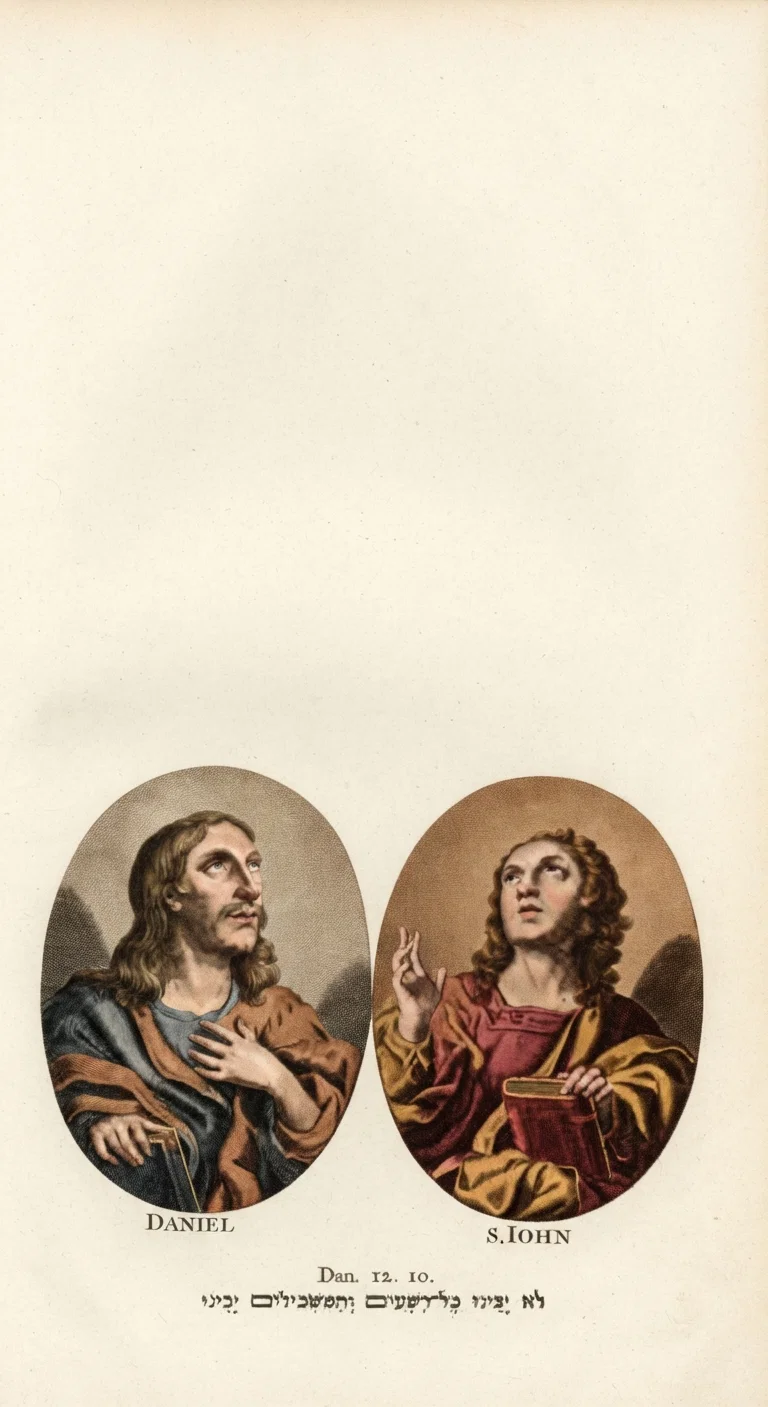
Title page of Joseph Mede's "Works" on the prophecies, published in 1677.
In these days of prophetic enlightenment, but few pause to consider the prodigious labors of the early expositors of prophecy. In the words of Scripture, "Other men labored, and ye are entered into their labors." Sketches from the life stories of six of the forerunners of prophetic interpretation will be presented in as many articles by Clarence C. Crisler, beginning with this issue.
AMONG the marked providences preparing the way for the great advent movement was a revival of interest in the study and exposition of prophetic portions of Holy Writ. While the desire to understand prophecy seemed strongest during the first few decades of the nineteenth century, yet the search after the hidden things of God's word was prosecuted with vigor for a century or more before the long-locked treasures of truth in the book of Daniel were opened to the understanding of all who sought for a knowledge of the times and the seasons in which they were living.
AGE-OLD PERVERSIONS OF TRUTH
The earlier fathers of the Christian church had a correct understanding of the general features of the prophecies of Holy Scriptures concerning the second advent, the resurrection of the righteous, the millennium, and the final destruction of Satan and his host. But these truths were spiritualized by Origen, Augustine, Jerome, and other expositors of Scripture during the fourth and fifth centuries.
"The doctrine of Christ's reign on earth," says Gibbon, "was first treated as a profound allegory, was considered by degrees as a doubtful and useless opinion, and was at length rejected as the absurd invention of heresy and fanaticism. A mysterious prophecy (the Apocalypse), which still forms a part of the sacred canon, but which was thought to favor the exploded sentiment, has very narrowly escaped the proscription of the church." ("Decline and Fall," chapter 15, paragraph 21.)
"It was not till the church had learned to Platonize," says Dr. Horatius Bonar, in his comments on the twentieth of Revelation, "or had taken lessons in the school of Origen," that they could condemn the doctrine of the coming and kingdom of the Redeemer as revealed in the Apocalypse, "without disputing the inspiration of the Revelation."
During the centuries that followed, to the time of the Reformation, there were but few who held to the Scriptural doctrine of the second advent. In the time of the crusades, one of the most learned of the expositors of those days, Joachim, a Calabrian abbot, lifted his voice in protest against the prevailing tendency to spiritualize away the meaning of revealed truth. He had the privilege of lecturing on the Apocalypse before Richard Cœur de Lion while that valiant knight was passing through Messina on a crusade to the Holy Land.
Two centuries later, there occurred in all portions of the then known world a series of "calamities, more tremendous than any which had lighted on the earth since the great plague which made the reign of Justinian so disastrously memorable." (Le Bas, "Life of Wycliffe," pages 105, 106 — Harper's edition, 1832.) Wycliffe, who later became "the morning star of the Reformation," was then a young man of about twenty-five. All around him were many whose hearts were failing them for fear, and who were inquiring concerning the meaning of these things.
Wycliffe's thoughts turned toward the writings of the learned abbot, Joachim, to whom had been given the spirit of wisdom, of discernment, and of a sound mind in the study of prophecy; and Wycliffe became convinced that in pestilence and earthquake and flood, as well as in conditions prevailing in the social world, he could discern the signs of the times; so he was impelled to write his first tract, entitled "The Last Age." In this, he attempted to interpret the meaning of the signs of his times, and to urge the importance of preparation for the day of Judgment to come.
In the teachings of the Waldenses, also, may be traced a knowledge of God's purpose as revealed in prophecy. Thus the way was preparing for the larger work of the Reformers of the fifteenth and sixteenth centuries. But not until the seventeenth century, when the beginning of "the time of the end" foretold by Daniel the prophet was drawing on apace, did learned men of God's appointment give special attention to the exposition of prophetic Scripture in the light of history, as a means of determining approximately the time of the second advent.
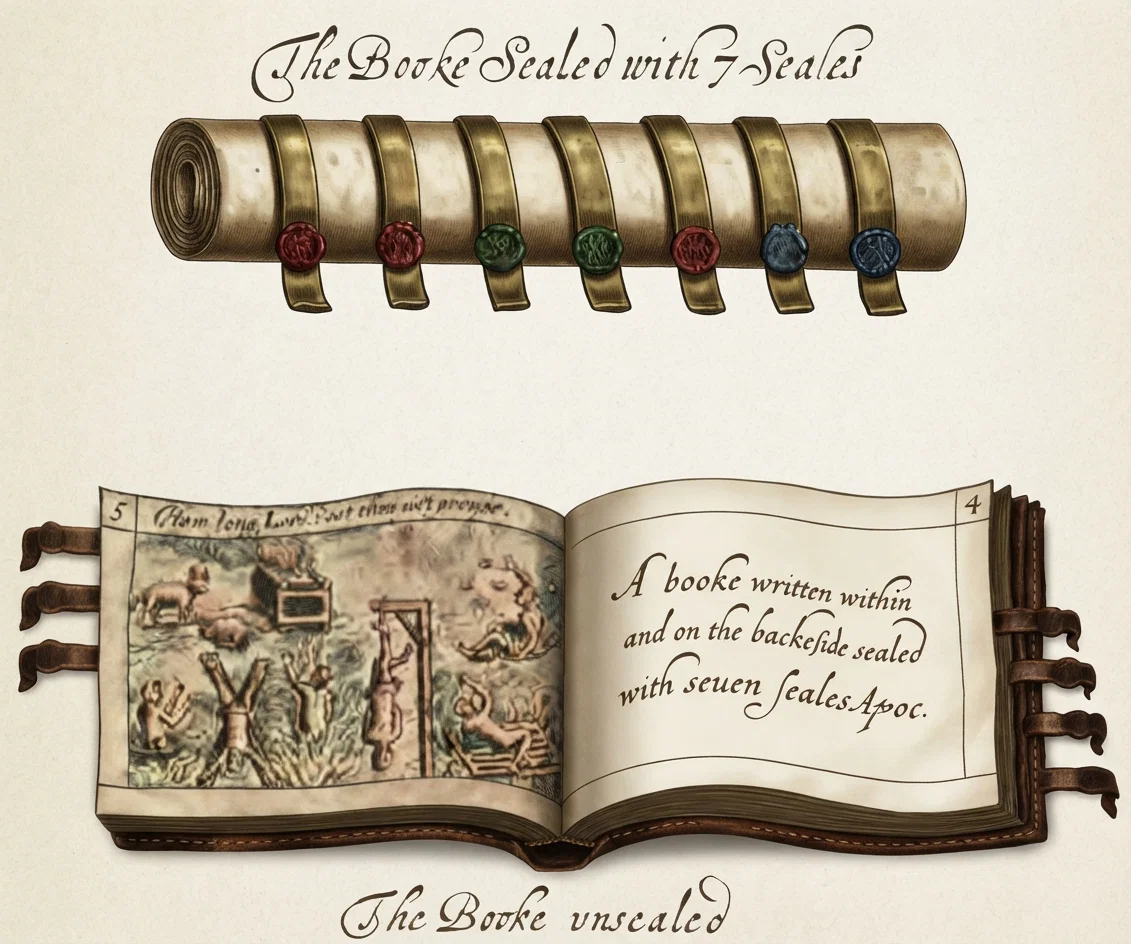
Mede's conception of the appearance of the book sealed with seven seals.
THE FATHER OF MODERN PROPHETIC INTERPRETATION
Among the more prominent of these seventeenth century expositors is Joseph Mede, B. D., of Christ's College, Cambridge University. It was Mede who made the discovery that several of the prophecies in the book of Revelation are synchronous. For this reason, declares Dr. Worthington, the editor of his published works, "shall the present and succeeding ages owe a great respect and veneration to his memory."
And truly the hand of God is revealed in the conscientious and painstaking labors of this "pious and profoundly learned man," as he is quaintly characterized by Dr. Worthington on the title page of his collected "Works." During his study of the Apocalypse, Mr. Mede wrote to a friend "that it was his daily desire and prayer to God that he might not be led away with delusions"; and he earnestly requested his friend to pray for him. As he advanced in the preparation of his exposition of the book of Revelation for publication, he wrote again to this same friend of his: "I am conscious of my weakness and unworthiness. . . . But if it be found the least means of farther light, to the Father of lights be the glory." (See the general preface to his "Works," folio edition, London, 1677.)
Of his published works, Mr. Mede's "Clavis Apocalypticae" ("Key to the Apocalypse") is generally conceded to be his masterpiece. His "Commentary on the Apocalypse," which appeared in 1632, together with the "Key," earned for him the title "The father of modern prophetic interpretation."
"COMPARING SCRIPTURE WITH SCRIPTURE"
In large measure, Mr. Mede's success as an interpreter of the apocalyptic visions is due to his "accurate and judicious comparing of scripture with scripture, and observing the proper and genuine use of the like words and phrases in several passages of Scripture." (Idem.) He found, says the editor of his "Works," that "the word of God is a lamp unto our feet and a light unto our pathway, not only as to the guiding of our life and practice, but also as to the directing our spirit in the safest and clearest method of interpreting itself; and that such comparing of places is as needful for our conduct in the more solitary and dark passages of Scripture, as that burning pillar of fire was to the Israelites in their journeyings through a waste and desolate wilderness, which God gave them to be both a guide of the unknown journey, and an harmless sun by night." (Idem.)
Mr. John Tudor, the editor of the Morning Watch, a quarterly journal on prophecy published in London from 1829 to 1833, wrote thus of Mr. Mede's labors:
"He entered upon the study of prophecy with the deliberation and calmness of one whose aim is not distinction, but to know the will of God; and seeking this first, all other things were added unto him. He soon perceived that the Apocalypse is the key to all the other prophecies, and that it is also the scale by which they are to be adjusted: then, reasoning by analogy, and concluding that the scale must be well understood before it could be applied with advantage to any other thing, he endeavored to adjust the structure of the Apocalypse from the book alone, and independently of any interpretation. A very important principle this, which serves as a good test of modern commentators, who, we believe, have never succeeded in their interpretations except in proportion as they have adhered to this principle."8—Editorial on "The Gradual Unfolding of Prophecy," Morning Watch, December, 1829.
Mr. Mede brought to his study of prophecy a mind enriched with a vast store of learning. During his long residence at Cambridge as a teacher in the university, he spent much time in the study of history, Jewish antiquities, and sacred chronology. "When foreigners traveling into England came to visit the University of Cambridge," declares his biographer, "they would carefully seek him out, and endeavored to gain his acquaintance, as much as many others then more eminent in place." (See "The Author's Life," in "Works," page 7.)
Among his learned contemporaries with whom he corresponded more or less regularly, was Archbishop Usher, the author of the "Annals of the Old and the New Testament," embodying the system of chronology adopted by the publishers of the Oxford editions of the King James Version of the Holy Scriptures.
"HIS WORKS DO FOLLOW HIM"
The untiring labors of this illustrious Church of England divine did much to prepare the way for the advent movement, to which so many honest-hearted men of every creed have given their noblest efforts. The spirit of his labors is beautifully set forth in a prayer left on record by Dr. Worthington at the close of the general preface to his "Works":
"He who is the Father of mercies and the God of all grace, that giveth power to the faint, and reneweth their strength who wait upon Him, who worketh both to will and to do, and to continue patiently in so doing unto the end; to His name alone (not unto me, not unto me) be the glory and praise for His mercy and for His power's sake. The same Father of lights, who commanded the light to shine out of darkness, shine into our hearts, unveil our eyes, that we may behold wondrous things out of His law; purify our souls from prejudice and passion, from every false principle and corrupt affection, that we may receive the love of the truth, and know the mysteries of the kingdom of God; that being filled with all wisdom and spiritual understanding, we may walk worthy of the Lord unto all pleasing: to whom be blessing, and glory, and wisdom, and thanksgiving, and honor, and power, forever and ever, Amen."