The Hottentots as Masters and Warriors — The Bushmen as Sculptors and Painters Aptitude in Learning — Hottentot Hearts Touched by the Gospel
By WILLIAM A. SPICER
This is the third of the dozen articles furnished by W. A. Spicer on the interesting peoples and work in South Africa. Elder Spicer recently spent some time in Africa; and what he writes, is from the standpoint of personal experience and observation, as well as reading and study. His next article will tell what he saw and heard in Kafir-land.
WHEN Europeans discovered South Africa, they found the Hottentots in possession of the coast line, with a fringe of Bushmen disputing their lordship. But back in the interior, along the river valleys, the Bushmen hunters still lived their wild life.
The Bushmen were the early dwellers in the whole southern country, evidently, though none of these tribes appear to have been very numerous. Then the Hottentots came down from the north, pushed out of the lake country of east central Africa by the southward pressure of the more powerful Bantu races from the Nile valley.
The Hottentots were better armed, and a larger, stronger people than the Bushmen. They took the coast line, and tried to reduce the Bushmen to slavery. But these men of the wilds were not of the kind to yield their freedom of life.
"They never thought of submitting and becoming the slaves of the invaders," says Theall; "but like the lions and leopards whose habits they knew so well, when brought to bay, they did all the harm they could to their opponents, and died breathing defiance."
THE BUSHMEN HAVE VANISHED
When Europeans came and instituted slavery, the Hottentots were brought under subjection; and though not very numerous, they continue to this day. But the Bushmen resisted, and have all but disappeared. Of the Bushman type, Theall says:
"They were pigmies in size, yellowish brown in color, hollow-backed, and with skins so loose that in times of famine their bodies were covered with wrinkles and flaps.
On their heads were rows of little tufts of wiry hair hardly larger than peppercorns, and leaving the greater portion of the surface bald. Their faces were broad in a line with the eyes, their cheeks were hollow, and they had flat noses, thick lips, and receding chins. They anointed their bodies with grease when any was obtainable, and then painted themselves with soot or colored clay. The clothing of the males was the skin of an animal hung loosely over the shoulders, and often cast aside; that of the females was little more than a small leathern apron. To the eye of a European, no people in any part of the world were more unattractive."
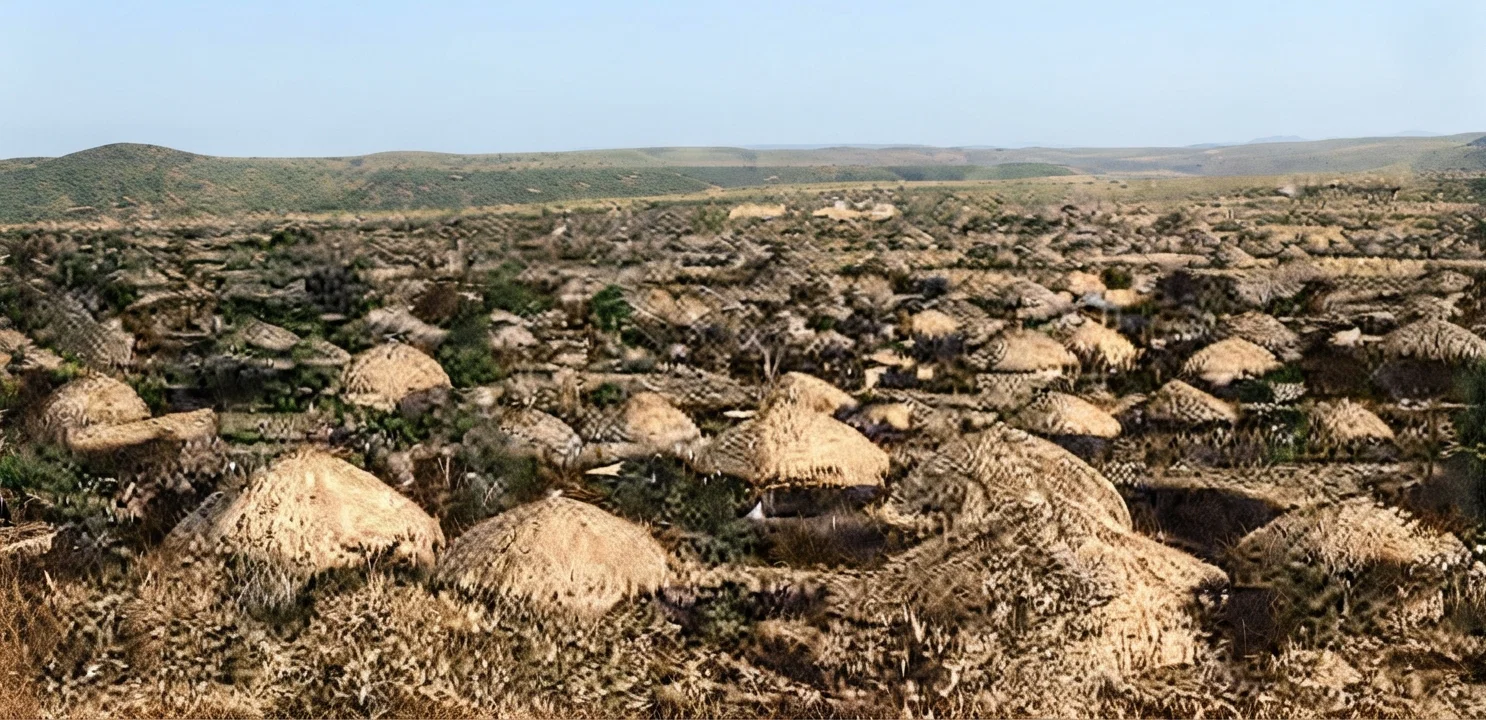
The Hottentots built pole huts, plastered with mud, and covered with rush mats. They tilled a bit of land, kept cattle, and called themselves khoikhoi (men of men), as distinguished from the inferior hunter Bushmen, whose homes were scooped out of the sand alongside overhanging rocks or bushes, or more permanently fixed in caves from which they had perhaps driven wild beasts.
THE INTELLIGENCE OF THE BUSHMEN
Yet the Bushmen was not without intellect. He has so often been represented as such, that it is worth while to say more of him. Driven into the deserts and the wilds with the beasts as he was, and with the lowest mental capacity, we are told, yet in many ways he showed keen intelligence. Bleek, the author of "Bushman Folklore," says, "The rapidity with which a Bushman learned to speak Dutch or English . . . was regarded as almost marvelous in the early days of the Cape Colony."
Of another side of Bushman culture, arguing as high an origin as any tribe, Stow, in his "Native Races," says, "The Bushmen in their undisturbed state might have been34
Aboriginal Tribes of South Africa
(Continued from page 1)
termed the most musical people in South Africa, as in both the number of their tunes for dances, and the variety of their musical instruments, they were unsurpassed by any other native races."
HOSPITALITY OF THE BUSHMEN
Let this suffice; though really Ellenberger's word should be added in tribute to a vanished race. After speaking of their cunning and vindictiveness, he says:
"On the other hand, they were hospitable and generous. They had an idea of justice and benevolence and devotion, as well as a passionate love of liberty. They were also very loyal to their chiefs. They showed the greatest devotion and bravery in their attempts to rescue their fellows from slavery—a state which they held in greater horror than death itself. . . . They would always share their food with others, even when it was scarce."—"History of the Basutos," page 7.
A HOTTENTOT KRAAL OR VILLAGE
All this in behalf of the lowest of the South African tribes. The origin of the Bushmen is one of the mysteries of tribal history. There were two distinct branches, the sculptor tribes and the painter tribes. The former came from the eastern Sudan region, plainly enough, for they left their mark in the rock carvings all the way down.
THE BUSHMEN PAINTERS
But the painters, whose works of art adorn the rocks, in colors that are everlasting apparently, had a tradition that their ancestors came over the water in big baskets—boats; and while their paintings are all over eastern South Africa south of the Zambezi, there are none north of that stream.
Some believe they were brought down as slaves, in the ancient days, Canaanites or Sudanese, to work the mines of Mashonaland, which may have been one source of the gold that flowed into the treasuries of Hiram of Tyre, and of Solomon, whose ships sailed down from the Red Sea into the Indian Ocean, in search for gold. Here in Africa is gold, and the remains of prehistoric mines show that some foreign people ages ago worked the rock veins for the precious metal.
One old Bantu name for these painter Bushmen meant the abandoned, the cast-aways. So it is surmised that the tradition of their forefathers' coming by boats is true, and that they were brought as workmen in the mines, thousands doubtless having been employed. Then when connections were broken, and the mines were no longer worked by the far-away operators, these people were left—abandoned, cast away—to be pushed ever southward as the succeeding waves of tribal migration came down from central Africa.
THEIR INDELIBLE PAINTINGS STILL ON THE ROCKS
However that may be, they have left their paintings on the rocks and lining the caves from Southern Rhodesia to the cape. The strangely formed boulder heaps of Mashonaland are often decorated with them. While at our Solusi Mission, in Matabeleland, I found Bushmen paintings, well preserved, on the rocks of a kopie near the mission house. "We used to think God made them," said one of our now Christian teachers. "We stood in awe of them, and felt they ought to be worshiped."
Is it because I have only just been over these old Bushmen trails that I am interested in this aboriginal tribe? And am I taking too much for granted in thinking that readers far away will follow their story with interest? I believe not; for their story is somewhat parallel to that of our own nearly vanished Indian race. One really seems to get a glimpse of the Africa that once was, in looking at these caverns or shelters of overhanging rock, with their curious and often skillful tracings of animals and men. A South African poet, W. C. Scully, in "The Bushman's Cave," gives a graphic picture of the aboriginal home in the rocks:
" 'Tis here the vanished Bushman dwelt —
He with his brood, long years ago —
Beneath this ledge, and deftly spelt,
In pictures that still freshly glow;
The wildwood creatures not more wild
Than he, who, hiding thus apart,
His idle days and hours beguiled
At his strange, harmless, limning art.
"There in yon cleft is still the mark
Of bygone fires, whose flames are dead
As those who lit them — life's strange spark
And glowing ember both have sped.
Through fancy's glass, I see around
The shades of long dead forms arisen.
"There lies an antelope, fresh killed,
By hungry stomachs close surrounded;
And there's a wicker basket, filled
With luscious locusts, freshly pounded;
And look! The glowing coals upon,
A scaly snake is quickly toasting,
Whilst on that ledge, there in the sun,
The hunters of their deeds are boasting.
" 'Tis gone; 'twas but a glimpse, a flash,
That for an instant lit the past;
I see now but the water dash
In quivering spray sheets downward cast,
And on the rocks, in deathless hue,
The records of a perished race
That from this land of ours withdrew
In silence, leaving scarce a trace."
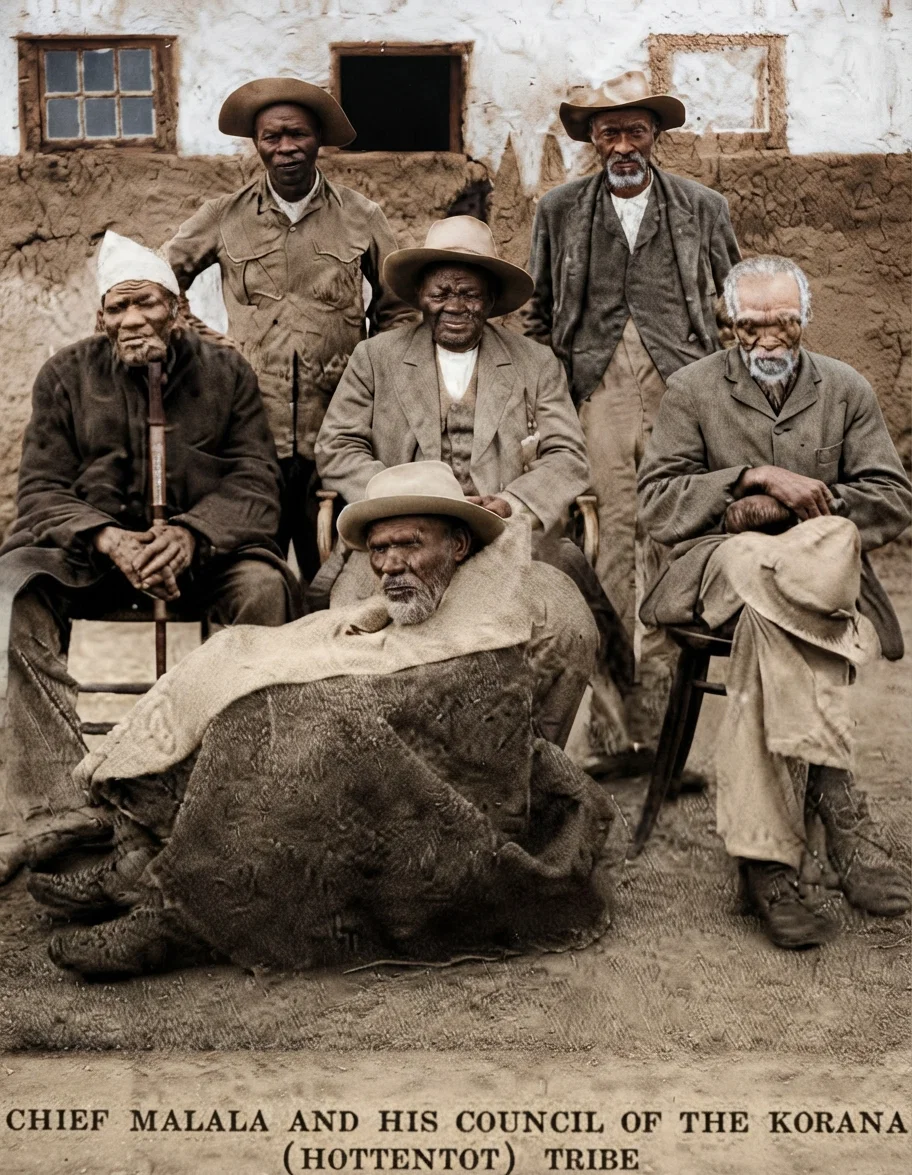
CHIEF MALALA AND HIS COUNCIL OF THE KORANA (HOTTENTOT) TRIBE
I was not able to learn that our work has touched any heart among the few Bushmen still surviving. In fact, I could learn of no converts from among this people in any missions, though surely some must have heard and heeded the gospel call. Yet there are8
few missions operating in the interior desert regions of the southwest, where the scattered remnants of the Bushman race are found.
REACHING HOTTENTOT HEARTS
But among the Hottentots, this message has found its way. The Koranas, of whom there are about one hundred thousand in the southwestern part of the Cape Province, are a Hottentot tribe. Our first fruits among the Hottentots was a Korana, recently baptized by Pastor H. J. Edmed, president of the Cape Conference. He told me the story as follows:
"One of our members, Brother van der Westhuizen, saw in our papers the call for every member to seek to win one soul to Christ during the year. He had a servant, a heathen Korana, and somehow it came to him that here was a soul to win to Christ.
"The Korana was a wicked sinner, using profane language, and sometimes getting drunk. He could not read. But our brother began to pray and work for his conversion.
" 'Every day,' Brother van der Westhuizen told me, 'I sat down with that boy to read the Bible; and, strange to say, in a few weeks, he got so he could read the Bible himself. In a few weeks more, he stopped drinking. Later he threw his tobacco away. Then one day, to my surprise, he came into our meeting and prayed; and breaking down, he wept, and said he wanted to be a Christian.'
"So the good work of Brother van der Westhuizen went on until a time when a day of fasting and prayer in the churches had been appointed, to seek God together for the blessing of greater earnestness and power in the work of saving souls, in view of the solemn times. The war had broken out, and special issues of our paper were being brought out for wide circulation. On this day of fasting and prayer, Peter, the Korana, stood up in the meeting, and said, 'I want to belong to the remnant church, that keeps the commandments of God, and the faith of Jesus.' Brother van der Westhuizen came to me, when I visited that region, telling me the story, and adding, 'Now, pastor, will you baptize my Korana boy?'"
This brother had won a Hottentot to Christ; and Peter, redeemed from vices and from the heathen worship of the moon and the snake, is praying that many more of his people may be reached by the closing gospel message.
At that same meeting, a father and a mother came to Pastor Edmed, saying: "When we saw the call to win one soul this year to Christ, the first thing we tried to do was to bring our own children into the kingdom. God has blessed us, and here they are. Will you baptize them?"
Thus everywhere, and among all people, the gracious work of God is being wrought.