New Departures in the Catholic Policy for the Restoration of the Temporal Power
By C. E. Milton
THE PAPACY AGAIN IN OPEN POLITICS.
THE world in general seems quite well persuaded that the Papacy has ceased its struggling and resigned itself to its present condition, and therefore does not any longer hope for a return of the temporal power. But those who have come to the conclusion that the Papacy has descended from the mountain of its ambition, and does not any longer turn its eyes toward the promised land of the temporal dominion, are not acquainted with the inner workings of the Vatican. For while the church is not agitating the question very much internationally, still she is working with a febrile activity within the confines of Italy itself.
In order to understand something of these efforts that are being put forth in the direction of reacquiring the lost prestige of the pontiff, I shall endeavor to give something of their modus operandi. As we are all aware, the Catholic Church in general has an organization probably unequalled by any other institution in the world. Here in Italy, for practical working purposes, the activity of the church is divided into groups. These groups are numbered as first, second, third, etc., and each one has a certain work apportioned to it. The first group deals directly with the spiritual interests of the church, while the second group interests itself in the political policy of the Papacy.
As we are here considering the Papacy in its relationship to the temporal power, I shall confine myself to the work of the second group, and endeavor to give some idea as to what is being accomplished by it.
In the first place, I might speak of the organization of the second group, that we may better comprehend the scope of its influence. The leading men of each parish are selected by the parish priest, and they constitute the active committee of the second group for their district. This committee is composed of about twelve to fifteen persons, and they represent each district of the parish. These men meet two or three times a month at the parish home, to compare notes and discuss plans of operation. However, in the plans formulated the priest has a deciding voice.
This committee, by means of public and private agitation, the organizing of young people’s societies and social benefits, tries to arouse every one in its community to take an active interest in the restoration of the lost prestige of the church. They found rural banks with a small capital, and by taking deposits and making loans endeavor to tie the people to the church. A person of the community that has need of some money can get it at these banks without so much security as is required at an ordinary bank; but as the priest is practically the head of the institution, he makes one of the conditions of the loan a faithful attendance on church duties. By this and many other social schemes the committee works to put the people under obligations to the church and the priest.
Then there is a committee for the diocese, which is appointed by the bishop and composed mostly of priests. This committee follows largely the same program for the diocese that the local committee does for the parish. The bishop has the power to annul any plan made by this committee, or to dissolve the committee itself, when to his mind it does not seem to accord with the best interests of the church.
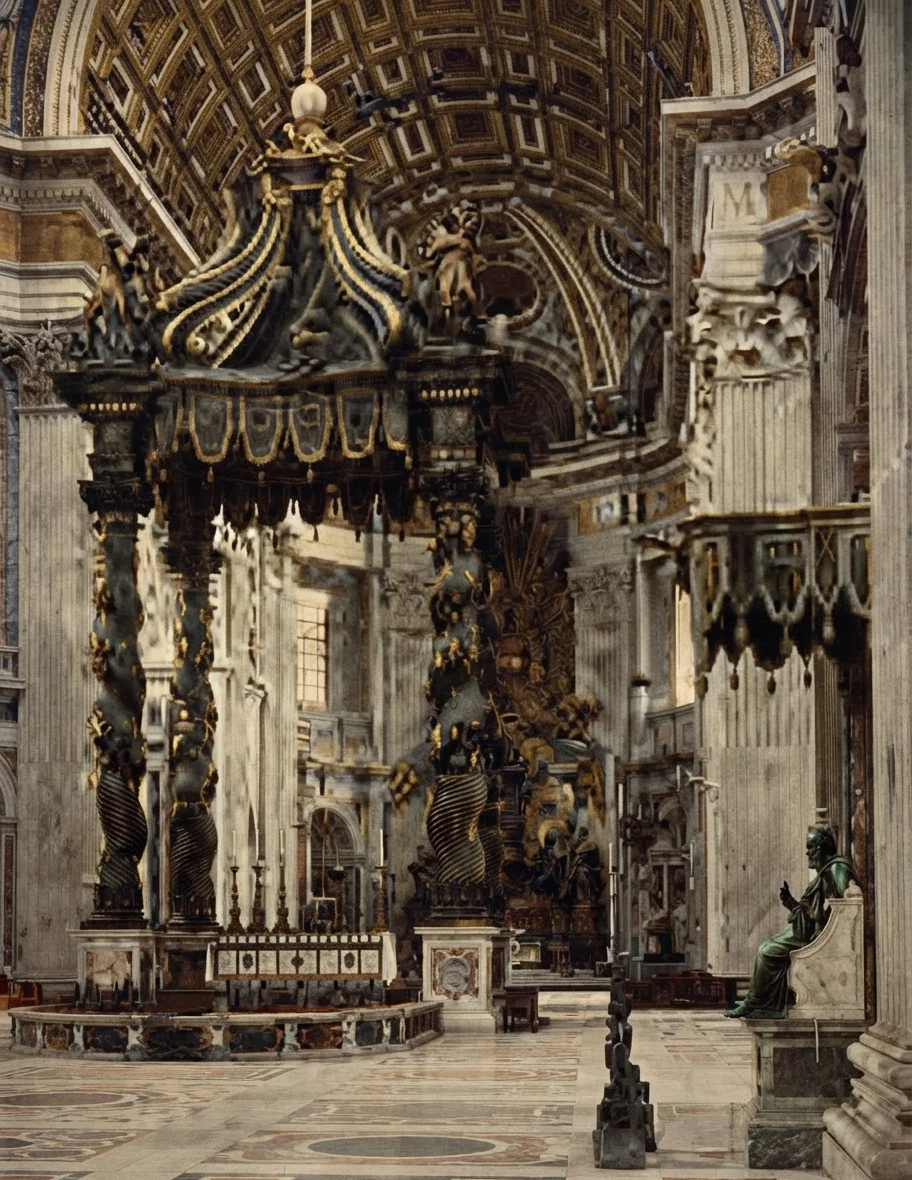
THE FAMOUS BRONZE STATUE OF ST. PETER ON THE RIGHT, AND THE GREAT ALTAR, ST. PETER'S, ROME.
Practical Abolition of the 'Non-Expedit.'9Then there is a general over all who resides at Rome or may hold his residence in any large center.
At the present time the general is a layman. He visits the different dioceses, and helps to consolidate the movement and guide in forming plans for the better accomplishment of the general results aimed at by the second group.
Every two or three years is held a congress of the Catholic forces, to which delegates are sent representing the various groups of the church. In these congresses the past progress is reviewed and new plans are formulated for future activity. These programs of plans are first submitted to the bishops, and finally to the pope, who, if he find difficulty in accepting them, may annul them. After these programs have passed through this careful inspection, they are printed and sent out to the members of the respective groups, and they form the basis of operation.
The second group, in its present form and policy, has existed only about ten years, and has for its declared aim the restoration of the lost power and prestige of the Papacy. It proceeds along social and political lines in its endeavor to obtain the object at which it aims. Therefore one of its aims is and has been to cause the 'non-expedit' to be revoked. 'Non-expedit' is the title given to the order issued by the pope against the participation of the Catholics in voting for officers to public position. After the fall of the temporal dominion, the pope being asked about the matter of voting, said that it was not expedient to vote for the time being, hence the term 'non-expedit.' And while the second group has not as yet succeeded in having the 'non-expedit' officially revoked, yet at the last election, at least, it was practically a dead letter, and the Catholics showed great activity at the polls.
It is only a question of time when the church will consider it expedient to abolish this order. The second group, with this object in view, is preparing men that will be able to fill public offices and posts of responsibility. Therefore they have their own schools, literature, and journals whereby they are educating the people. They are working at the present in a special way to gain control of the municipal public offices, and in many places they have entirely succeeded. They are also playing their game for the Parliament, and it will not be long before we shall see many of their candidates elected to the House of Deputies.
As the sentiment of the people in general is turning toward liberalism and against the old conservative monarchical party, this movement goes under the name of Christian Democracy, that it may be in tune with the popular feeling. And as statesmen and politicians of the present are almost all actuated by self-interest rather than by principle, they naturally rush to the side that they see in the ascendancy. Already we see some very prominent men in the Italian Government, and even in the Cabinet, who were strong anti-clericals some years ago, and who to-day are working hand in hand with the Papacy. And it is certain that as soon as the Catholic Church returns to the political arena, with all of its forces well organized, it will form a party that will gather to itself a strong following and influence.
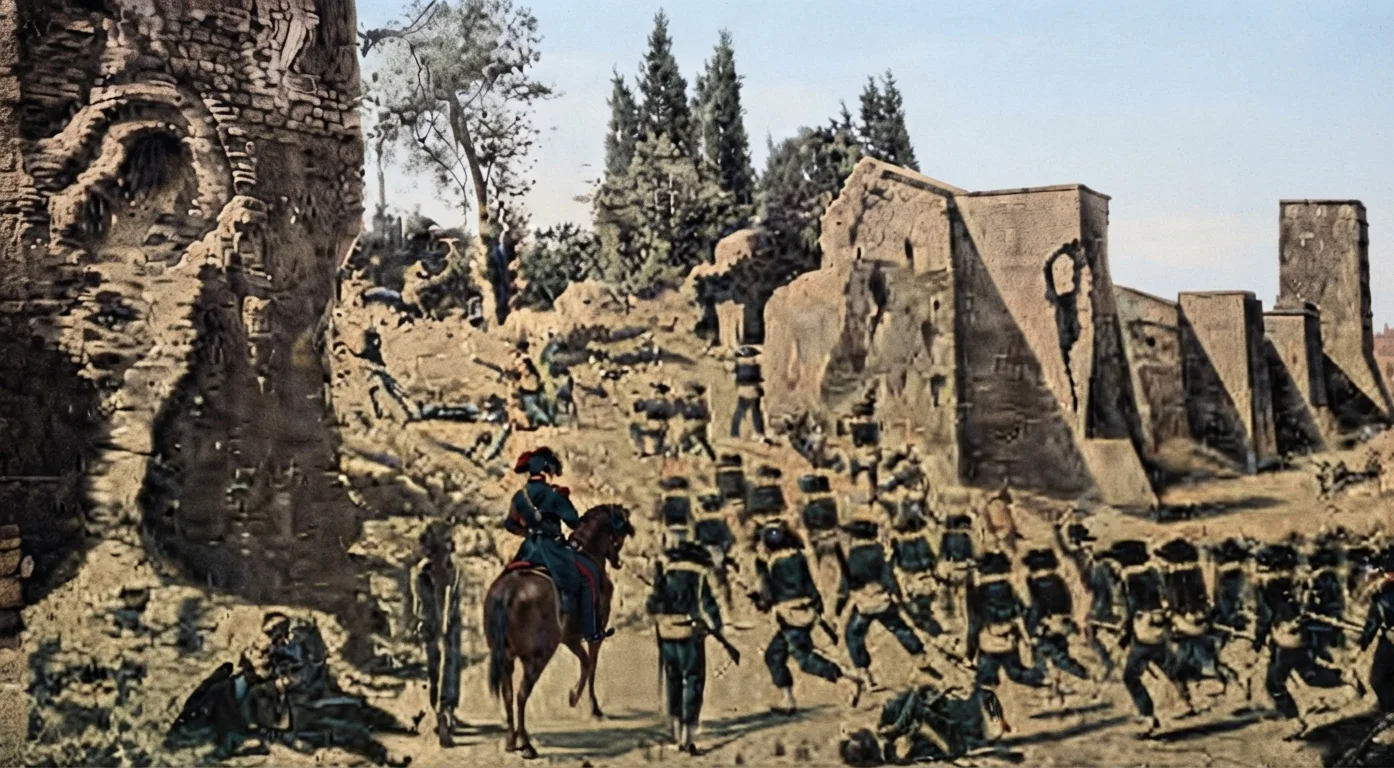
ITALIAN TROOPS ENTERING THE CITY OF ROME THROUGH THE BROKEN WALLS, IN 1870.
The turn that the Catholic Church has already taken in allowing its members to go to the polls has made a deep impression, and its results are in evidence all around us. The newspapers that before were hostile to the interests of the church are now actually fawning at its feet. The strong anti-clerical speeches in the Parliament are growing less very perceptibly. In fact, the government is almost linking arms with the church, so much so that at Rome one seeking an office or help from the government can hope for little without the signature of the parish priest to render his application of value.
The Catholic Church is likewise honoring the government in certain ways. The national flag, which in the past has been trailed in the dust by the church, has recently been hoisted over its convents in Constantinople. And a short time ago the entire country was scandalized by the action of the Duke of Aosta, who is the cousin of the king, and would be heir to the Italian throne should the king die without an immediate successor. The duke, in official array and attended by his entire court, assisted at the service held in the cathedral of Naples, and kissed the vessel that is supposed to contain the blood of St. Januarius which is said to liquify miraculously once every year. Had he gone as an ordinary citizen so much would not have been said, but going in his official capacity and accompanied by his court he certainly designed to show a special respect to the church, in spite of the position that he holds in the government.
Policy Gaining Favor.
For some time the Roman Curia was not exactly in favor of the work that was being attempted by the second group. But now that the pope sees how well their program is working out to the advantage of the church, he is taking a personal interest in it. And a short time ago he appointed some of the leading men of the party as a committee to investigate thoroughly the movement, and to form a new program that shall be more practical and certain of success. He has eliminated the revolutionary element from the party, and put the movement on a basis where its triumph will mean the triumph of the church. And it is quite certain that it will come out victorious. The triumph of this party will mean the restoration of the lost power and prestige to the pope. The question might be asked, Will it involve giving back to the pope the temporal power in Rome? This question I shall not endeavor to answer by a simple negation or affirmation. But I shall call attention to a few facts.
Not long ago, from a strongly Catholic source, and at least partly with the approval of the Vatican, a book, entitled 'The Papacy in 1915,' was published. Among other plans proposed, there was one that suggested the solution of the question of the temporal dominion in another way from those contemplated in the past. According to the Catholic Church, the temporal dominion is an absolute necessity, as the pope must not be subject to any government. But this writer suggests that in order to satisfy this precept of the church, the restoration of Rome to the Papacy is not absolutely necessary. He said that that part of the city of Rome which surrounds the Vatican and is cut off from the rest of the city by the Tiber River might be given over to the pope as his dominion. The part of the city of Rome in the immediate vicinity of the Vatican, at the time of Leo IV. (848), was enclosed by a wall forty feet high, and thus became known as the 'Leonine City.' It is this part of Rome that is proposed as a fit place for the pope to again exercise his temporal dominion.
This writer further says that the important offices of the Papacy might be transferred to that part of the city, and a large hotel might be built to accommodate the strangers and pilgrims that come to visit St. Peter's and the pope. I do not know that this plan will be adopted, but it is suggested as a possible solution of the much-discussed question dealing with the restoration of the temporal dominion of the Papacy. It might well be questioned, however, if the Papacy, like the camel of the fable, would not plot to enter in and take possession of the whole city if it were allowed to get its nose inside, and it should begin to smell the sweet savor of the temporal power. C. E. MILTON.