ACCORDING to a report in the Boston Globe, the enforcement of Sunday observance by law, and incidentally the movement to put religious education in the schools and to form a federation of the Protestant churches, were all vehemently denounced as perils to the liberty of the republic at a “Religious Liberty Day” meeting of Seventh-day Adventists in Lorimer Hall, Boston, on February 24. The purpose of the meeting was to protest against the Sunday bill before the Massachusetts Legislature, a hearing upon which had just been given by the Legislative Committee on Probate and Chancery. The speakers were Rev. L. S. Wheeler, pastor of the church, and Prof. P. T. Magan, formerly of the Battle Creek (Mich.) College. The Globe quoted Mr. Wheeler as follows:
This country was the first in the world to build its government on the foundations laid by Christ, of civil and religious liberty, with the complete separation of church and state. Jesus Christ proclaimed this principle when He said to the people, “Render unto Cæsar the things that are Cæsar’s, and unto God the things that are God’s.”
In this government from the very beginning, the church and state have been separate; but within recent years there has grown up a party seeking to unite church and state. The effort has been made to enforce religious teaching in the public schools. The effort has thus far been unsuccessful, but if it succeed, it means that some religion, whether Catholic or Protestant, Jewish or Mohammedan, must be taught by the force of the government. Religious instruction can not be enforced without prosecutions and persecutions.
Another great effort which has come from this recent movement has been one to have the observance of Sunday enforced by law. Here in New England we have the Sabbath Protective League, whose work is to lobby the legislators of this state and to worry the members of Congress into the passage of laws which will put the power of the state back of religious observances.
The government has no more right to enforce Sabbath observance than it has to enforce the observance of baptism, or the Lord’s Supper, or any other religious institution. The Lord is Lord of the Sabbath, and He does not ask that His Gospel shall have the protection of human governments.
I believe God has raised us up to give warning to the people of the danger which confronts their liberties in the passage of these religious laws. The people are sleeping when they ought to be awake to the danger, and while they are sleeping, the enemies of liberty are planning to drag them back into the bondage of domination by the church.
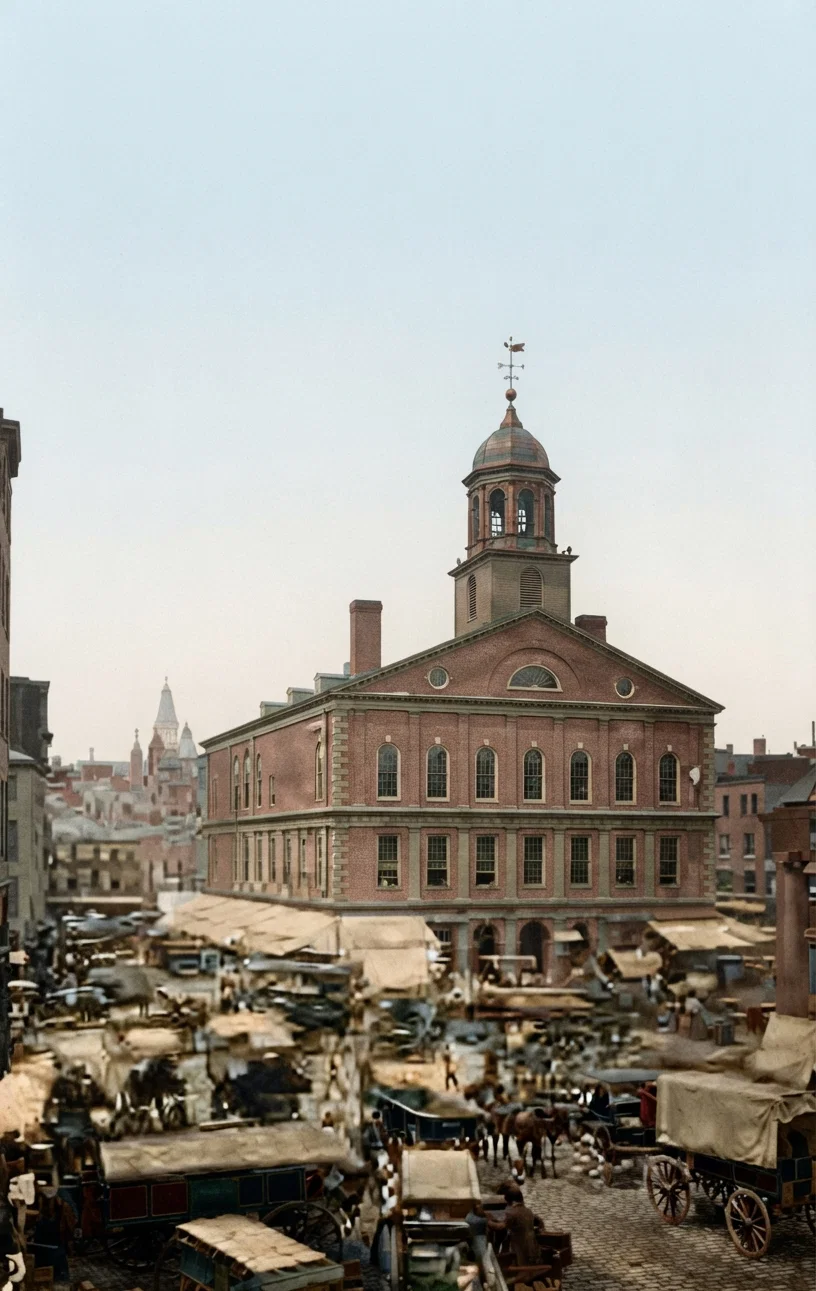
Faneuil Hall, Cradle of Liberty, Boston, Mass.
Professor Magan was quoted as follows:
If the people could realize what these subtle movements mean to their future liberties, they would not tolerate them for one moment. Passage of Sunday-observance laws will bring into this state what has been experienced in other states, such as the prosecution of a poor woman for buying five cents’ worth of ice to cool the feverish brow of her dying child. The passage of Sunday legislation will bring about the destruction of the church which attempts it. The moment you get a confederation of churches in this country, that moment Revelation is realized in the appearance of the false prophet of the West. Out of a movement to force the people by law to an observance of religious rites, will come scenes more terrible than the world has ever yet seen, and in comparison with which the events of the French Revolution are insignificant.
Events in this world are moving rapidly toward that day of judgment foretold in Revelation. Today hardly a merchant can buy or sell his goods without the consent of the trusts. At the same time on every hand come the mutterings against them, come the wrath and the fury of public investigations, and the culmination of all those terrible things which will mark the closing days of this world. For the sake of the truth that has been given us, let us turn to with all our might, and proclaim to every one the truth, and the way to liberty and life.