In all lines of recognized modern progress, Japan is leading the Orient. Her brilliant dash against Russia begat a desire among all Asiatics to emulate her, and inspired the thought that it was possible for all the brown and yellow peoples to do so by adopting her methods. Japan, too, recognizes that she gained her prestige by learning and adopting western methods. Therefore, to a considerable extent, Japan is in the position of medium through which western progress and thought is being imparted to Asia. Great numbers of pupils from China and adjoining countries are attending Japanese schools. For these reasons it is very important that special attention be given to Gospel work in Japan. Such a course will surely prove both expeditious and economical in reaching the Asiatic millions. To this end it is well to note conditions in Japan that have a bearing on the transition from hide-bound orientalism to the expansion into freedom of thought. For this purpose we reproduce some statements by Theodore M. Macnair, a missionary of the American Presbyterian Church, as given in the Missionary Review, under the caption, “Influences That Are Moulding Japanese Thought.”
Periodical Literature.
In accounting for the remarkable progress made in Japan during recent years, large emphasis must be placed upon the influence of literature, particularly periodical literature. These influences are second only to those of the schools, which have made of the Japanese people a nation of readers.
The Meiji era had scarcely begun, thirty-eight years ago, when Japanese periodical literature took its rise contemporaneously with public speaking; and if at the first it was crude, and played little part in the shaping of popular thought, that condition did not last. Rapid literary development took place, and now, a generation later, it makes a fairly creditable showing. In 1898, the thirty-first year of Meiji, there were 829 newspapers and magazines published; but five years later these had increased to 1,328; and figures for 1905 show not less than 1,500 as the present aggregate. Moreover, there are some among the more influential of the Tokyo dailies that have reached a circulation of a quarter of a million of copies.
All varieties of opinion, secular and religious, are provided, through this medium of periodical literature, with the means for exploitation; but in Japan, as elsewhere, the results are widely varying. The secular journals, especially those of Tokyo, are in the lead, as the great moulders of public opinion. With their machinery for news gathering, manipulation (!), and scattering, through the agency even of the gogai, or “extra,” they justify the claim that they are fully “up-to-date.”
There is one daily paper edited and published by Japanese, entirely in the English language—namely, The Japan Times. It is a creditably conducted journal, and though only eight years old, has numerous patrons from among the Japanese, as well as in the foreign community.
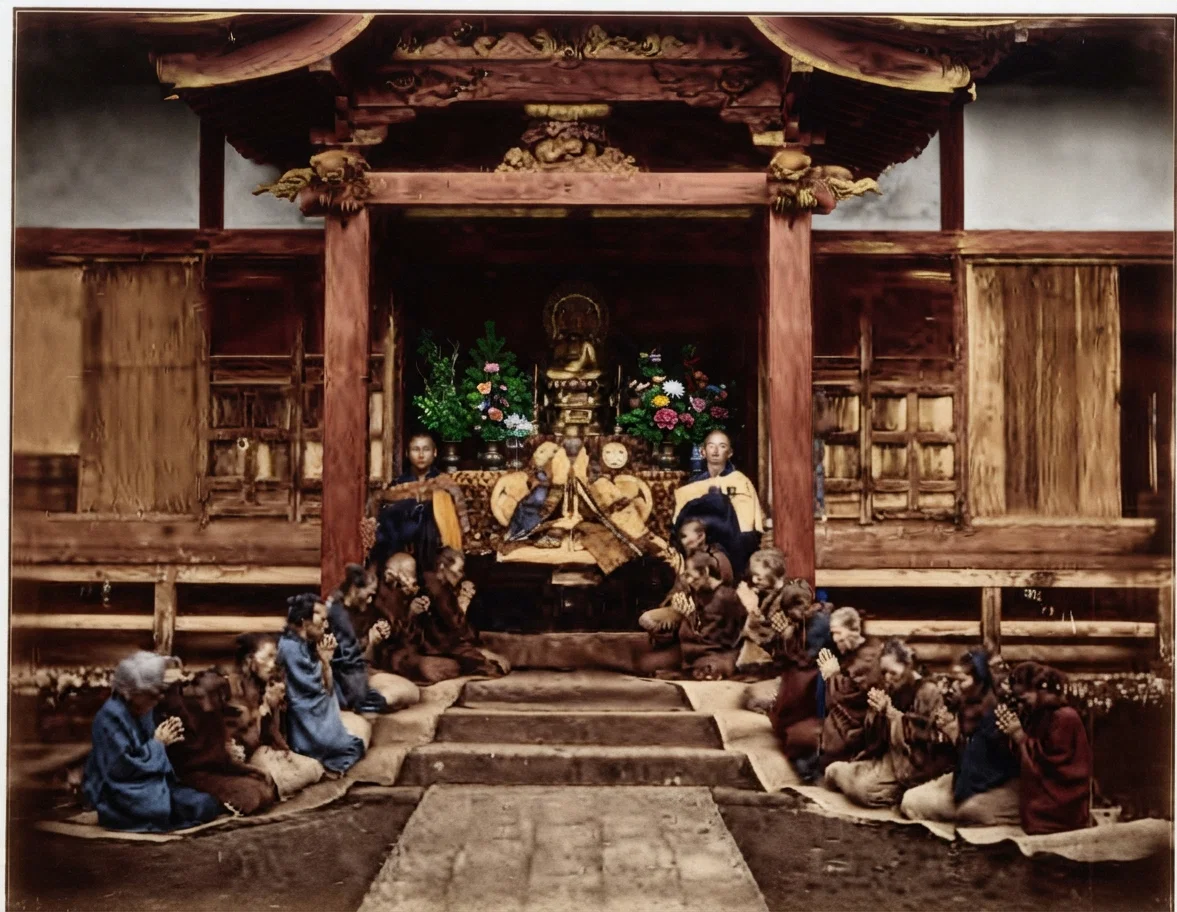
JAPANESE WOMEN WORSHIPING AT ENTRANCE TO A BUDDHIST TEMPLE.
The Japan Mail, however, under foreign management, is recognized as the leading English newspaper, and has been so ever since its establishment in 1865. Its present editor is the well-known Captain Brinkley, a retired English army officer.
Magazine literature can not be said to have developed in Japan correspondingly with that of the newspaper class. There has been no lack of enterprise in this direction, but the patronage secured is as yet relatively small. Still, there are some magazines which pay well, and among them the Taiyo, or “Sun,” which was begun as far back as 1887, and easily takes the leading place, with a monthly circulation of a hundred thousand copies.
There is a constant and increasing inflow into Japan of foreign literature, however, particularly English. In fact, the imports of English-printed books nearly trebled, between 1901 and 1903, while for German and French they remained practically the same, and the latest available figures (in yen) stand relatively at 371,000 for English, as compared with 94,000 German and 15,000 French. This drift in favor of English will no doubt continue, as is indicated by the steadily increasing place that is given to English study in the schools. Nitobe, the author of “Bushido,” has been quoted as saying that “the Christian and Western moral ideas must be the standard for the future in Japan, and the most immediate and practical means for disseminating them, besides personal influence, will be the study of English literature. New Japan will receive her greatest impetus toward the new ethics through the desire, which is universal, to learn English, not as a language alone, but for the benefit to be derived from it in the formation of character.”
Religious Influences.
Religious literature, as at present produced, is mostly due to Christian enterprise, though there are some notable exponents of Buddhism among current books and periodicals. They are in striking contrast, however, to the number of Buddhist believers, as these are compared with the combined total of Christians, the latter a hundred and fifty thousand, the former some twenty-eight millions!
As for Buddhism, the reform element is practically the only source within it from which modern literary influences proceed. The apathy in the matter of faith, which may be affirmed of the great majority of enrolled Buddhists, does not conduce to the acceptance of new religious ideas, or favor such innovations as religious periodicals with which to circulate them. But there are some who desire that the creed of Shaka may be revised to suit modern conditions, and have adopted the usual literary means for securing a hearing with this end in view.
The role of the critic is the one they commonly adopt, and the following will serve as a sample of the kind of criticism that is offered:
“Priests have of late been freely distributing amulets among the soldiers, and when acting as army chaplains, they bear the name of imonshi (comforters); but how many of them are there that have any real faith in the efficacy of the religion they profess?”
As bearing on this very matter of the traffic in charms and on divination in general, a government proclamation of December, 1905, forbids it in toto on pain of fine or imprisonment.
The Buddhist Chuo Koron proposes a rendition of the Buddhist Scriptures into the colloquial of the people of Korea and China, and of Japan also, in order that they may become a means of Buddhist propagandism, similar to what the Bible has been in the propagation of Christianity. “Now is the time,” it declares, “for Buddhists to go in13and win, and it is earnestly to be hoped that they will show themselves possessed of the energy, the enterprise, and the sense of responsibility required for the full utilization of their unique opportunities.” On the other hand, the adherents of Christianity are convinced that the opportunities are theirs instead.
The following compliment to Christianity is taken from the Jiji Shimpo:
“Altho the Christian religion is of recent introduction, the improvement it has effected in Japan's moral condition, and the influence it has had on the minds of the people, are very great. No one can deny the great good accomplished by the believers of that religion, in establishing charitable institutions, in assisting in the progress of the nation, and in promoting the happiness of the poor and helpless. There are already many schools and colleges in the country, both for boys and girls, which are supported entirely by Christians. As for the charitable institutions, excepting those founded by the government, it is not too much to say that they are all the result of Christian enterprise.”