SECRETARY OF THE NAVY, the Hon. Charles J. Bonaparte, delivered an address September 12, at the graduating exercises at the Naval Academy, Annapolis, Md., and assured the graduates that "the era of perpetual peace is not near." In part he said:
"Young gentlemen, you begin to-day the work of your profession; your profession is the profession of arms; you have chosen a military life. I saw not long ago the prediction that 'in forty years, war would be a lost art.' This sapient deliverance rolled along in that flood of talk about the beauties of peace and the horrors of war which ripples around us just now, as it has from time to time during all the history of civilized mankind, too often as a prelude to bloody and disastrous wars."
This declaration concerning the deception of the "peace and safety cry," is very significant considering the source from which it comes and at the time it comes. No one is better prepared to make such a statement as will remove the mask of false peace assurances just as we are on the eve of the most "bloody and disastrous wars" this old earth is yet to witness, than the man in the war chamber, feeling the momentary pulsations of the coming storm and crisis among the nations of the whole world.
It would be well if some of these "peace and safety" dreamers could listen to a lecture on the "prelude to the bloody and disastrous" war of the French Revolution. History informs us that on the eve of this most bloody war the clergy of Paris and from every pulpit in France declared with vigor that the millennium of peace on earth was beginning to dawn, and that in a few years the sword would be beaten into the plowshare, and nations would lose the art of war. Gibbon, the great historian of the decline and fall of Rome, prefaces several "bloody and disastrous wars," with the prelude of this soft "peace talk" from the clergy, declaring that the millennium was about to dawn.
They would learn still more if they would open their Bibles and read the Word of the Lord; thus, "Hear ye the Word of the Lord: Thus saith the Lord God: Wo unto the foolish prophets, that follow their own spirit, and have seen nothing! . . . Because, even because they have seduced My people, saying, Peace; and there was no peace." Paul, in giving one of the signs showing the unmistakable proximity of the great and dreadful day of the Lord, writes: "For when they shall say, Peace and safety; then sudden destruction cometh upon them, as travail upon a woman with child; and they shall not escape." "But this is that which was spoken by the prophet Joel: And it shall come to pass in the last days, saith God"—"For, behold, in those days, and in that time . . . I will also gather all nations, and will bring them down into the Valley of Jehoshaphat, . . . for the Lord hath spoken it. Proclaim ye this among the Gentiles: Prepare war, wake up the mighty men, let all the men of war draw near; let them come up. Beat your plowshares into swords, and your pruning-hooks into spears; let the weak say, I am strong. . . . Let the heathen be awakened, and come up to the Valley of Jehoshaphat; for there I will sit to judge all the heathen [nations]. . . . The Lord also shall roar out of Zion, and utter His voice, . . . and the heavens and the earth shall shake; but the Lord will be the hope of His people."
John, the Revelator, writes of the last of earth's struggles as follows: "I saw . . . the spirits of devils, working miracles, which go forth unto the kings of the earth and of the whole world, to gather them to the battle of that great day of God Almighty; . . . and he gathered them together into a place called in the Hebrew tongue Armageddon." Armageddon is that range of mountains hemming in the Valley of Jehoshaphat, spoken of by the prophet Joel, where God will cause to be gathered "all nations," and "the heathen."
There will occur the most "bloody and disastrous" war, styled "the battle of that great day," and "a time of trouble, such as never was since there was a nation even to that same time," and the "blood" flowed "even unto the horse-bridles, by the space of a thousand and six hundred furlongs." And this most "bloody and disastrous" final conflict will be introduced by the prelude song of "A Good Time Coming"—of pulpit lectures on "war becoming a lost art," and by "that flood of talk about the beauties of peace" in the millennium.
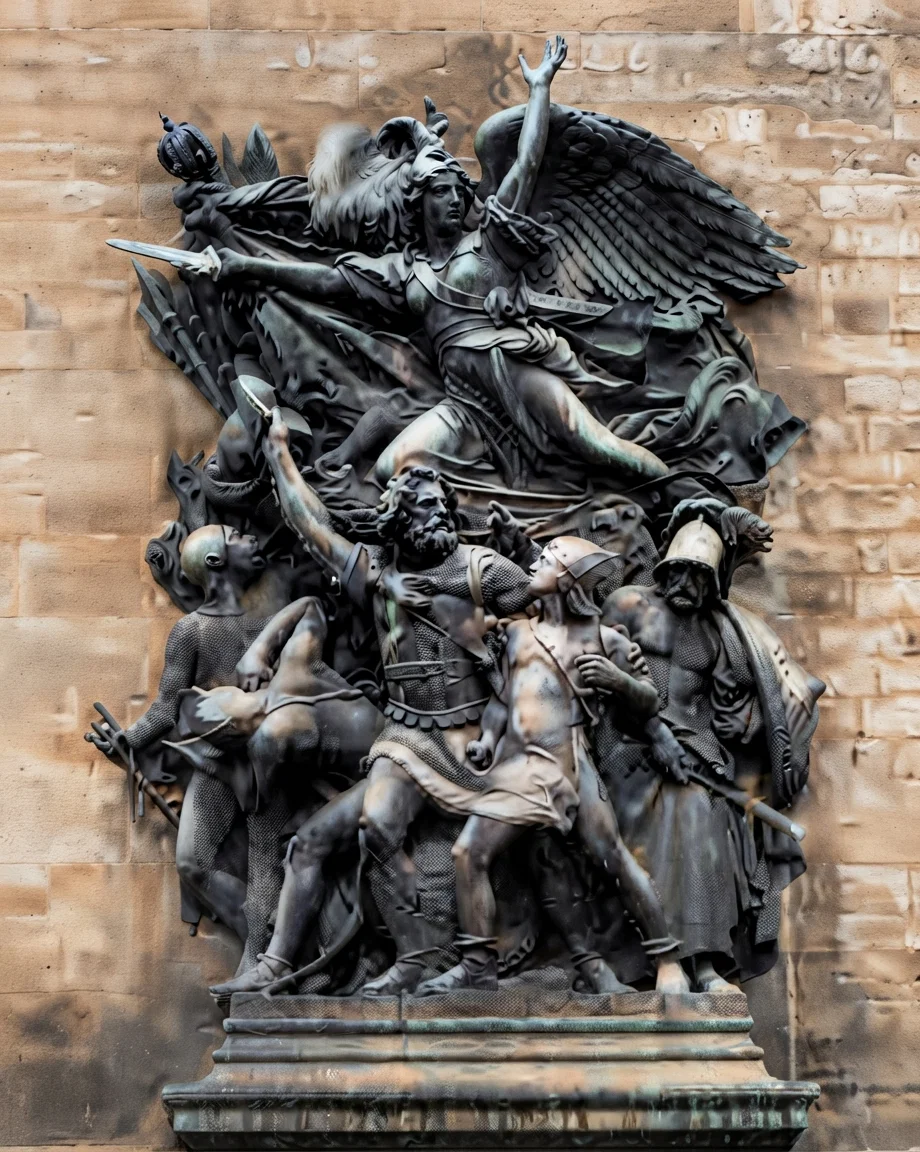
"The Departure;" the Genius of War Summoning the Nations to Arms.
Thank God, these deceivers and the deceived are without an excuse when, in the providence of God, such men as Bonaparte are led to unmask the deception and publish the true situation according to fact and Gospel prediction.