FRANCE AND THE PAPACY

6%

Pacific Press Publishing Company · Mountain View, California · Oct 17, 1906

FromSigns of the Times, Vol. 32, No. 40.

Read the full edition

FRANCE AND THE PAPACY.

THE conflict between the French Government and the Papacy has reached a state of acuteness, out of which almost anything may be expected. This is, briefly told, the situation.
The famous law which asks the Jewish, the Protestant, and the Catholic Churches to pay their own expenses from henceforth, was voted last December. Five long months the French Catholics waited for a word from the pope to know how to prepare for the emergency. Then came the encyclical Vehementer nos, calling the French law an impious, iniquitous law, and denouncing the principle of the separation between the church and the state as altogether unchristian and God-defying. The pope's letter did not, however, give any advice as to what to do, but promised that such advice would be forthcoming.
In the meantime the pope advised the gathering of a full meeting of the French bishops and archbishops, who were to return to the pontiff the benefit of their candid opinion on the matter. The bishops convened, over seventy in number, deliberated, and forwarded to Rome, with an obsequious letter of submission, the verdict of the majority of the council. As was later found out, that majority verdict was decidedly in favor of giving the law, such as it is, a fair trial, and of organizing immediately such "associations for worship" as the law called for.
On the 10th of August last, a second encyclical was forthcoming, in which Pius X, "confirming the almost unanimous decision" of the French bishops, flatly refuses and forbids the acceptation of the law such as it is, and asks the bishops to meet again in order to find another way out.
As you may imagine, there was great astonishment when it was discovered that the alleged "unanimous decision" was a fraud, and that the conviction and advice of the French bishops was overruled in Rome at a meeting of foreign cardinals in which one single Frenchman took part.
The bishops met again, and sent in their unconditional submission to the wisdom of the "sovereign pontiff." So did twenty-three leading men, mostly academicians, devout Catholics, who had signed an open letter to the bishops, advising them to accept the law.
And now comes a new open letter, signed by hundreds of men, whose names are still unknown, and directed to the pope himself. The signers call themselves good Catholics, which makes the "remonstrance" all the more interesting. They address the pope in tones with which he has not been accustomed on the part of good church members. They say in part:
"In all the enlightened circles—that is to say, among all those professors, physicians, lawyers, engineers, and business men, . . . who generally carry along the opinion of the nation—the surprise (at your letter) was immense, and the disappointment profound and lamentable. . . . But, most holy father, if your letter saddened all the good citizens, we must tell you that it caused all the lovers of violence, hatred, and disorder to rejoice. . . . Only such men cheered it who are the known upholders of royalism, imperialism, and antisemitism, . . . to whom religion is only a mask, thrown off when the play is over."
The writers of the letter agree with the pope in condemning in principle the separation of church and state. But they remind him that the law makes a free grant to the Catholic Church of two hundred million francs' worth of church edifices and presbyteries and valuables, not speaking of the pensions to which the priests are entitled, and which for the present make their bread a certainty. Then they go on saying (I boil down the document, as it is rather lengthy):
"Now, most holy father, if your encyclical means what we discover in it, all these advantages will be lost. See what a terrible situation the dawn of the year 1907 will witness. Over 50,000 cathedrals, churches, and chapels will return to the state, which in time will dispose of them as it may please; the bishops and priests, thrown out of their residences, will be forced to find a refuge for themselves and their families. The people will be obliged to find the forty millions that are necessary to make a living for our priests and the twenty other millions required in order to carry on church services. The seminaries will be closed, public worship will be reduced to privacy, and held under suspicion. After a few years of this regime it will be a wonder if Catholicism has not lost most of its devotees, and if Protestantism has not stepped in to take our place."
"All this and more would be nothing if the question at issue were such a vital one as the church can not yield without ceasing to be the church of Jesus Christ. But we dare to ask you publicly if indeed our doctrine is imperilled by the law of separation. Catholics we are, and Catholics we shall remain, come what will. Only, most holy father, do not blame us if we live in the country of clear ideas. Our language and habits of thought, unknown to you, require frankness, and are averse to vague situations and ambiguous formulas. Pardon us for desiring to know the true and grounded reasons for this unexpected non possumus."
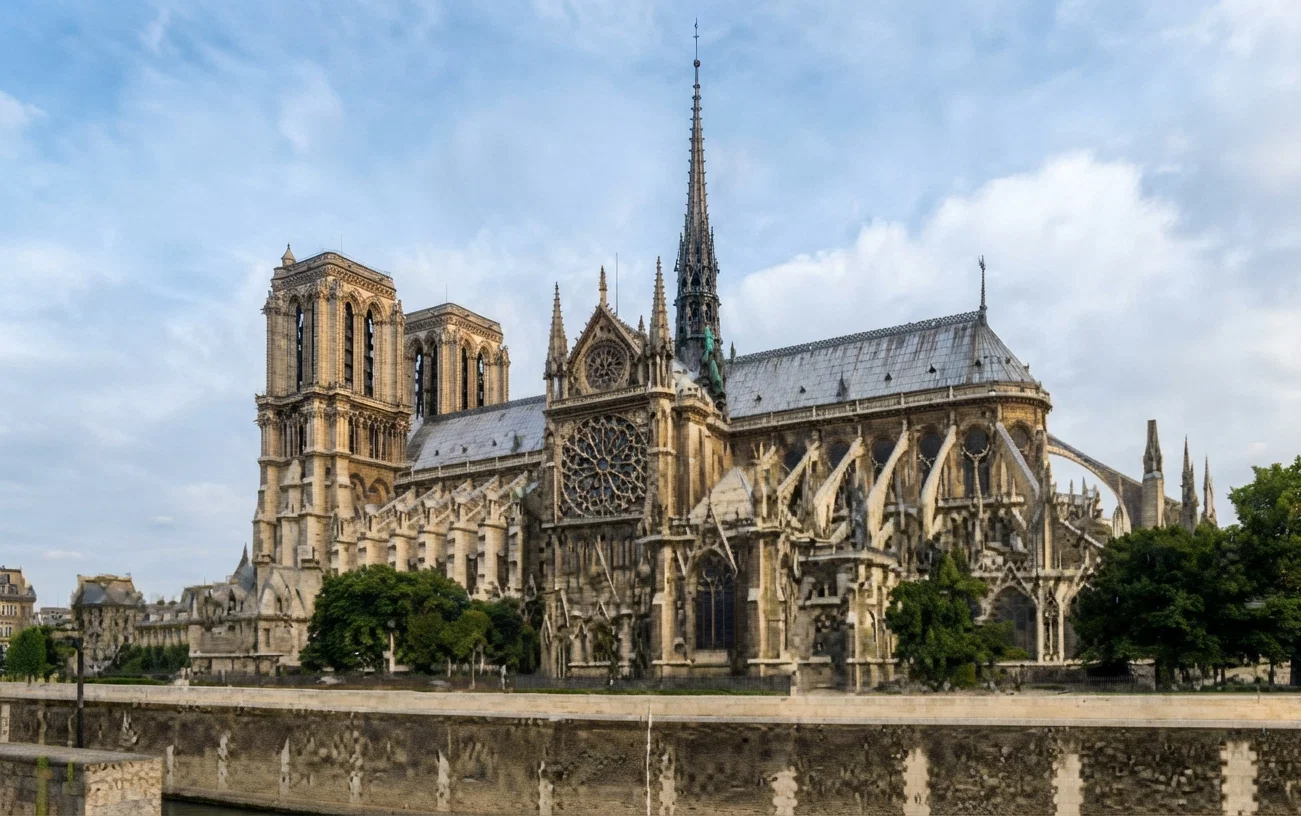
The Cathedral of Notre Dame, Paris.
"You have feared that the democratic regime might invade the church. But let not your holiness be afraid of this! Was this not one of the reforms most ardently desired, in his spiritual will, by the pious and quiet Cardinal Manning? Must we, then, regret those glorious days when the people played a much more important part in the affairs of the church than they ever will under the provisions of this law?"
The signers go even so far as to tell the pope that the bishops were in favor of the law, a fact concealed by him, and that the French people will "never deny the principles of the French Revolution, but rather trace its faith clear back to the Gospel and to the very heart of Christ!"
This is surely a new language for a pope to hear on the part of his own constituency. It breathes a healthy tone, which gives us who are laboring to spread the Gospel in this land great hopes of seeing many honest souls embrace it with joy. I met just such a case at our recent camp-meeting at Nimes—a young, intelligent couple, who hardly knew how to express their admiration and gratitude for the truth. May God greatly bless the laborers in France, and multiply their numbers!
JEAN VUILLEUMIER