CHRIST is the "all in all" of every age. In the beginning He was the Word, through whom God's creative voice was heard. All things were created by Him and for Him. John 1: 1-3, 14; Col. 1:16, 17.
God, through Christ, walked and talked with man in Eden. Gen. 2:16, 18; John 1:18. But when sin entered through the first pair, Christ's subjects renounced Him, to their own loss, and His kingdom was greatly marred by the curse which rested on the earth. Because of this He set about to redeem His injured heritage from its sad condition, that He might return to it in person, and reign in glory with His ransomed people.
But sin has so deformed the image of God in man, and so enfeebled his moral faculties, that a simple promise of help could not do the work for those who not only had no power left in themselves to accept the proffered aid, but whose environments were wholly satanic. It was therefore necessary to leave with men some constantly prompting influence for good, which would not only offset man's evil surroundings, but draw him heavenward as well.
This Word, then, must not only contain a general warning against corrupt control, but to be entirely effectual, it must point out the distinctive nature of this agency in all its many phases. This would demand divine foresight, in accurate description, of all the evils to be met in different ages, in order that man might recover himself from all the diplomatic schemes of Satan's cunning.
Suffering and Glory.
All this being a part of the great plan of salvation, these prophetic words must reveal, not only the sufferings of Christ, but also His reign over the saints in glory, as the outcome of those sufferings. It was this view of the work of Christ which led the inspired writer to say that in the work done by the prophets, they "enquired and searched diligently" concerning man's salvation through Christ, when prophesying of the grace to come unto Him. 1 Peter 1:10.
The Spirit of Christ in the Prophets.
But there is another point in Peter's testimony concerning the prophets which is worth emphasizing here. He says that their "diligent" search of this salvation was specially directed by the Spirit of Christ which was in them, and that this same Spirit testified beforehand, through them, of the sufferings of Christ, and the glory to follow, in consequence of His sufferings. From this it is plain that the prophetic Word was inspired by Christ, and that it, as well as all other parts of the Bible, make Him the great central object of their existence.
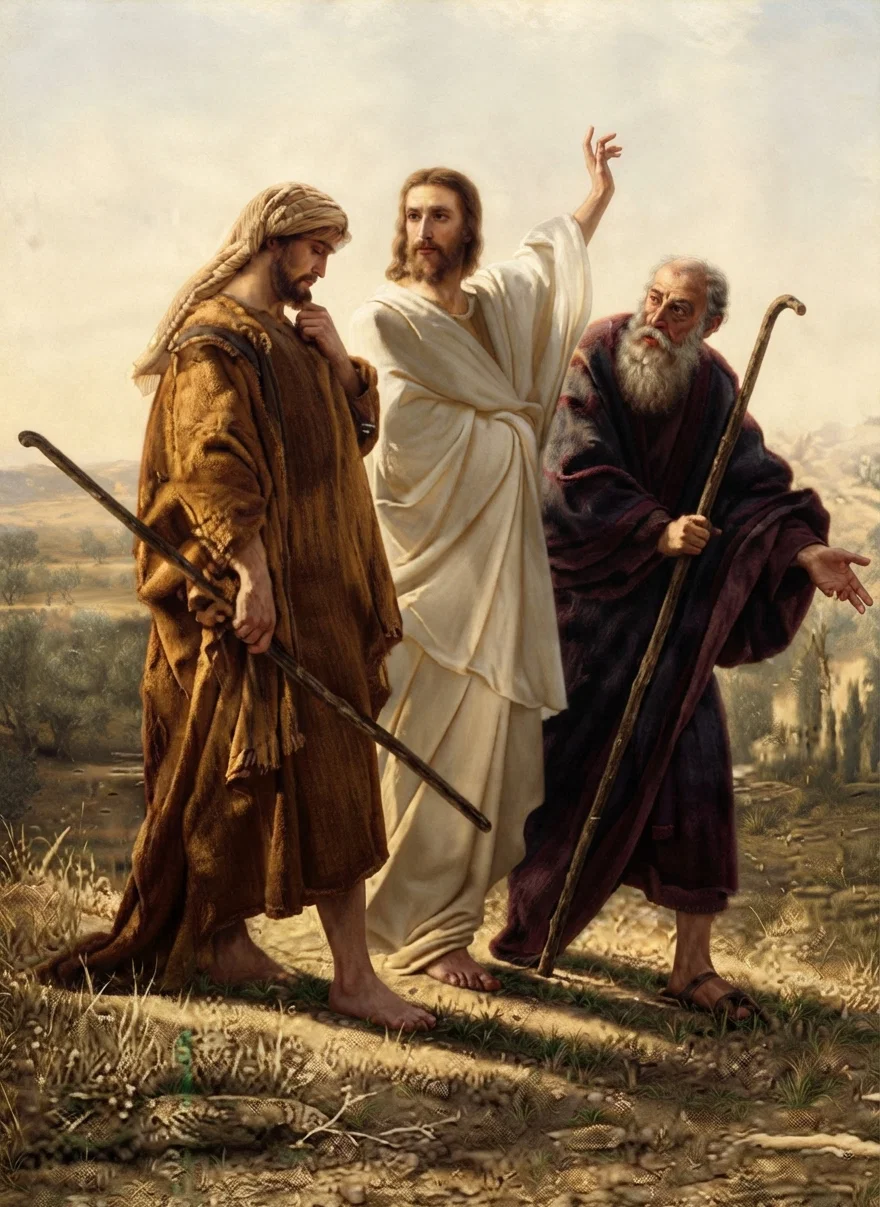
This thought having been so clearly stated by Inspiration itself, Christ's words of reproof for two of His disciples seem justly merited. These disciples were on their way from Jerusalem to Emmaus, near the close of Christ's resurrection day, and, when nearly there, were joined by their risen Lord. Thinking Him to be simply a fellow-countryman, in deepest sorrow they poured the fulness of their disappointed hopes into His ears. After listening to the end of their lamentation, Christ replied to them thus: "O foolish men, and slow of heart to believe after all that the prophets have spoken! Behooved it not the Christ to suffer these things, and to enter into His glory?" Luke 24:25, 26, A. R. V.
Had these professed disciples known the statements of the prophetic Word, they might have been saved their wail of unbelief, upon seeing Christ give up His life in agony on the cross. But as they had neglected this important study, it became necessary to administer balm to their wounded hearts. Christ Himself did this, by "beginning at Moses and all the prophets, He expounded unto them in all the Scriptures the things concerning Himself." This was satisfying enough to the disciples to make their "hearts burn" within them, while He talked with them about these things. Their sorrow also was turned to joy, as they discerned in the stranger their Master, who was risen according to the prophetic scripture, and they hastened back to Jerusalem to spread the good news of a living Saviour.
Prophetic Word for Us.
The fact that Christ Himself, and His apostles after Him, used the prophecies to reveal the work of Christ, and to establish His claim to the Messiahship, shows the prophetic Word to be absolutely reliable. More than this, it having been dictated by the Spirit of Him who is our common Saviour, and for the purpose of enlightening us relative to His sufferings and their object, that Word must be adapted to the needs of those for whom it was written. That is, it must be so exempt from secret intention that no one may possess the privilege of reading its mystery for himself alone. In other words, the interpretation of the prophecies has been absolutely delivered from "private" ownership, by the revelation of the Holy Spirit, freely distributed to every person. 2 Peter 1:19-21; John 16:13, 14.
All this being true, those who will may know the portent of the strange events which, in our day, crowd so strenuously upon the heels of their predecessors. That many of the scenes and incidents of the present time are startling, and almost unaccountable from natural causes, many are ready to admit, yet they do not know their meaning, because, like the two disciples on their way to Emmaus, they have not studied the prophetic Word, and so noted its reference to these things which were to be omens of the soon-coming Saviour to redeem His waiting people, and receive them into His glory. May such hasten to redeem the time, and so be prepared to receive the Master when He comes.