(The writer of the following article is head of the Science Department of Healdsburg College.)
My eyes have looked upon the devastation in our cities all along the line of the earthquake from Healdsburg down the Russian River, through San Francisco, down the Santa Clara Valley as far as the town of Mountain View, but to-day I have seen where the mighty temblor has blown a blast that has devastated the very mountainsides.
I had heard for days of a "slide" in Alexander Valley, but recent rains and bridges broken and wrecked by the earthquake hindered. But to-day I reached there, and I feel well repaid.
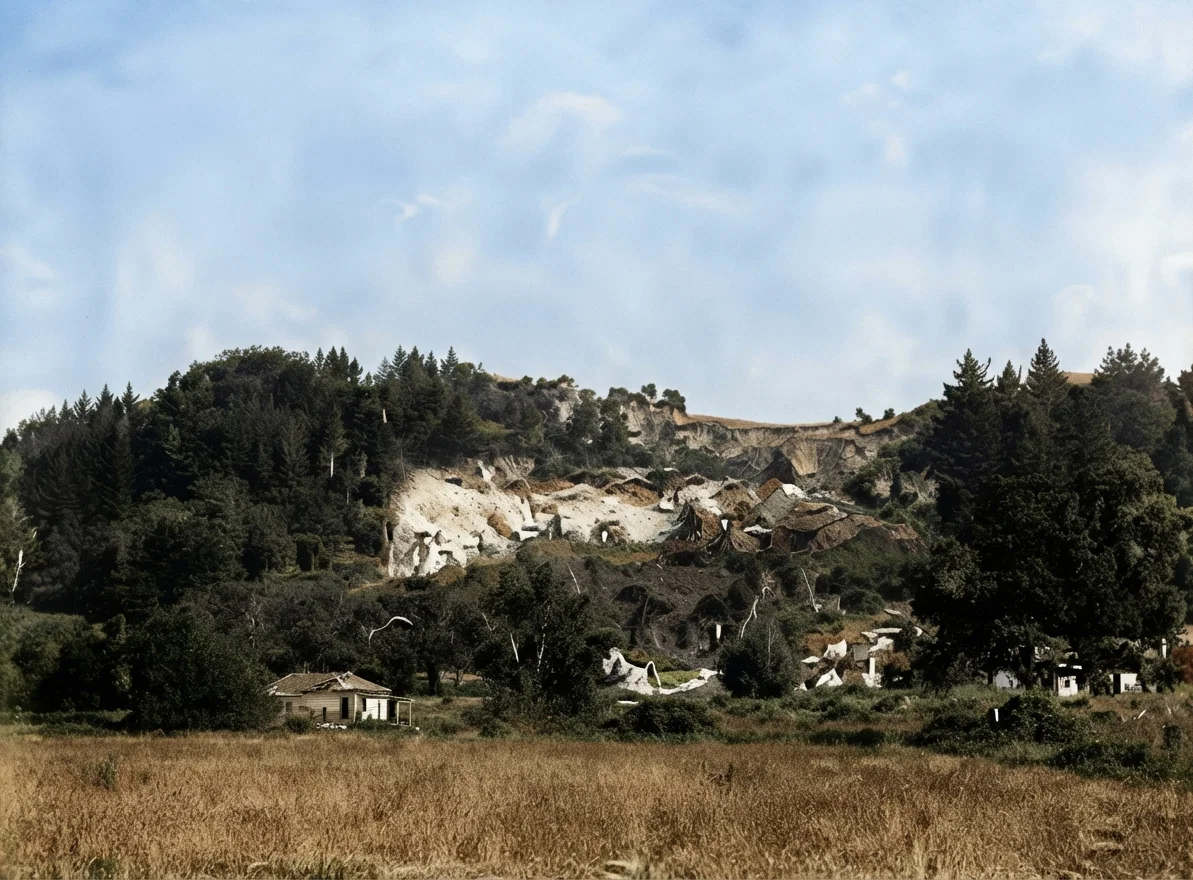
Eruption in the hills five miles east of Healdsburg. In the words of George Madeira, geologist and mineralogist, selected by the state mineralogist, Lewis E. Aubrey, to arrange the mineral exhibit of this state at the St. Louis Exposition: "The scene of the explosion is directly in front of the home of Mr. Hugh Simpson. . . . Before the earthquake three conical, wooded hills arose above the small flat lying between the creek and the base of the hills. The third or highest and most easterly of these hills was the one that received the full force of the internal explosion, and was in consequence thrown northward in a mass carrying everything growing upon its surface and depositing the material in broken masses of huge proportions for a distance of 2,000 feet and a width of 550 feet. . . . The stratification indicated that much of the underlying material was erupted as dry, hot volcanic ash, a light, fluffy material, bluish-gray in color. Climbing over the huge broken masses, we reached what appears to be the summit of the outburst—a mass of surface ground fissured and broken. . . . The masses were blown out on each side of this middle ground, that to the north of the dividing line being blown toward and across the creek, while to the south of the middle line the material was shot from a deep crater into the air, much of it falling back into the excavation, where it lies in broken masses mingled with the trees that once adorned its surface." This view of the explosion was taken three-fourths of a mile away. Before the earthquake the hill was wooded uniformly, the bare place in the center indicating the mass which was blown out by the explosion. The trees which cover this ground are about 200 feet high. Mr. Snook, the photographer, says that it is utterly impossible to get a picture of this place which does it justice.
Some distance beyond Alexander village the road forks, one branch running toward Calistoga and St. Helena, and the other toward Santa Rosa, sixteen miles away. As one makes the turn into the Santa Rosa road, the looked-for wonder looms into sight, something like a mile or more away. The whole side of the hills seems to have been blown out by carloads of dynamite simultaneously discharged.
And yet dynamite is but a feeble thing as compared with the might that has been exemplified here. Sandstone rocks have been fractured through an area forty feet deep and hundreds of feet long. They have been riven, upheaved, tipped, turned, upset, and dumped into chaos.
Early the morning of April 18 a country home nestled close to the hills. Not far away ran the hurrying stream. Thirty acres of level land lay between the hills and the water.
Early that morning the young man of the place, a youth of some eighteen years, was out and about the house, when suddenly there came a terrific roaring, a shaking of the earth; the great fir trees on the side of the hill began to upturn and fall as tho swept by a mighty reaper; rocks and dust went flying into the air; with roar and rush and tremble and terrorizing fury the very side of the hills went sliding, rushing, upturning, upheaving, riven to ruin, pell-mell, across the thirty acres of level land, and into the river, and even beyond to the farther shore—dirt, rocks, and trees.
Fish were thrown out of the river, and the boy gathered up enough for breakfast, finding one large one in his neighbor's hen yard. Not a soul was touched. But the farm had received a most remarkable top dressing, a deluge of mountain wreckage.
Any one who looks over that more than forty acres of torn-out mountain-side, will readily see the unmistakable evidence of explosive violence. There has been a breaking out here of pent-up forces that hurled full-sized trees, huge rocks, and acres of dirt this way and that, and piled them, in some instances, higher than they were before.
And now we may ask, What are the forces that cause such disturbances of the earth? They are mainly two, steam and gas. When solid matter assumes the gaseous condition, there is a tremendous increase in the volume, and something must move out of the way to give it room.
Water, in passing from the liquid to the state of vapor, expands seventeen hundred times, and takes up, or tends to take up, just that much more room. In other words, a cubic inch of water becomes a cubic foot of steam.
Another strange thing: If we increase the temperature, say upon a boiler, the pressure increases very much faster than does the temperature. For example, at 240° Fahr., there would be thirty pounds of pressure on every square inch of the boiler's internal surface; the steam would be hammering with a blow of thirty pounds every instant of the time. If now we double the temperature to 480°, we have increased the temperature to twice what it was before, but the pressure—if the boiler could stand it—would have been raised twenty-three times. The steam now presses 690 pounds to every square inch.
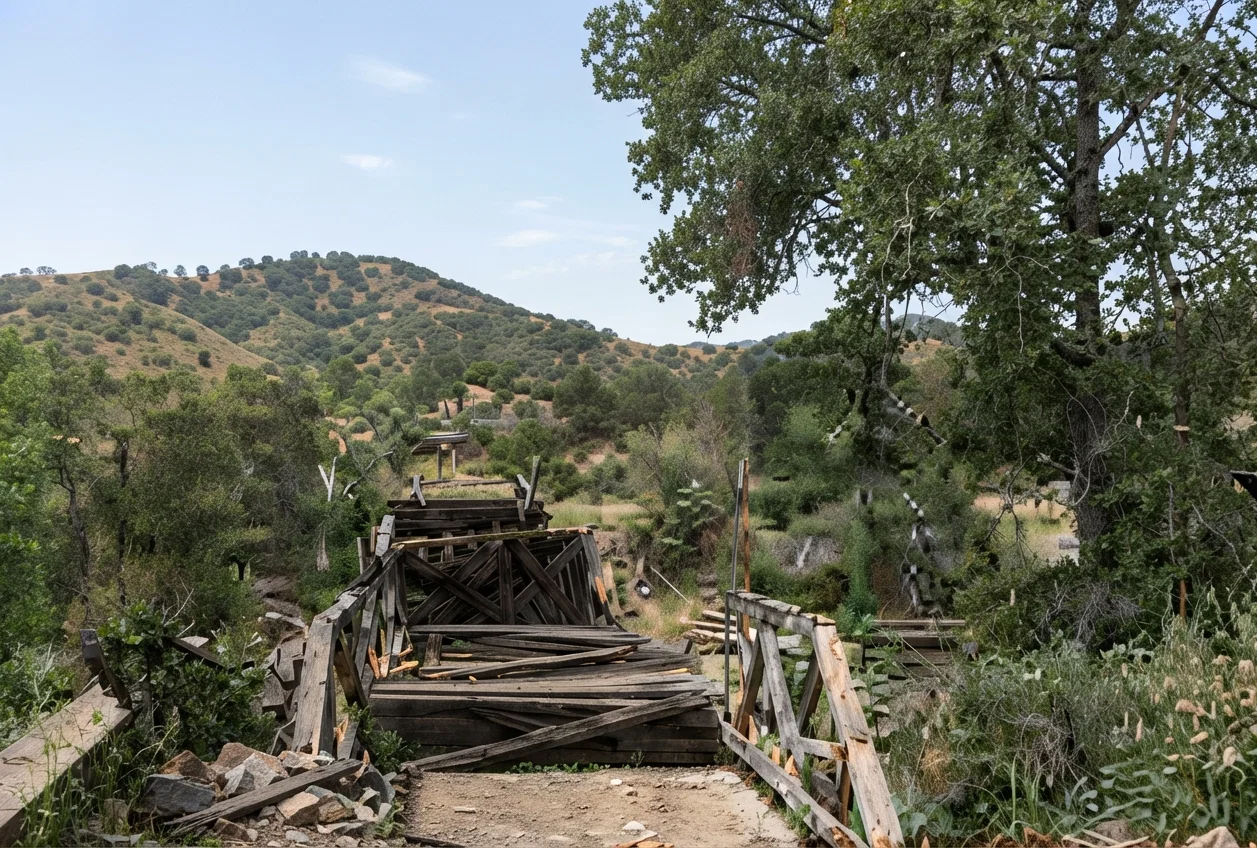
Ruins of a Bridge about Five Miles from Healdsburg. Caused by the Earthquake.
But these facts about steam are true only while there is still some water in the boiler—some water that is still ready to be turned into more steam. But when the water is all turned into steam, if the heat continues to be applied, it superheats the steam. It is well known that superheated steam suddenly takes on such great power that no boiler can hold it. Once let the water in a boiler get very low and no boiler can hold the force of the resultant superheated steam. The same heat that, applied to water, means perfect safety, applied to steam produces utter destruction.
And this is one of the great causes of earthquakes; possibly it is one of the most common.
We know only suggestions of the mighty forces that operate in nature. An inch-square bar of iron, ten feet long, if raised through eighty degrees of temperature, will expand about one-seventeenth of an inch, and if its expansion is opposed, will exert a pressure of twenty-five tons!
The mighty forces of expansion under heat are the power of dynamite and all similar explosives. And they are at least one of the forces that cause the earthquake.