I HAVE seen San Francisco in the heyday of her glory; I have seen her humbled in the ashes of her ruined homes. I have seen her people marching in pride and revelry through thronging thoroughfares; I have seen them hurrying out of the flames and smoke with the flotsam of their treasures in napkins and blankets. I have seen her people pandered to by liveried servants, or speeding in costly automobiles and luxurious palace cars for pleasure; and I have seen them tugging their earthly belongings in unwieldy trunks along the streets at the end of frayed ropes—not in pleasure, but in desperation, with blood-shot eyes and terror-stricken faces.
I have stood on Nob and Telegraph Hills, and looked over the thousands of acres of gilded wealth and tattered poverty, of princely palaces and hovels of misery, of massive churches and gilded palaces of lecherous sin; and now I have stood upon the great funeral pyre of all this conglomerate congestion of modern civilization, rubbed its whirling ashes from smarting eyes, and listened to the moaning of the winds through the wreck and ruin of it all. Other cities have passed from opulence to ash heaps in an age or a generation; but we are living rapidly today. San Francisco has become an acropolis, a parthenon, a Thebes, a stone henge, an Alhambra, altogether, in less than half a week. Here are the broken columns of ancient Grecian architecture; yonder are the crumbling ruins of the playhouses of some ancient Rome; there stand the trembling remains of some historic "Court of Lions," and we can almost see in the fleeing people some weeping Abbu Abdullah, sorrowing for a lost kingdom. What sorrows, what heart-breaks, what terrors, what separations, what terrible deaths, what serious lessons a great catastrophe like this can huddle into a few hours of time! and over it all we can see spread a deep mantle so like to Herculaneum and Pompeii.
We looked to the north, to the south, to the east, and to the west, and could see with the mind's eye in every one of those ten thousand acres of disaster the graves of thousands of cherished hopes. San Francisco had a number of populous cemeteries in her outskirts, and many funeral trains wended their ways to these every day of the week; but no such municipal cemetery as this one had ever before been beheld by this palsied world. The wealthy buried much; the poor in very many cases buried more—for they buried all.
Great buildings were not the only things the earthquake leveled; for the silk-clad and the rag-clad touched elbows in the doubling, winding bread-line, received milk from the same can, and waited hungrily for their slice of steak from the same round. The silk tile looked down on the grimy slouch hat while their wearers took bread from the same hand. The rich learned what it was to be hungry, and the poor learned that money can not shield its owner from sorrow and distress.
This earthquake was a great demolisher of false trusts and false hopes. Men and women had come to trust in their substantial residences, in the effectiveness of their fire-fighting apparatus, and gave little thought to the future, or to their eternal interests; but somewhere deep down in the earth arose the growl of an angry power that seemed to gather itself for an effort at ruin that would send the groan of dismay around the world. It gripped the whole gateway of this western empire in teeth stronger than iron or steel or stone, and shook the hills and the valleys, the cities and the waters of the sea—shook them as no living power can shake anything else that lives, and the fury seemed to grow with the very expenditure of its energy. Then it ceased, and flung down its victim; and O, what a ruin was there!
In no place in all this world, at no time in all its history, have human eyes ever looked upon such a scene as spreads itself out by the Golden Gate today. Go where you will, look in what direction you will, the eyes rest upon the splintered skeletons, the twisted ribs, and the staring, eyeless sockets of what were once creations of architectural beauty, and embodiments of wealth. Man spared nothing—not even truth and purity—to make it all it was; and the flames have spared nothing save that which they seemed to consider unworthy of their prowess.
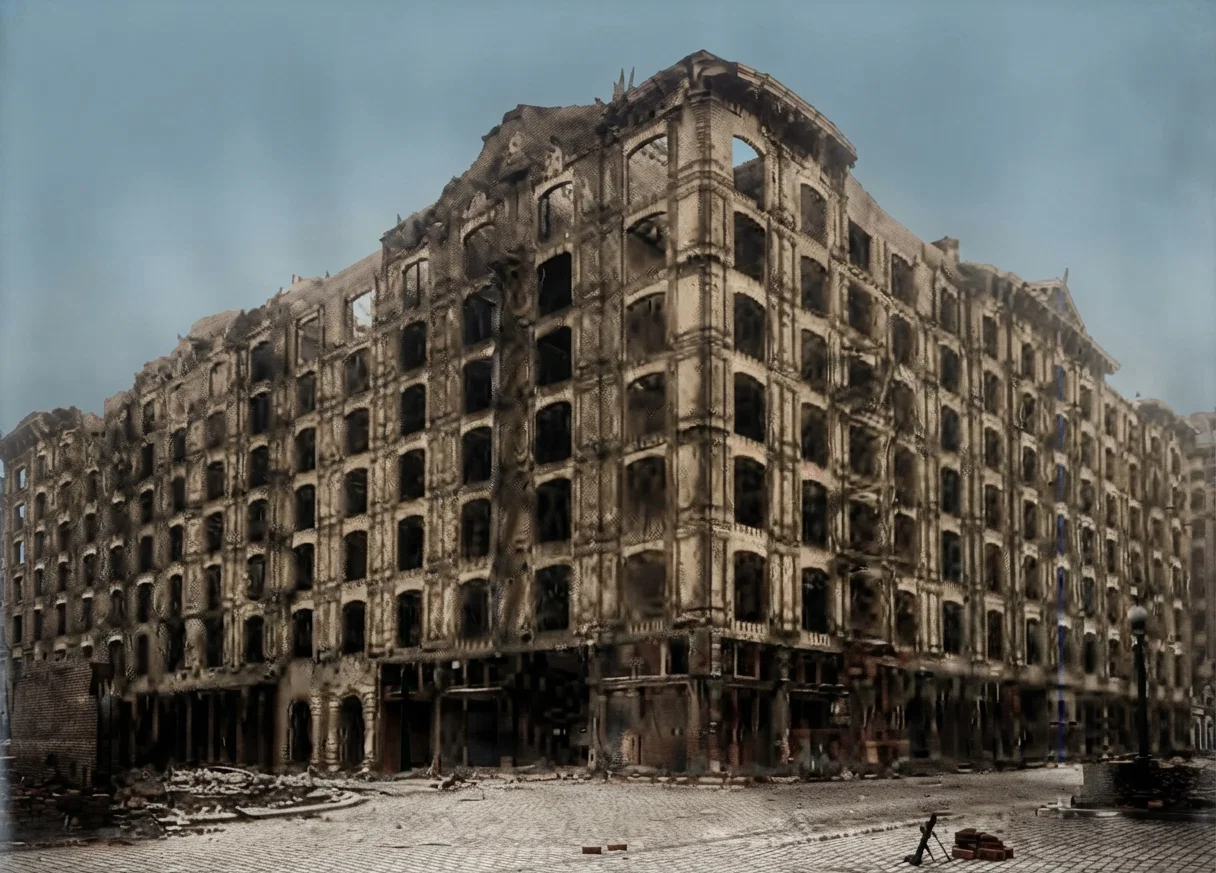
The Palace Hotel, one of the finest hotels in the world. Its register has carried the names of some of the greatest of earth's people who have passed through San Francisco. The building cost over $7,000,000, and over 30,000,000 bricks were used in its construction. Its massive walls, tied by strong bolts in every direction, withstood the earthquake shock and verified the words of the builder that "It could be shaken up, but could not be shaken down." But the fire destroyed its beauty, and left it a majestic ruin. It will be torn down, and a steel and cement structure built in its place. How uncertain are the grandest palaces of earth.
Year after year men piled block upon block, and column over keystone, riveted steel upon steel, and enfleshed the structures in stone and stucco; high as Babel's tower they builded; beautiful as the Alhambra they embellished; and then traveled to the ends of the earth to laud great San Francisco. But as quickly as a broom in the hands of a servant sweeps the cobwebs from a kitchen, so quickly did the besom of earthquake sweep San Francisco's beauty into her crumpled streets. In that instant the great arteries of her life were broken, and the water that would have saved her from the all-enveloping tongue of flame poured itself out in useless torrents upon the ground.
No one who has not seen it can ever realize what it is; no one who has yet seen it has been able to tell it to any one else so they can realize it. One who has known San Francisco in most of her stages of development said of it, " San Francisco is gone." Another says, " It was not a fire in San Francisco; it was a fire of San Francisco." This burning metropolis sent up a pillar of cloud by day, and a pillar of fire by night which could be seen for a hundred miles. One said, " I supposed, of course, that the matter was exaggerated." He looked upon the wreck and declared there were no words in the language by which an exaggeration could be produced. He had seen some of the ruins of ancient cities; but they could all be bundled into one corner of San Francisco's ruin and be lost. The areas covered by the great fires of Chicago, Boston, and Baltimore, would cover scarce one-half of the ash heaps of San Francisco.
In the calamity that has come to this fair country, man may learn, if he will, the utter worthlessness of human trust in the works of human hands. How many thousands have utterly forgotten God, and been putting their trust in their own powers. Souls are infinitely more valuable than dollars or buildings. I will not say that God sent the earthquake or the fire; but we do know He permitted them to come. Knowing that, it should be enough to show to every human being that there are lessons in them for him to take most seriously to heart. God does not willingly afflict, or permit to be afflicted, the children of men. He " is long-suffering to usward, not willing that any should perish."
Soul, have you learned the lesson? Have you allowed that earthquake to shake the tendrils of your heart free from the crumbling ruins of the false hopes to which they clung? Have you let those fires burn away every rootlet that has bound you to the world and the things of the world? If not, will it be necessary for a closer lesson to come? When God's " judgments are in the earth, the inhabitants of the world will learn righteousness." Are we learning it without the judgments? If so, well and good. If not, then let us not complain if God permits the judgments to come.
A day is coming wherein the " cities of the nations" shall fall; a day when not cities merely, but the very heavens, shall be on fire, and the elements " melt with fervent heat, the earth also, and the works that are therein shall be burned up." God has provided a refuge for His children in the days of these calamities. The child of God need not be fearful. Mountains may rise or fall; cities may shake down or burn up; all the elements may be at war; pestilence and famine may spread their devastating blight. But in it all, and through it all, the true child of God may rest and trust in the arms of the Almighty. Peace in the midst of turmoil; protection in the midst of calamity; trust in the midst of terrors—these are the portion of every soul that lives upon the Word of God, walks in His footsteps, and yields the heart and hand to His service.