THE following excerpts are taken from Mr. Fred Hewitt's article which appeared in the Examiner of April 20:
I was within a stone's throw of that City Hall when the hand of an avenging God fell upon San Francisco. The ground rose and fell like an ocean at ebb tide. Then came the crash. Tons upon tons upon tons of that mighty pile slid away from the steel framework and the destructiveness of that effort was terrific.
An Eternity.
It is impossible to judge the length of that shock. To me it seemed an eternity. I was thrown prone on my back and the pavement pulsated like a living thing. Around me the huge buildings, looming up more terrible because of the queer dance they were performing, wobbled and veered. Crash followed crash and resounded on all sides. Screeches rent the air as terrified humanity streamed out into the open in an agony of despair. Affrighted horses dashed headlong into ruin as they raced away in their abject fear.
Then there was a lull.
The most terrible was yet to come. The first portion of that shock was just a mild forerunner of what was to follow. The pause in the action of the earth's surface couldn't have been more than a fraction of a second. It was sufficient, however, to allow me to collect myself. In the center of two streets I arose to my feet. Then came the second and more terrific crash.
The street beds heaved in frightful fashion. The earth rocked, and then came the blow that wrecked San Francisco from bay shore to ocean beach, and from the Golden Gate to the end of the peninsula.
As if in sympathy for its immediate neighbor, the old Supreme Court building danced a frivolous frolic and then tumbled into the street.
The Second Upheaval
was heart-rending. It made me think of loved ones in different portions of the country. It turned my stomach, gave me a heartache that I will never forget, and caused me to sink upon my knees and pray to the Almighty God that me and mine should escape the awful fate I knew was coming to so many thousands.
Down Golden Gate Avenue the houses commenced again their fantastic, ogreish dancing. One long line of frame buildings tottered a moment and then, just as a score or more of terror-stricken, white-shirted humanity tried to reach the open, it laid flat. The cries of those who must have perished reached my ears, and I hope that never again this side of the grave will I hear such signals of agony.
I turned about from that point of view to shut out the terrible sight, but what went on on all sides seemed to be just a repetition of what I had already witnessed. Looking up Golden Gate Avenue, I saw tons and tons of brick and stone coping poise for a fraction of a second on beam end and then plunge into the street below. Then it was that the idea flashed through my mind that
God Is Merciful.
What would have been the loss of life had the Almighty allowed that earthquake to occur in mid-day?
Suddenly, as sharply and as abruptly as it had begun, the end of the temblor came. Ruin endeavored, it seemed, to outdo ruin. A world of structural work found resting-place on mother earth. Bent steel girders and huge blocks of decorative stones made their sleeping-place beside all this.
A cloud of deep dust hung tenaciously about the City Hall. I realized that there something dreadful had happened. As the wind carried the dust away and uncovered the ruins, there stood a mountain sheared of all its crowning glory. It could be fittingly compared with a mountain that had passed through a forest fire. The dome appeared like a huge bird-cage against the morning dawn. The upper works of the entire building laid peaceably—if that term can be used—in the street below.
After I had drawn myself together I found my way to my home, where, thank God, the wreck had not been as complete as many others I had witnessed. Then it was that I realized the condition of an excitement-crazed populace. Herds of huddled creatures, attired in next to nothing, occupied the center of the streets, not knowing what would happen next or which way they would turn for safety. Each and every person I saw was
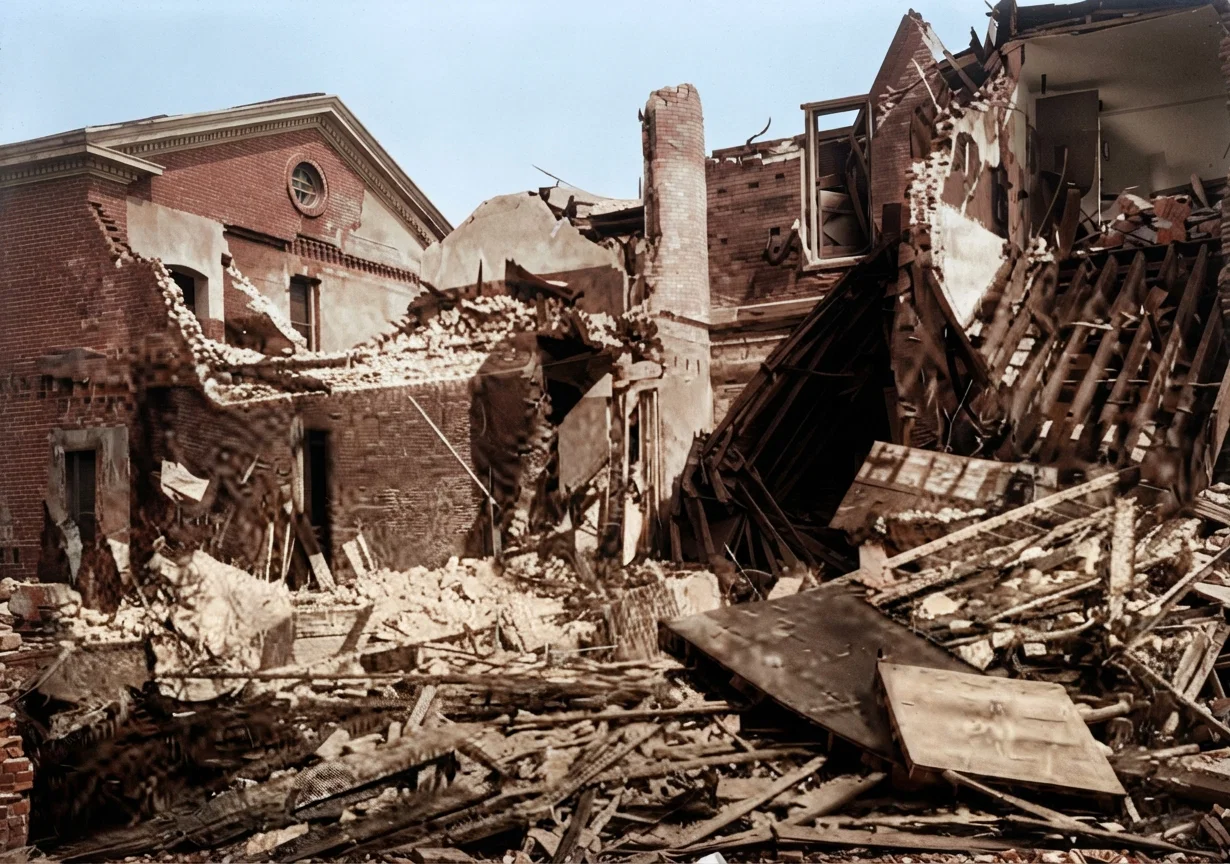
Agnews State Insane Asylum, near San Jose, showing the terrible power of the earthquake, and the utter collapse of the great building, in which 117 persons were killed. This structure was four stories, built of brick. One of the insane, a doctor, became sane.
Temporarily Insane.
Laughing idiots commented on the fun they were having. Terror marked their faces, and yet their voices indicated a certain enjoyment that maniacs have when they kill and gloat over their prey. Women, hysterical to an extreme point, cried and prayed for those they loved when they were standing at their elbow. Mothers searched madly for their children who had strayed, while little ones wailed for their protectors. It was bedlam.
Strong men bellowed like babies in their furor. All humanity within eyesight was suffering from palsy. No one knew which way to turn, when on all sides of them destruction stared them in the very eye. A number of slight tremors followed the first seven series of shocks. As each came in turn fearful
agony spread over the countenances of the afflicted ones. Terror stamped its mark on every brow.
Then an unnatural light dimmed the rising sun and the word went forth from every throat:
"The city is ablaze. We will all be burned. This must be
"The End of This Wicked World."
From down south of Market Street the glare grew and grew. The flames shot heavenward and licked the sky. It looked as if the end of the world was surely at hand.
For an hour or more after that terrible shock which shook the buildings of all San Francisco to the very foundations, people wandered about in an inane fashion. There was no attempt at concerted action to hold the sufferers. People were stupefied. And meanwhile the fire burned and burned.
THE EARTHQUAKE AND FIRE.
(From James Hopper's article in June Everybody's. Mr. Hopper is a member of the Call staff.)
Thus of the early morning hours before the earthquake:
As I passed a livery stable on Post Street between Powell and Mason Streets, a horse screamed with a sudden, shrill cry. I asked a stableman lolling in the darkened doorway what was the matter. "Restless to-night; don't know why," he answered. And
then, with my head poked in, I heard the thunder of a score of hoofs crashing in tattoo against the stalls.
The Earthquake.
Right away it was incredible—the violence of the quake. It started with a directness, a savage determination that left no doubt of its purpose. It pounced upon the earth as some sidereal bulldog, with a rattle of hungry eagerness. The earth was a rat, shaken, shaken, shaken, with periods of slight weariness followed by new bursts of vicious rage. As far as I can remember, my impressions were as follows: First, for a few seconds a feeling of incredulity, capped immediately with one of finality—of incredulity at the violence of the vibrations. "It's incredi-
ble, incredible"—I think I said it aloud. Then the feeling of finality. "It's the end—St. Pierre, Samoa, Vesuvius, Formosa, San Francisco—this is death."18
As I walked slowly down the street I was very busy taking notes for the paper. "Such and such number, such and such street, cornice down; this building, roof down; that building, crumbled." And then, I exclaimed to myself after a while, with childish peevishness, "I'm not going to take a list of all the buildings in the city!"
The Fire.
I started up Third Street. At Tehama Street I saw the beginning of the fire which was to sweep all the district south of Market Street. It was swirling up the narrow way with a sound that was almost a scream. Before it the humble population of the district were fleeing, and in its path, as far as I could see, frail shanties went down like card houses. And this marks the true character of the city's agony. Especially in the populous district south of Market Street, but also throughout the city, hundreds were pinned down by the débris, some to a merciful death, others to live hideous minutes. The
flames swept over them while the saved looked on impotently. Over the tragedy the fire threw its flaming mantle of hypocrisy, and the full extent of the holocaust will never be known, will remain ever a poignant mystery. . . .
We started first to cover the fire I had seen start on its westward course from Third Street. From that time, I have only a vague kaleidoscopic vision of whirring at whistling speed through a city damned. We tried to make the fallen Brunswick Hotel at Sixth and Folsom Streets. We could not make it. The scarlet steeplechaser beat us to it, and when we arrived, the crushed structure was only the base of one great flame that rose to heaven with a single twist. By that time we knew that the earthquake had been but a prologue, and that the tragedy was to be written in fire. We went westward to get the western limit of the blaze.
Passing Fifth Street, we caught, behind the flaming smother, a glimpse of the Mint, square, squat, like a rock in the flaming sea. Its iron windows were all closed; it brooded there, unmoved, inscrutable as a sphinx. Later we learned that behind those iron doors men had lived through the maelstrom of fire, had lived and fought and had saved the building. West of it, a long, white skyscraper towered, still untouched. It was never touched. I saw it a few days later, rising white, unsullied, above the surrounding desolation. I read its name and the tremendous irony of it staggered me. "The United Undertakers" was written into the granite above the door.
At Third Street we caught the starting-point of the fire. It had worked north as well as west, and the Call Building, the tallest skyscraper in the city, was glowing like a phosphorescent worm. Cataracts of pulverized fire poured out of the thousands and windows. The Examiner Building across the way was burning. The Palace Hotel, treasured perhaps above everything by San Franciscans, was smoking, but was still making a magnificent fight. To the east the fire had gone as far as Second Street. There it had leaped Market Street toward the north, and was roaring, a maelstrom of flame, through the wholesale district, before the southeastern breeze. We circled to the north, through the Latin quarter, picturesque in its ruins as it had been in life. I remember passing six dead horses under a pile of bricks on Washington Street. We went up toward the Hayes Valley district, in which heavy volumes of smoke announced another conflagration. In passing I stopped at the Neptune, where I had been at the time of the earthquake, five hours before. The fire had not yet reached it. I ran up to my room. A key was in the door. "Looters," I said to myself. I pushed open the door. Spick, span in his loose white clothing, Ah Wing, the Chinese chamber-man was making my bed. The room was swept, the plaster that had fallen was gathered in a heap in the hall, my clothes were all hanging in the closet, and he was putting a clean slip about my pillow. Coming out of the whirl of death and devastation, this piece of domestic fidelity absolutely flabber-gasted me. I closed the door upon it, and left on tip-toe as in the presence of some sacred rite. I'd like to see Ah Wing again. When the next morning, it struck me at last that it was time to take my things out, I wasn't able to get within fifteen blocks of the Neptune.
At seven o'clock the staffs of the Call and the Chronicle met for a conference in the editorial rooms of the Evening Bulletin. The pink glow of the fire, near by on three sides now, was the only light. The order given to the Chronicle men was: "The men of the Chronicle will meet at the Chronicle Building to-morrow at one o'clock, if there is any Chronicle." That given the Call was: "The men of the Call will meet at the Fairmont to-morrow at one o'clock, if there is any to-morrow." There was a to-morrow, but long before one o'clock the Chronicle was a gutted ruin, and the magnificent Fairmont, like a great Greek temple upon its hill, was blazing like a funeral pyre. . . .
All night the city burned with a copper glow, and all night the dynamite of the fire-fighters boomed at slow intervals, the pulse of the great city in its agony. When the sun rose, a red wafer behind clouds of smoke that were as crape, the tidal wave of flame had swept three-quarters of it. Nob Hill,
the Fairmont, the homes of the pioneer millionaires, Mark Hopkins', with its art treasures, were aglow, a ruby tiara upon the city. Before the irresistible advance, the people were fleeing toward the sea. For the third time the headquarters of the Government had been changed, this time to the North End Police Station. By eleven o'clock that was in danger, another exodus was made to Franklin Hall, on Fillmore Street, once suburb, now center.
I walked down Market Street late in the afternoon of the second day. It was as if I walked through a dead city, not a city recently dead, but one overcome by some cataclysm ages past, and dug out of its lava. Fragments of wall rose on all sides, columns twisted but solid in their warp, as if petrified in the midst of their writhing from the fiery ordeal. Across them a yellow smoke passed slowly. Above all, a heavy, brooding silence lay. And really there was nothing else. Contortion of stone, smoke of destruction, and a great silence—that was all.