I. JAPAN IN HISTORY

4%

Pacific Press Publishing Company · Mountain View, California · Nov 7, 1906

FromSigns of the Times, Vol. 32, No. 43.

Read the full edition

I. JAPAN IN HISTORY.

An Ancient Empire.
THE early history of the Japanese people, like that of many another nation, is lost in the fogs of ancient myths and uncertain traditions. Japanese accounts of the origin of the world differ somewhat, but agree that the world was at first ruled by Ama-terasu, the sun goddess. And Jimmu Tenno, the fifth in descent from this goddess, became the first ruler of Japan. The date of his accession is placed at 660 B. C.; but the sacred histories which contain these early records, date only from the early part of the eighth century, A. D. The Japanese claim that an unbroken line of rulers has descended from Jimmu Tenno, the present emperor being the one hundred twenty-second in order. This would make their dynasty the oldest in the world.
There is good evidence that many of the earlier monarchs of Japan were vigorous and able rulers. In the first century A. D., Yamato-da-ke subdued most of the aboriginal inhabitants of the north. In the third century the Empress Jingo is said to have conquered Korea; and her son, O-jin, is worshiped as Hachiman, the god of war. During the succeeding centuries the arts of peace were encouraged by various rulers. Intercourse with the Koreans led to the cultivation of literature and of the fine arts.
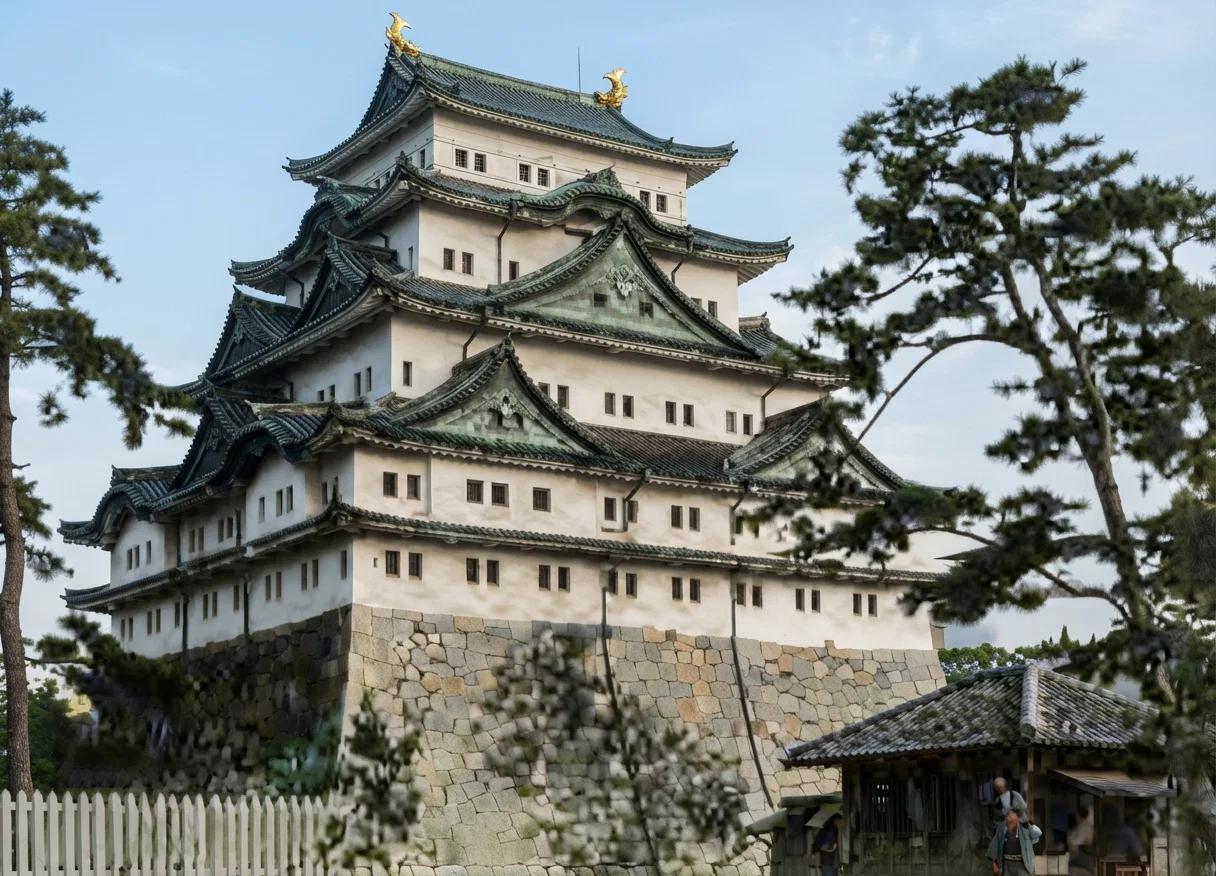
An Old Feudal Castle in Nagoya, Japan.

Emperors Lose Influence.

But the belief in the divine descent of the emperors was to exert a strong influence to lessen their power. This belief naturally led the people to regard their rulers with much reverence. Their persons came to be regarded as too sacred to be looked upon by the common people. Even high officials were allowed only a partial view of the Son of Heaven as he sat behind a screen. The result of this excessive reverence was that the emperors became virtual prisoners in their palaces at Kyoto, which became the capital near the close of the eighth century A. D.
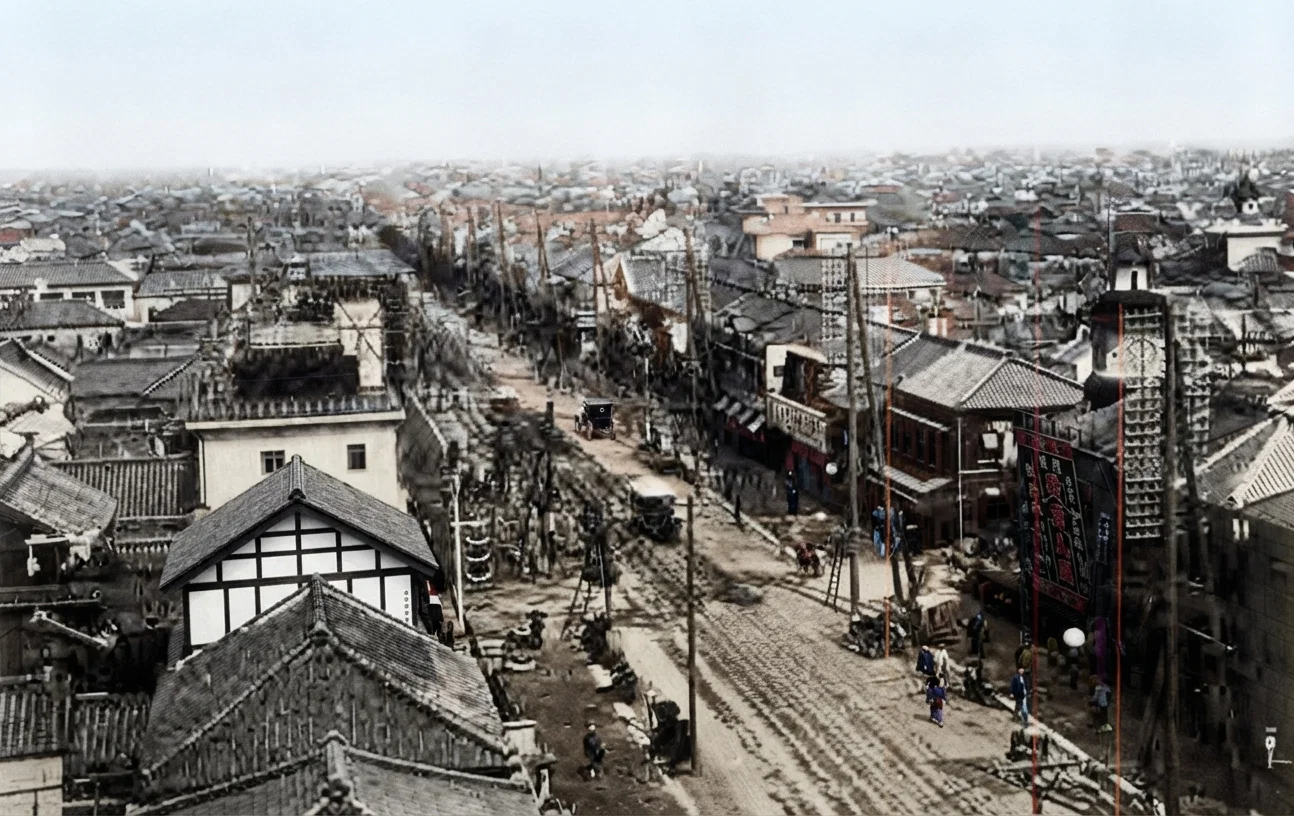
The Main Business Street of Tokyo, Japan.
This condition paved the way for the usurpation of power by the strongest and most popular military leader of the times. And so, just at the time when feudalism was developing in Europe, an almost exact counterpart was arising in Japan, altho there was absolutely no intercourse at that time between Europe and Japan. This period of Japan's history is full of tales of revolt, and of strife for supremacy. The rival families of the Fujiwara, Taira, Minamoto, and Hojo successively rose and fell. The military chieftain of the country finally came to be recognized as the virtual ruler of the country by the emperor, in whose name he ruled. Thus Yoritomo, the head of the Minamoto clan, became the recognized master of the country in the latter part of the twelfth century, and received from the emperor the title of shogun, or great general.
Yoritomo fixed the seat of his government at Kamakura, a few miles south of the present city of Yokohama. From this time the dual form of government became well established, and continued till the Restoration in 1868. At the death of Yoritomo in 1199, the power passed to the Hojo family, which retained it till 1333. Following this the Ashikaga family came into power, and governed the country till the latter part of the sixteenth century.

Three Noted Men.

At this time there arose three men, whose names are household words in Japan. The first of these was Nobunaga, who exercised all the power of a shogun, tho he never received that title. When Nobunaga was assassinated, his murder was avenged by Hideyoshi, the most powerful of his retainers. Hideyoshi was of very humble origin, but was a born leader of men with a genius for war. After securing himself in control of the whole country, he planned and partly executed an invasion of Korea. But his death in 1598 put an end to his ambitious schemes.
Hideyoshi left a son as his successor, and named Tokugawa Ieyasu, his most powerful retainer, as the young ruler's guardian. But suspicion and jealousy arose, civil war followed, and the widow and son of Hideyoshi were finally put to death. Tokugawa Ieyasu then received the title of shogun from the emperor; and this was the beginning of the Tokugawa line of shoguns, which continued for fifteen generations, from the year 1603 till the Restoration in 1868.
The period of the Tokugawa shogunate was one of peace and material prosperity. The genius of Ieyasu and his immediate successors brought the existing feudal system to its highest state of perfection, thus securing their position at the head of the government. Ieyasu removed the seat of his government to the little fortress town of Yeddo, which has since become Tokyo, the present capital of the country.

Why Isolated from the World.

With Hideyoshi and Ieyasu began that policy of seclusion which sealed Japan to the rest of the world for nearly three centuries. Historians are not fully agreed as to the reasons for the adoption of this policy; but it would seem that the suspicions of the rulers were aroused against foreigners by the arrogance and meddlesomeness of certain of the Roman Catholic missionaries; and possibly also by misrepresentations of the Dutch traders against the Portuguese. At any rate, one thing is clear, that the Japanese authorities feared that the foreigners intended finally to bring the whole country under their control.As results, there followed the persecution of Christians to the point of extermination, and the closing of the country to all foreign intercourse. Death was alike the penalty for adhering to the foreign religion, and for attempting to leave the country. The only Europeans allowed in the country were a few Dutch merchants, and they were confined to a small tract of land in the harbor of Nagasaki. And when this policy of seclusion was abandoned a few decades ago, Japan emerged at once from the feudalism of the Middle Ages into the full glare of nineteenth-century civilization.

Open to the World.

Altho the power of the Tokugawa shoguns was secured by every device that their genius could invent, there were some who never forgot that the emperor at Kyoto was the real source of authority. Various causes operated to bring this question to the front during the nineteenth century. Prominent among these was the effort of various foreign powers to secure the opening of Japan to the world commerce. In 1854, Commodore M. C. Perry, with a squadron of American war-ships, came to Japan, and secured a commercial treaty with the shogun's government at Yeddo. This treaty was entered into very reluctantly by the Japanese, as it were by compulsion; for they feared the foreigners' gunboats. And because the shogun did not secure the consent of the emperor to the treaty, the loyalists started an agitation for the overthrow of the shogunate, and the restoration of the emperor to his rightful position as the real ruler of the country.
The agitation continued for years, and resulted in much strife and bloodshed. Finally the young shogun Keiki was induced in 1867 to resign his position in favor of the emperor. Through dissatisfaction with the new government, he soon took up arms to regain his lost power. A short, sharp struggle ensued, in which the imperial forces were at last successful. So the year 1868 marks the beginning of the present era of Meiji, or Enlightened Reign.

More Modern History.

With the history of Japan during the last forty years, the intelligent reader is more or less familiar. The Japanese have proved that they are not naturally conservative and seclusive, as their long isolation might seem to indicate. On the contrary, they have appropriated with avidity the civilization of the Western nations. And in this they have shown that they are not mere slavish imitators, but that they are able, not only to imitate, but also to adapt the ways and means of other peoples to their own peculiar needs and conditions. Furthermore, during this modern period, Japan has developed men who rank high among the world's scientists and scholars.
But we sometimes hear it said that the new civilization of the Japanese is merely a veneer, an outside show that has not really affected the character of the people. What truth is there in such a claim? It is sufficient to observe that civilization of itself is entirely apart from morality and religion. Civilization alone does not refine and ennoble the character, or change the moral nature of mankind. Its refinements may render wrong doing more pleasing and less offensive; but the result is often to make sin more seductive.
The conclusion is that Japan, in common with all other nations in this sinful world, needs the everlasting Gospel of Jesus Christ to transform the hearts of her people. And we rejoice that Japan is now open to the messengers of the Gospel, and that souls are here being reclaimed from the innate barbarity that deforms the unregenerate heart in whatever nation. And may this good work go forward till the Lord of the harvest shall, at His coming, find many a precious sheaf to garner in these islands of the sea.
F. W. Field. Tokyo, Japan.