THREE and one-half millenniums ago Egypt ruled the world. Of all the kingdoms of earth she was the greatest. The world acknowledged her might and power and skill and wisdom in statecraft. Her river in its annual overflow fertilized her land and brought abundant substance, and she deified it as one of her gods. The sun joined with the river in producing food, and she worshiped the sun, from whom her kings received their title as the representative of the sun-god upon the throne of men.
AMONG the peoples that sought supplies from her granaries were the few descendants of a nomadic patriarch named Abraham. Only a few years before, one of the same people, a captive slave named Joseph, had taught Pharaoh how to store his grain in plenteous years, that he might become rich in time of famine. At the same time he instituted one of the best land-laws for Egypt the world has ever known, and the rental and the taxes combined were easy for the people. During the time while this truly great young man was prime minister to Pharaoh, Egypt prospered, and the people who lived in Egypt knew no oppression. Nay, more; as long as his memory lived among the rulers of Egypt he was honored, his laws governed, the country flourished, and the people prospered.
BUT a new dynasty arose. A king came to the throne who "knew not Joseph," Egypt's great prime minister of blessed memory, or his people who were in Egypt with him. The king of Egypt saw that people prospering in the province of Goshen. He coveted their property. He envied them in their prosperity. To check their growth, he subjected them to slavery under taskmasters. Finding this insufficient, he declared that all their male children under a certain age should be slain. This was not enough. Learning that their teachers were endeavoring to induce them to be faithful to the God of their fathers, and remember His creative power by observing His Sabbath, the king suppresses this, and lays upon them additional burdens so that they shall be compelled to desecrate their holy day or suffer corporal punishment.
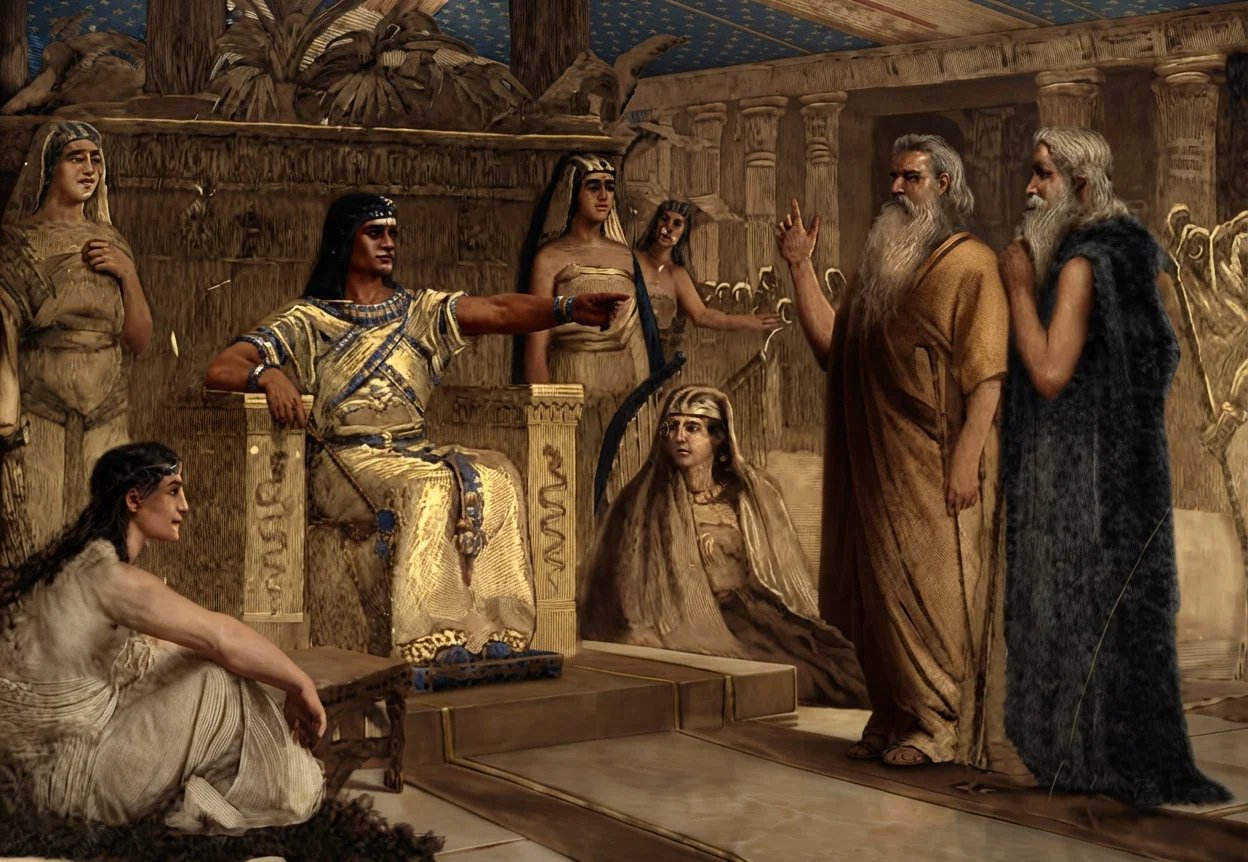
MOSES AND AARON BEFORE PHARAOH.
To the teachers he said, "Ye make them [the people] rest [literally, "sabbatize"] from their burdens." Of the people he said, "They are idle," therefore were they set to make bricks without furnished straw.
THE oppression could not go on forever. God sent His servants to Pharaoh with the reasonable request, "Thus saith Jehovah, the God of Israel, Let My people go that they may hold a feast unto Me in the wilderness." As tho He had said, "All these years Egypt has been enriched by Israel. During all this time you have worshiped as you will your multitude of gods with multiplied ceremonies. This people desire but to worship the One God. You will not let them do it here; they will go into the wilderness to do it. They will keep the simple feast apart from Egypt." If Pharaoh had yielded to that reasonable request, great blessing would have come to him. He would have enjoyed part emancipation from the fearful system of idolatry which held him in thrall.
PHARAOH refused, and pressed the burdens heavier. He proudly declared, "I know not Jehovah, and moreover I will not let Israel go." Jehovah is kind. He would save the king; He would save His people. Therefore He wrought miracles before Pharaoh, and the king's servants seemed to duplicate them, and the ruler's heart was made obstinate. The river is turned to blood, and Pharaoh's god demonstrated to be nothing, but he digs wells and finds water to drink, and again hardens his heart. Once more the man of God comes with the reasonable request, "Thus saith Jehovah, Let My people go, that they may serve Me." Ex. 8:1. Then comes the warning, repeated subsequently again and again, that if Pharaoh refused to let Israel go, all the gods of Egypt and all their worshipers would be humbled. But the king made stubborn his heart, and refused the request.
NOTE always the reasonable request of Jehovah, the Creator, to Pharaoh, the creature, and to all the kings of the earth, for all time, "Let My people go that they may serve Me." Not that God would compel their service, but that they would be able to render free service. No ruler on earth, no religion on earth, pagan or Christian, papal or Protestant, has the right to bind one single soul in bondage. Nor council, nor consistory, nor presbytery, nor conference has the right to throw about one single soul that which will fetter him in his worship or non-worship of God. Let the soul go that he may, if he will, worship. That soul is responsible to God alone. God created him. God redeemed him. To God he belongs. But God made the soul free to choose. Around him He placed the sacred circle of choice that even Deity will4not enter to compel. "Choose ye" is God's message to human souls. Leave them free to choose is His message to the rulers and oppressors of people.
God longed that Pharaoh should learn to know Him by the manifestations of His love, His reasonableness, His power. He longs that all rulers shall learn that "the Most High ruleth in the kingdom of men." He will permit the working out of evil's seed-sowing; He will show the utter powerlessness of the gods which men worship whether carved in gold or wood or stone, whether written in constitutions and laws, whether built into fine houses, or written in stocks or bonds, whether transcribed in creeds or dogmas. Not one must touch the conscience, and Jehovah will show them all to be powerless to make men better or fetter the conscience. If men still refuse to know Him and identify themselves with their golds and their sin, the plagues of God's just wrath, of which Egypt was the type, will devour them, as Egypt's king was destroyed in the Red Sea. That lesson of three and one-half millennia ago is God's lesson to rulers to-day.