THE success of Japan in the recent war, both on land and sea, has been quite phenomenal; and various opinions have been expressed by those who have sought to account for this success. Some writers, seeking support for a favorite theory, have given undue importance to those features of the case that seemed in harmony with their theory. An unbiased view will bring to light several causes that together account for the excellence of the Japanese arms.
Prominent among these is the intense patriotism of the Japanese people, which has its origin in the earliest traditions of the nations. Their emperor is unlike any other ruler in the world, in that he is descended from the gods; and hence rules, not simply by "divine right," but by divine descent. Loyalty and obedience to the emperor are instilled into the minds of children from their earliest years. With a great many of the people, the emperor is put in the place of God in the minds of their children. As Christian parents teach their children that they must live to please the Lord, who created them, so Japanese children are taught that they must live to please the emperor. This is the incentive placed before Japanese boys and girls to restrain them when they are naughty, and to encourage them in right ways.
One result of this early education is that the boys are miniature soldiers from the time they can toddle about. Swords, guns, drums, and flags are favorite toys, and military movements enter largely into their play. This line of education is continued in the public schools; and ere the boy has become a man, he has no higher ideal than to be a soldier, and fight for his emperor and his country, should occasion require. And when war actually does ensue, the soldier who goes to the front, to all intents and purposes actually gives his life for the emperor and the country. As another has tersely expressed it, "He goes into service determined that, if even the smallest good to his emperor can result, he will die willingly and gladly."
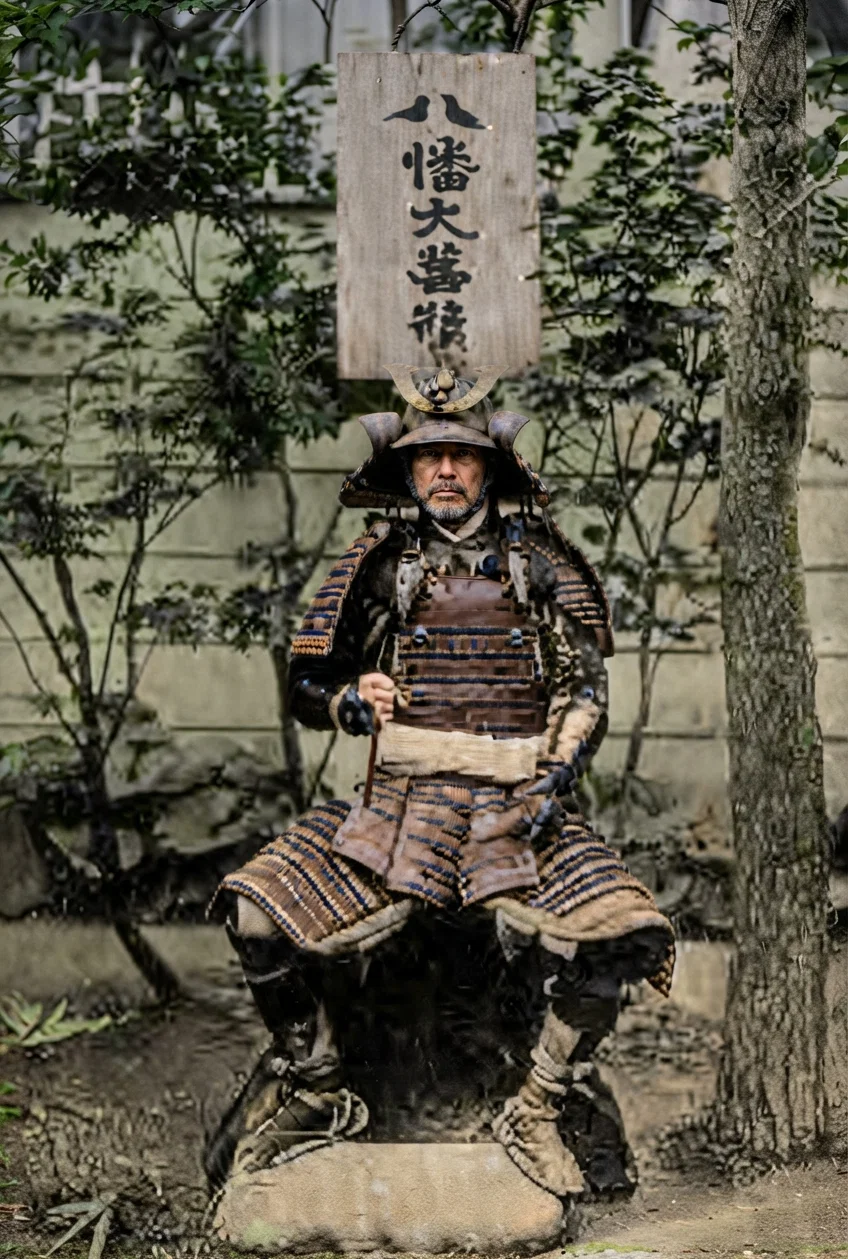
Warrior in Ancient Armor.
With an understanding of this ideal of the Japanese mind, it is not so difficult to appreciate the reckless daring shown in such actions as the frontal attacks on Nanshan Hill, where whole battalions were swept away. Yes, such intense patriotism certainly does make good soldiers, as the world reckons. Would that the soldiers of the cross were always equally brave and self-sacrificing.
But an efficient soldier, be he ever so patriotic, must have the physical stamina that will enable him to endure the hardships and privations of war. And the Japanese soldier has shown himself to be not wanting in this respect. To what causes or conditions does he owe his fine physique and great endurance? It is to the answer of this question especially that writers with theories to support have addressed themselves. One finds an answer in the vegetarian diet of the Japanese. Another in ju-jit-su, a peculiar system of physical training, in which the Japanese excel. It is granted that a vegetarian diet is ideal; and that the Japanese have a fine system of physical training. But it would seem that some have built large conclusions on a somewhat narrow foundation of facts.
It is true that the rations of the Japanese soldiers consisted largely of rice, and that very little animal food was furnished them. But boiled rice was not the whole staff of the soldier’s life. Large quantities of a kind of hard-tack were also used. These biscuits are made of wheat flour, sweetened a little, and contain a few oily sessamum seeds. The results prove that an army can be maintained on a practically vegetarian diet. But it seems too much to claim that this is the principal cause of Japan’s success in the war; or to conclude that the Japanese as a nation possess an ideal dietary.
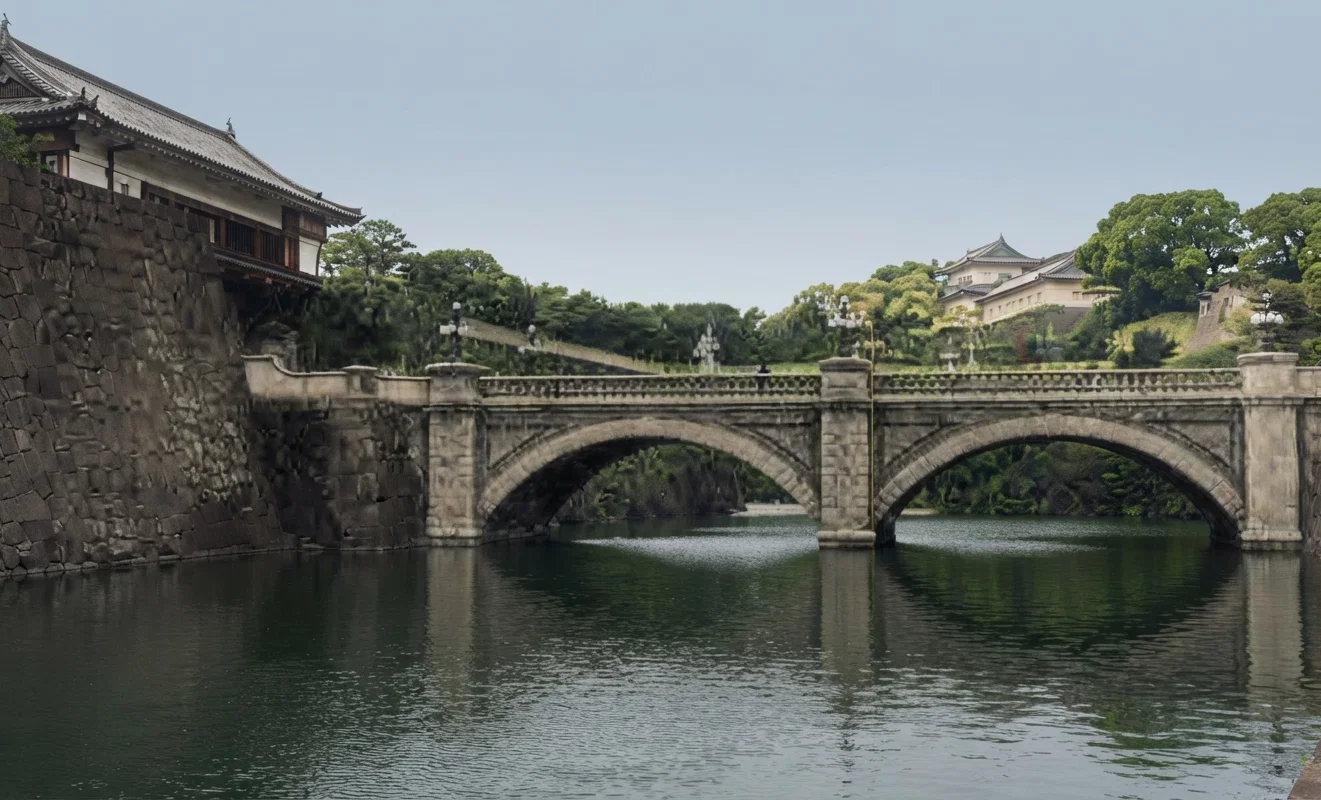
Entrance to Imperial Residence, Tokyo.
If the Japanese are to any extent vegetarians, it is by compulsion and not from principle. The country is so nearly devoid of natural pasturage that one may travel for hundreds of miles without seeing a single herd of cattle or flock of sheep. The bright green herbage covering the hillsides is found to consist largely of bamboo grass, so tough and siliceous as to be wholly unfit for fodder. So the few cattle found are used as beasts of burden, and sheep are practically unknown. But while mutton and beef are scarce and dear, the waters by which the country is surrounded yield an abundance of fish. And almost every living thing in the sea is used for food, from the whale and shark, to the mollusk, squid, and devil-fish. And yet even fish is comparatively so expensive, that most people use but little.
A word further concerning the diet of the common people of Japan will not be out of order. It is well recognized that even a vegetarian diet may be deficient in nutriment, or the food may be poorly prepared, or improperly eaten. For example, the dietary of the Japanese is almost entirely lacking in bread stuffs that require thorough mastication. Rice, their "staff of life," is simply boiled in water; and this, with other food quite as soft, is very hastily eaten. Ten minutes, or even five, is a common period for the eating of an ordinary meal. After observing the dietetic habits of the people, one is not surprised to learn that fully seventy per cent of them have some form of stomach trouble.13In view of these facts it seems more reasonable to conclude that the physical efficiency of the Japanese soldiers is due rather to the care with which the men are chosen, and then provided for while in service. There is a strict conscript law in Japan; and whether in war or peace, every young man, upon reaching the age of twenty, must take an examination for the military service. By this means the Japanese army is composed of the very flower of the country so far as physical fitness goes. The addition to the soldiers' bill of fare of the hard-tack already mentioned would supply one deficiency in the ordinary diet of the people. And it must not be supposed that the Japanese would be averse to the use of meat in the army, as far as they might be able to supply it. It would be interesting to know what use was made of a cargo of 9,500 barrels of corned beef that was confiscated while en route to Vladivostok during the war.
As to training in the art of ju-jit-su, I have it on good authority that not more than one Japanese in thirty or forty is so trained. Under the old feudal regime every samurai was versed in the art. At present it forms no part of a soldier's training. But policemen generally learn the art, and practise it as occasion requires.
A correct estimate of the Japanese army can not fail to take account of the masterful way in which the Japanese military authorities have taken advantage of everything that is known of the science of war. Much might be said on this subject, but the whole history of the war bears testimony. It may be sufficient to notice the remarkable results of the measures taken for the care of the soldiers' health. The statistics of the war show that the number of killed and wounded exceeded the number thrown out of action by disease. This is recognized by all military experts as a very remarkable and unprecedented record.
Thus the secular historian studies and weighs the various events of human history, and seeks for their causes. But, too often, no account is taken of the Power behind these earthly scenes. But the eye of faith sees an omnipotent Hand directing and restraining amid all the confusion and apparent uncertainty of results. It is still true that 'the Most High ruleth in the kingdom of men, and giveth it to whomsoever He will.' With Russia restrained in her unscrupulous aggressive policy in the far East, and with her borders torn by internal strife, let us hope that there will come out of this chastisement a greater degree of civil and religious liberty, that the closing message of the everlasting Gospel may speedily be carried to her people.
The student of prophecy sees also, in the unexpected conclusion of peace, the controlling hand of God. The circumstances seemed very unfavorable for an early close of the war; and when peace was finally concluded, it came as a surprise to the whole world. We see in this another evidence that the angels are still holding the winds of war till the work of God is accomplished in the earth.
But the final struggle will not be much longer deferred. The prophecy of Joel is being fulfilled, as it is written: 'Proclaim ye this among the Gentiles: Prepare war, wake up the mighty men, let all the men of war draw near; let them come up. Beat your plowshares into swords, and your pruning-hooks into spears; let the weak say, I am strong. Assemble yourselves, and come, all ye heathen, and gather yourselves together round about; thither cause thy mighty ones to come down, O Lord.' Joel 3:9-11. The rise of Japan as a military power is one of the wonders of modern times. And now China, profiting by the example and success of her island neighbor, is beginning to arouse, and will doubtless be ready to take an important part in the coming conflict long foretold. But it is not merely 'the yellow peril' that threatens the peace of the world. There is anger and distress of nations, with perplexity, the world over. And all these things are but signs of the soon coming of Him whose right it is to reign. And when the kingdoms of this world become the kingdoms of our Lord and of His Christ, then shall be ushered in the everlasting reign of peace and righteousness. 'Even so, come, Lord Jesus.'