MEN may think themselves very religious by reason of their sincerity in holding beliefs, and because they say a lot of prayers regularly, but when disaster overtakes them they usually fail to learn the lesson intended because they are unteachable. There are moral or rather immoral causes of all conflagrations and calamities. We should learn to shun the infected localities when it is not possible to purify them. By immoral is not here meant lascivious, but out of harmony with the One Divine Power of Wisdom, i. e., "God."
If sickness invades a family, poverty overtakes a person, flames destroy his dwelling, robbers invade his premises, or bunco-men deceive him and take away his possessions, such immorality or inharmony with the everywhere Ruling Power has previously entered. Sickness, poverty, flames, or calamity can not possibly overtake him in whom Divine Harmony has perfected Wisdom, for Wisdom can foresee and avert them.
Silly men, forgetful of Divine Wisdom, make to themselves a mental picture or concept which they label "God;" they pray to it to violate natural law, crowd children into believing their own errors, and in some colleges, boys are forced to listen to their idolatrous prayers. Vainly do they imagine that thereby they can escape the penalties of violated law and of forgetfulness to pursue Wisdom as the sole guide of life. In these circumstances, a wave of sectarian narrowness, a deadening spirit of carelessness, a chronic flow of incaution, a lack of foresight, settles down like a San Francisco fog over all their faculties, and utilizes a score of means for producing a terrible calamity. This was the case with our doomed city where everybody could recognize the contributing causes of the disaster. But I shall exhibit them in a pious college community free from saloons, from brothels, and gross immoralities. An enormous aggregation of stupefying forces may be operative in conjunction with ceremonial observances and incorrect beliefs and mental deficiencies. Please observe how the following facts illustrate the foregoing statements:
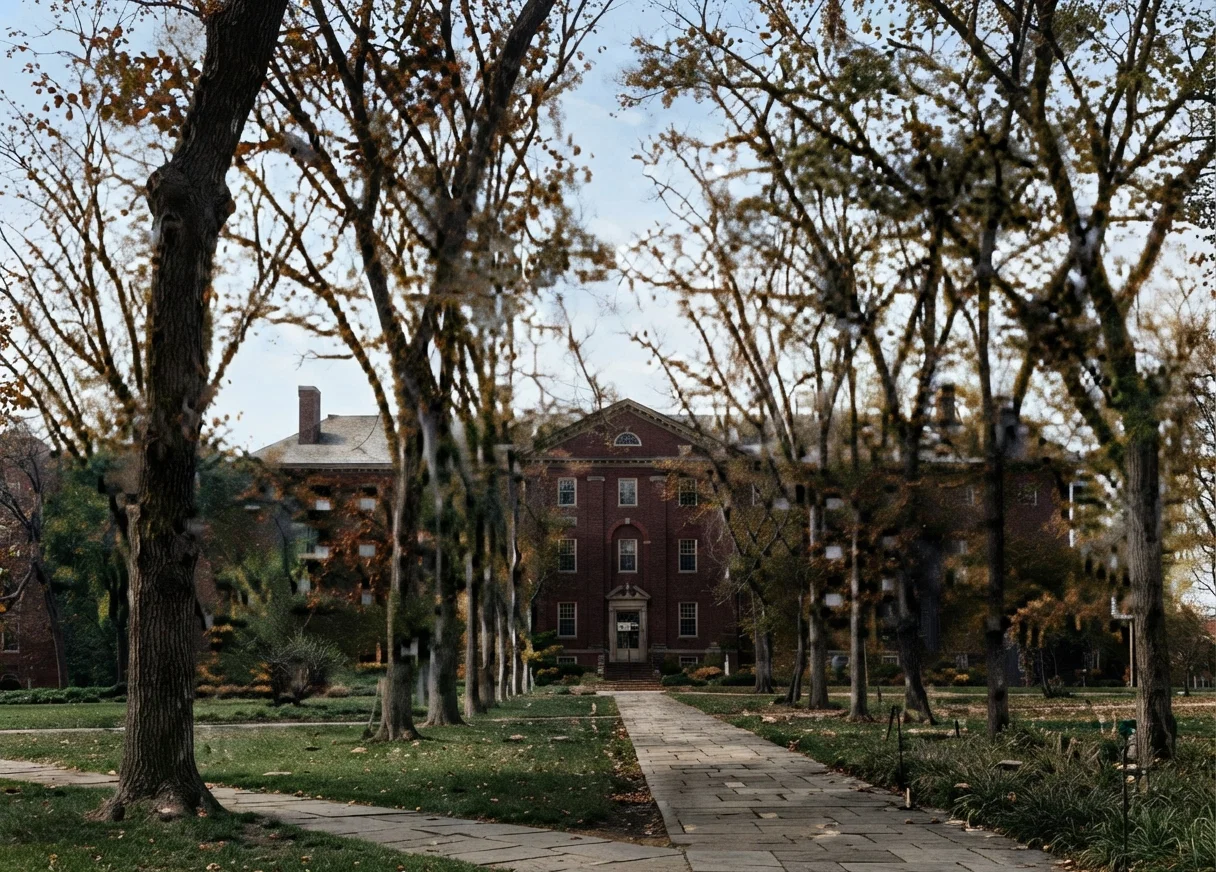
On a hill overlooking the town stood a stone building, four stories in height, with a front of about 150 feet and a depth of about 50 feet. Its value was $85,000. It contained sixty-four rooms and housed eighty-five college men. Of these, half were freshmen and the remainder were non-fraternity upper-class men. Fire-proof partitions separated the second, third, and fourth stories into three equal sections. Over the whole was one large attic of well-seasoned combustibles. The brick partitions did not, as they should have done, extend up through the roof. In that case, either section could burn separately.8The attic gable over the front entrance contained a small room with its double window opening to the east. This construction increased the attic woodwork. This room had been for many years rented by the college authorities to a coterie of seniors for
a class society. They blinded the window to such an extent that fire or light in the room could not reveal itself outside. They barred its entrance with a metal door which could not be broken down even if smoke was seen issuing around its joints. They met there every Wednesday evening to smoke, discuss college politics, and to plan to secure for their members as many class-day honors as possible.
North College, East Front.
On the last night of February, 1906, when the thermometer registered far below freezing, they occupied their room with pipes, cigars, and cigarets until about 10:30. About 12:00 o'clock three students who roomed on the fourth floor right under the attic room detected the odor of smoke. One man, and later another, J and C, looked into the halls, out of the window, felt the plastering, and found nothing. They all knew, theoretically at least, that Wednesday was the evening for a smoker in the attic overhead, but neither of them thought to hunt up a senior who could examine the attic room. Matters rested an hour. The odor continuing, V made a tour of the lower floors, went outside the building, glanced at the various windows, including the blinded attic window, and found nothing.
Another hour passed, when, a little before 2 A. M., the three heard crackling of flames and saw smoke coming down from the ceiling of their room. They found then that they could not get into the attic. The occupants of the building were awakened, and the city fire department telephoned to. One company started out with a hose-cart to climb the hill. Meanwhile, smoke poured out around the metal door which was not opened until a certain senior could be found. Buckets of water were thrown on flames that had already eaten out of the room into the attic.
For many years, off and on, the students of this sectarian, "praying," college had amused themselves with creating bon-fires and false alarms to summon the firemen up that long hill. Many execrations had been uttered by the fire laddies. Tho officially called over the telephone, only one hose-reel was started out at once. I venture that in the freezing cold and blustering night they did not exhaust themselves in climbing the hill. Later, a general alarm brought other apparatus, but no steam fire-engines. The city depended on a high pressure service, which, in the city proper, was theoretically sufficient.
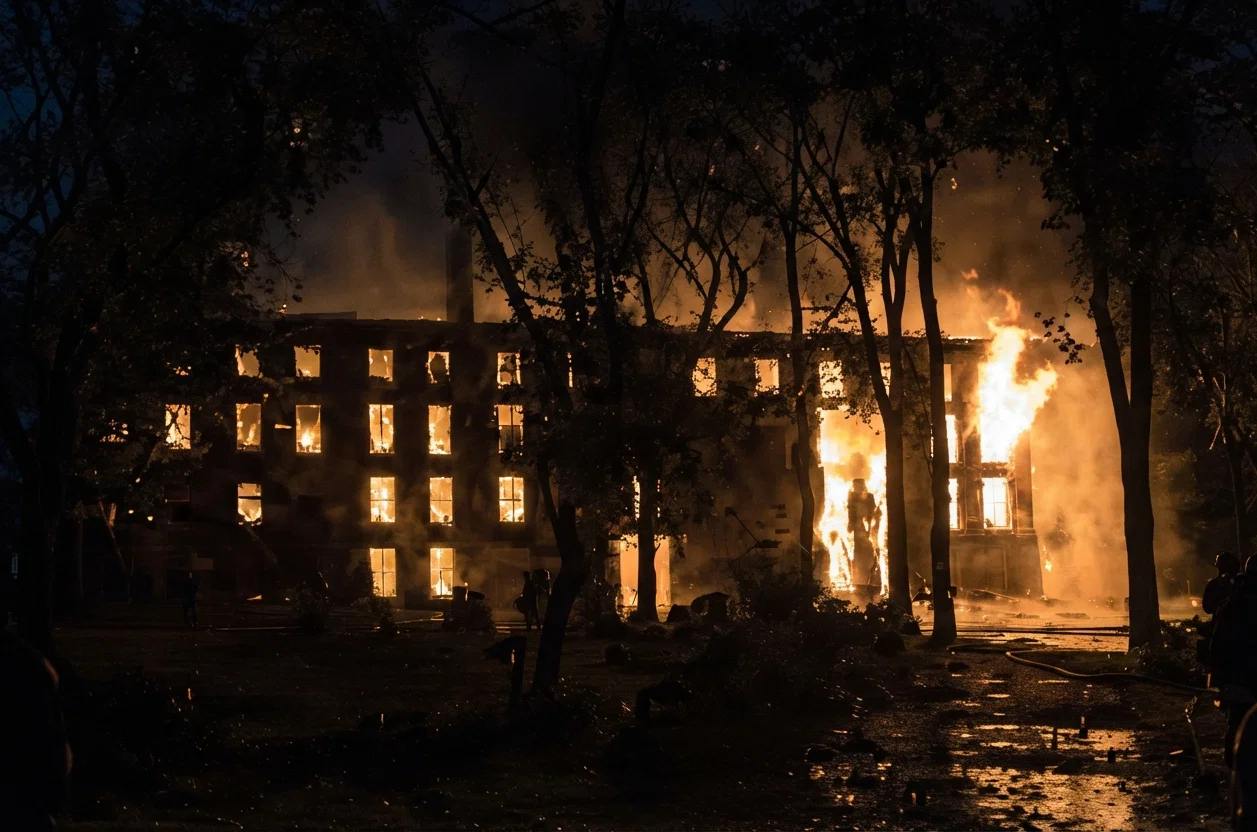
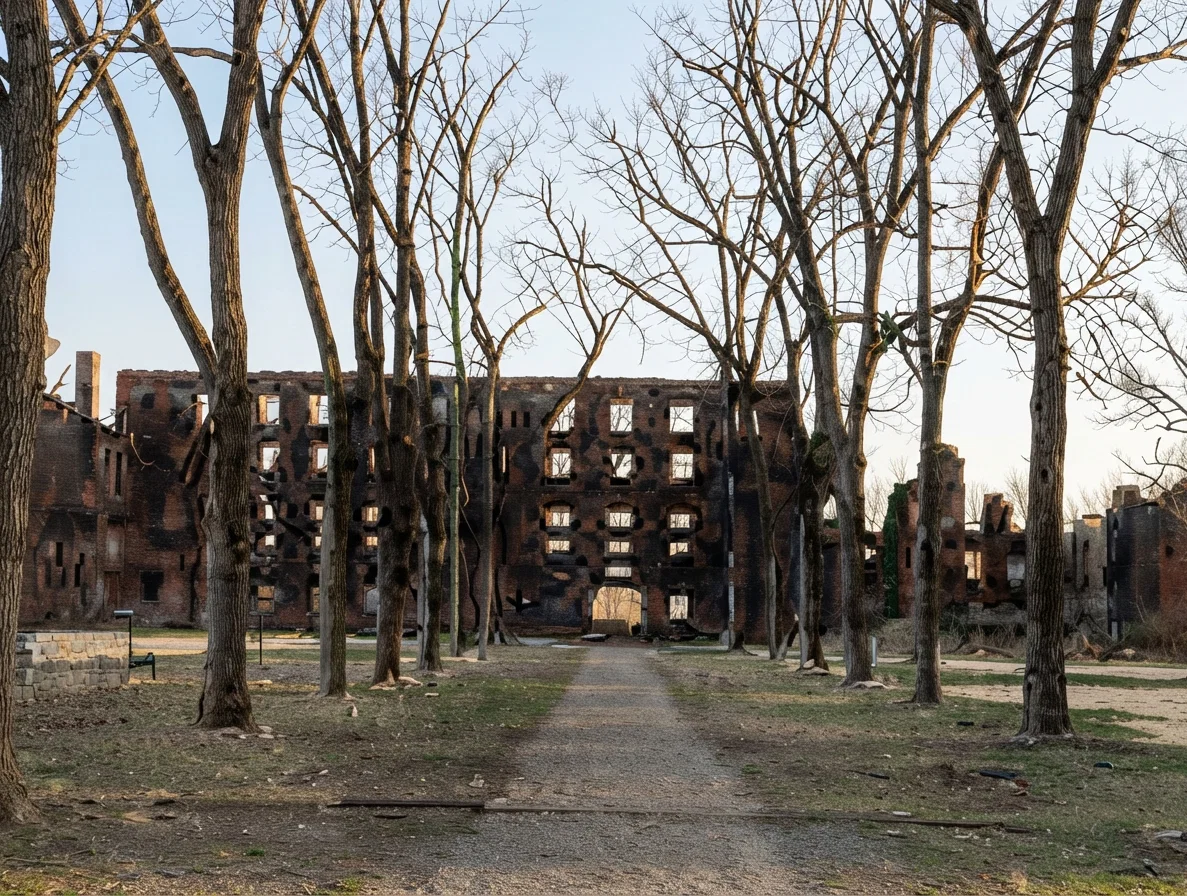
When hose had been carried to the fourth floor, there was not enough water pressure to render effective service. Some brick walls were pierced in a hope to reach the flames, but this only gave draught to increase them and to admit them to other sections of the structure. The increasing smoke soon drove everybody down from the upper floor and the whole attic blazed furiously. By degrees, the flames ate their way down to the very ground and consumed everything but the stone walls and fallen bricks. Most of the students were able to move their books and clothes out upon the campus where the blizzard atmosphere froze the very moisture of their breaths.
When insurance money was asked for, a funny surprise awaited these incredulous people. They had paid premiums on more than the value of this building, but instead of an itemized insurance on each building, they had been led to pay for a blanket insurance on all the buildings and their contents. The insurance welchers would pay only a pro rata upon the whole. This came to but $35,000 when $85,000 was expected, making a net loss of $50,000.
A janitor had occupied two rooms in this building for forty-two years, and well knew that the pressure of the city water was at times so low that water could not run at a sink on the fourth floor. Twenty feet from the building, there used to be a well from which water could be thrown by a force pump, but stupidity had filled it up to prevent sophomores from ducking the unruly freshmen.
East Front, 4 A. M., March 1, on Fire.
A professor had occupied a room in this building for thirty-nine years, but he never troubled himself about what went on in the attic any more than did the janitor.
With the building in ashes, they all stood around and commented on how one thing after another all went wrong; how some devil had arranged a hundred untoward circumstances, while men had not arranged one single circumstance for meeting such a contingency. In such a case the demon spirits had it all their own way. If we had only examined the attic when we first smelled smoke, said the three students. If I had looked after those smokers, said the janitor. If I had forbidden blinding the attic window, said the president. If there had been more water, said the firemen. If the insurance companies had not gulled us, said the local trustees. If the boys were not cigaret suckers, said the faculty wives. If God had not made the devil, said old professor R. If president C had not set the example of smoking in number 24, said an elderly graduate.
But what shall we say of the inexpressible stupidity of them all; of the president permitting cigaret-suckers to blind and bar the tinder-box; of the seniors habituated to throw cigaret stubs into waste paper baskets, sawdust spittoons, or corners full of dust and cobwebs; what of a janitor enriched with forty-two years' salary for neglect; what of three boys smelling smoke for two hours before they found it; what of local trustees, unmindful of every precaution; what of a city possessed of not one solitary steam fire-engine; what of students crazed over murderous or scandalous football, but oblivious to their own safety; what of the compulsory chapel attendance in lieu of a proper fire-drill; what of the value of constant stuffing of the memory to the destruction of intuition; what of the whole atmosphere of such an establishment?
At the very time a committee of professors was out begging more money when they did not know enough to protect what they had. They were complaining of small salaries and declaring, "We must have more money." Some of them had already drawn a hundred thousand dollars in salaries. Professing to be Christians, they were "conformed to the world." Preachers, they did not practise nor earnestly seek wisdom. Religious, their religion related only to post-mortem examinations. Full of belief in sectarian creeds, they would snub or persecute those whom they had first labeled as disloyal to their ideas.
We can only say that no religion is of value except as it produces wisdom, and that the entire crowd that witnessed that fire was devoid of wisdom. There is no wisdom apart from complete self abnegation, and this is not an easy matter. But he who has wisdom can foresee all these contributory factors to a calamity and can thus avoid the calamity. God imparts blessings, not in response to said "prayers," but through the mediumship of wisdom. He who will not comply with the laws of the acquirement of wisdom can not avert calamity. There is a kind of prayer which creates wisdom.
Ruins East Front, March 12.
If for four years a boy is kept in such a college, it matters not how many of other men's ideas he memorizes out of books, if he has the acquaintance of such a set of taskmasters called professors only for politeness' sake, if he acquires the false ideas of education there exhibited, he will be the worse and not the better for his course. He will not even find out what wisdom is in the9four years, and had better have worked on a farm. The way to wisdom is through learning, impregnated with a knowledge of God which is not taught from text-books. This knowledge is not of a theoretical deity, not a matter of speculative belief, but a very rare experience which such college professors and students will not pay the price of. Hence, these calamities are to them unavoidable accidents, or mysterious dispensations of Providence.
There is nothing in the way of calamity or even of sickness that can not be explained by wisdom that is available to every human being. A teacher of religion who is not a teacher of the practical pathway to wisdom is unworthy of a place either in church or in college. All these matters can be explained more fully but space does not here permit.
CHAS. W. SMILEY, A. M.
Berkeley, Cal., Oct. 31, 1906.