The Sabbath Question

6%

Pacific Press Publishing Company · Mountain View, California · Dec 12, 1906

FromSigns of the Times, Vol. 32, No. 48.

Read the full edition

The Sabbath Question

The great religious question of the day, burke it as men will, is the Sabbath question.
The question is not merely a question between two days of twenty-four hours each; it is a question between the living Word of God and dead human tradition.
The question is more than this. It is a question between evolution and creation; between a long process of education and the regenerating power of God. Evolution destroys the dying sinner's hope.
God's creative power, of which the Sabbath is a sign, a memorial, is filled with present help to the weakest.
Therefore, the question of the Sabbath is all-important to every soul. The great distinctive mark of the true God, the one attribute which the Bible ever sets before us, in contrasting Him with false gods, is His creative power. "All the gods of the nations are idols; but the Lord made the heavens." Ps. 96:5. See Jer. 10:10, 12; Acts 14:15; 17:24-26; Isaiah 40; Rev. 14:6, 7. The good tidings which God sends the world is that the power of God manifest in creation is the power which is manifest in salvation. He who knows it in his life can truly say: "I am not ashamed of the Gospel of Christ; for it is the power of God unto salvation, to every one that believeth. . . . For therein is the righteousness of God revealed from faith to faith." For all this God's Sabbath stands; it is the mark, the seal, of His covenant love and saving power. It asks no other place in this world than the hearts of those whom God has regenerated. None other can observe the holy day.
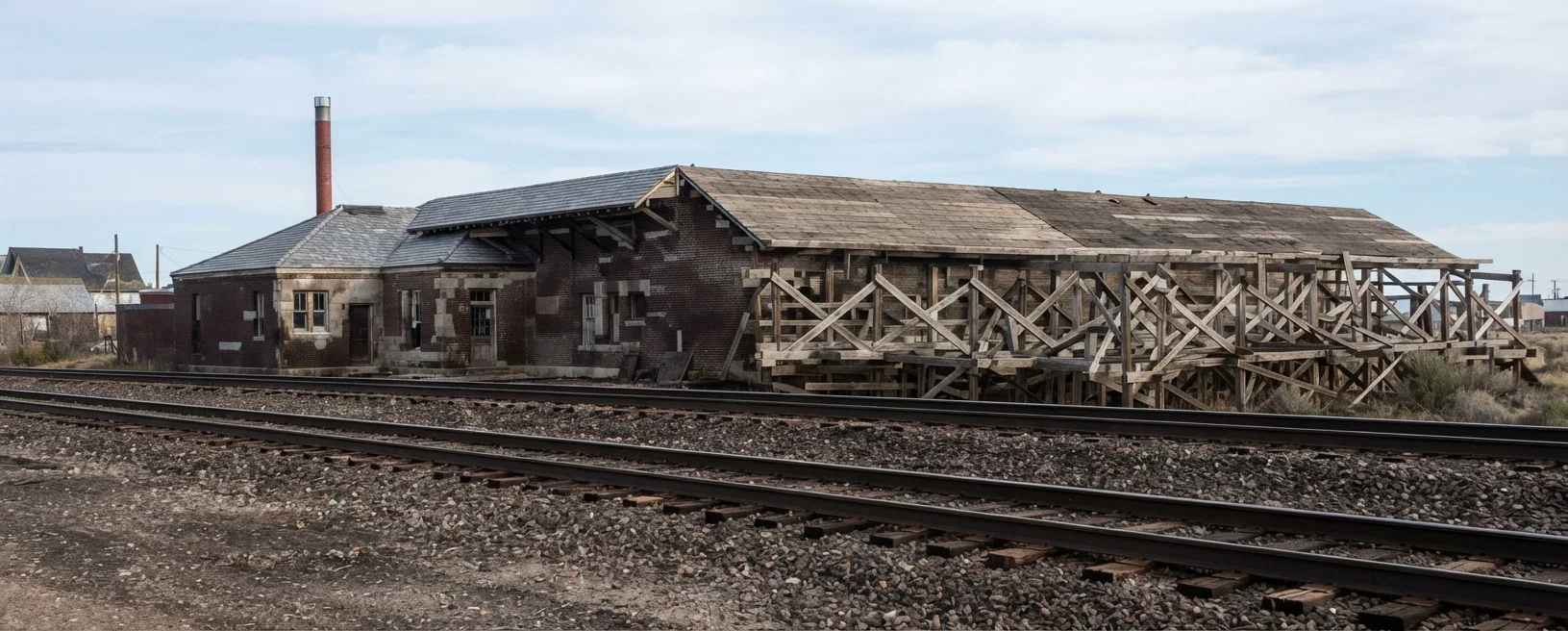
Press Building, Nov. 14, 1906, looking southeast from across railway track. The building is much further along now. Progress on interior work can not, of course, be shown. The cement floor is well started, and the roof nearly covered.
The great religio-civil question of the day is the Sabbath question. It meets the legislators of every land and state. They must meet it. They may laugh it down, may bury it in committees, may kill it with amendments; but it will face them the next session—this demand for a legally enforced day of worship. Legislators, who understand the principles of government and liberty, know that such legislation is wrong; know it in their very souls, and yet they fear to face a religious element who are clamoring for it. If they oppose such legislation, they fear defeat at the polls when they again come before the people; and so many weakly yield manhood, principle, justice, to the religio-political clamor, which never ought to have a place in American government or politics. Any religious institution whatsoever, that demands legislative support may be set down at once as not of God and the Bible.
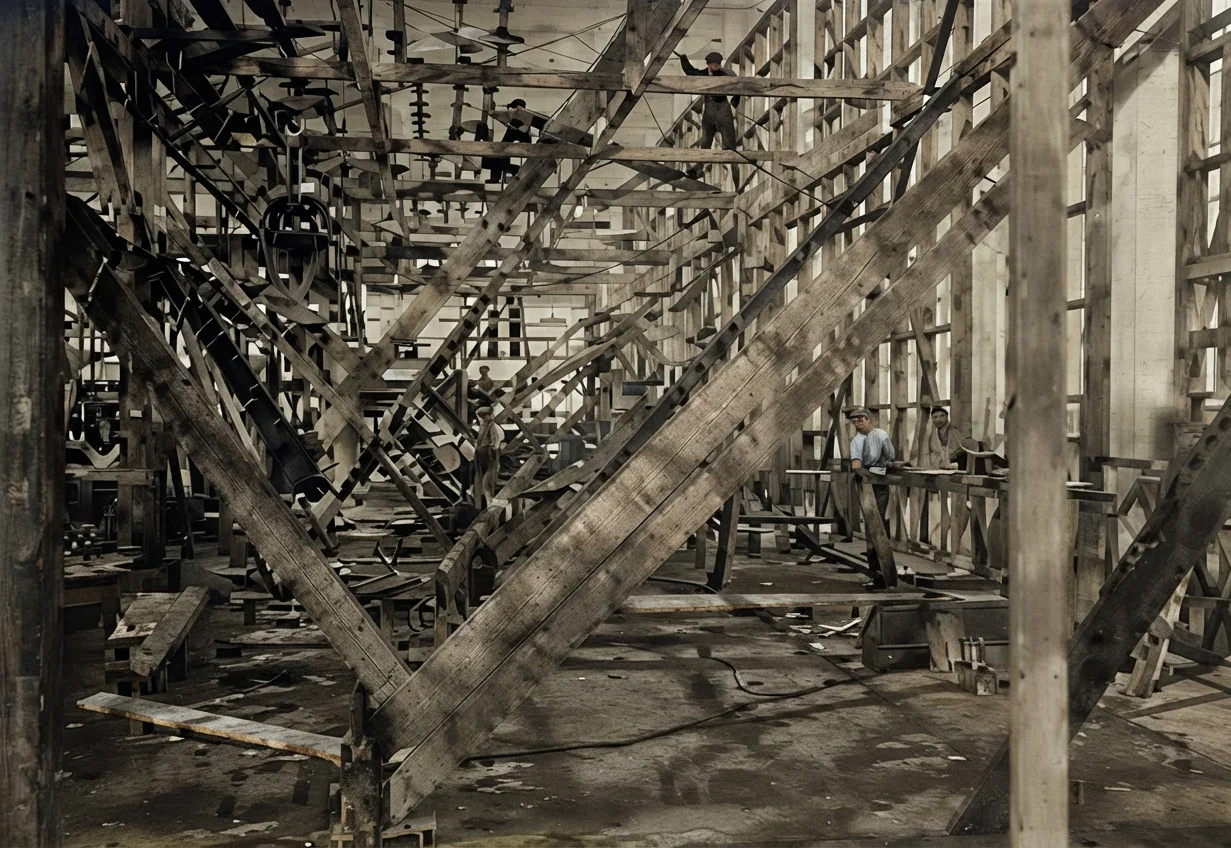
Interior of Press Building, Nov. 14, 1906, looking eastward; diagonal strips are temporary braces.
To yield to this demand is to encourage the church to go into politics; is to turn the ecclesiastical conscience in the wrong direction. Bigotry is always conscientious. The worst persecutors the world has known have been conscientious. Better a thousand times the rough old legislators of early California, who were ready to fight to the death at the drop of a hat, whose language was not always fit for the drawing-room, but who loved justice and believed in equality, than a legislature of preachers. The preacher's business lies elsewhere. Let him be God's mouthpiece for saving souls. There his worth
is priceless. But perverted good is the worst of evil. And when we write this, we know that every true, intelligent, fair-minded preacher in California, be he Sunday-keeper or not, will agree with us. The church of Jesus Christ has no business in politics. The minister of Jesus Christ has no business lobbying in legislative halls, and the truth of Jesus Christ needs no support from civil law.
Destruction to both church and state is in this demand of religious legislation if the state yields to it. If the state does not yield, she will save herself, and the church left to herself and God may find the good way. If the state yield, she yields to ruin. The United States Senate well said in 1829: "Religious combinations to effect a political object are . . . always dangerous. The first effort of the kind calls for the establishment of a principle which . . . would lay the foundation for dangerous innovations upon the spirit of the Constitution and upon the religious rights of the citizens. If admitted, it may be justly apprehended that the future measures of the government will be strongly marked, if not eventually controlled, by the same influence. All religious despotism commences by combination and influence; and when that influence begins to operate upon the political institutions of a country, the civil power soon bends under it, and the catastrophe of other nations furnishes an awful warning of the consequence." Wise, indeed, will he be who reads aright the omens of the day.
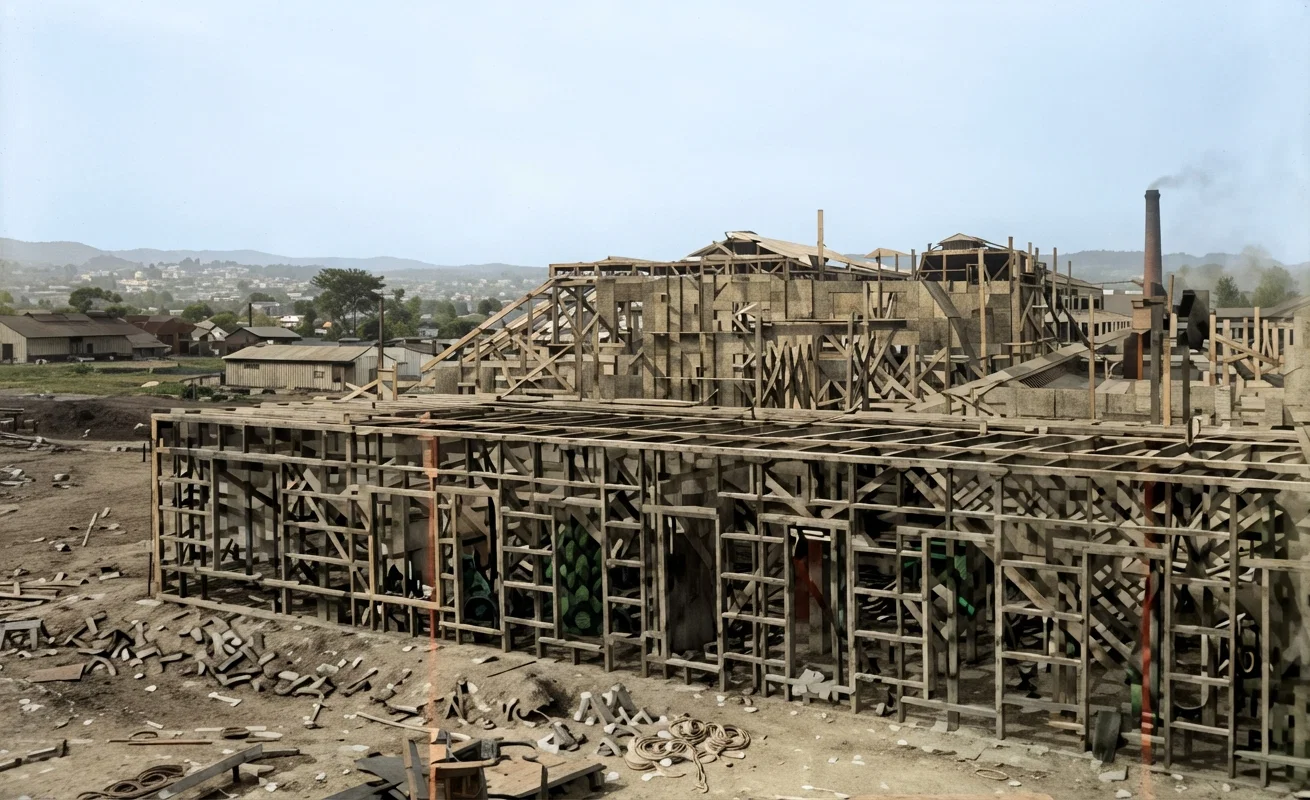
Press Building, Nov. 14, 1906, looking southwest, from engine room.
Mayor McClellan, of New York City, says that the project of bringing water for the city from the Catskill Mountains, a distance of a hundred miles, is a greater undertaking than the digging of the Panama Canal. But it is safe to predict that the city will do the work in much less time than the United States Government will take to finish the Panama enterprise. The difference is that New York people want and need the new water supply, while the men who were influential in securing the choice of the Panama over the Nicaragua canal route, were moved by a desire to delay, and eventually to kill, the canal project altogether.
At the annual convention of the American Federation of Labor, held in Chicago a few weeks ago, the following bit of statistics was presented in the report of the secretary: "There is $111,540.60 in the treasury of the federation. During the year there were 887 strikes, in which there were 91,530 men involved. Of that number, 68,812 were benefited and 11,183 not benefited. The total cost of strikes during the year was $3,982,865.66."
It would be a fitting climax to the graft and greed and grime of San Francisco officialdom to finish off with a Sunday-closing ordinance, as proposed. Pittsburg, whose record now stands about as dark morally as her belching coal smoke has painted her physically, began with a Sunday law. The dark city in western Pennsylvania has for years been a head center of National Reformism and Sunday-law agitation.
Why did not the United States Government use those arms, taken from the Cuban insurgents, and forge them into "plowshares," and give them to the poor Cuban peasants. This would have been in harmony with many of our latter-day predictions.