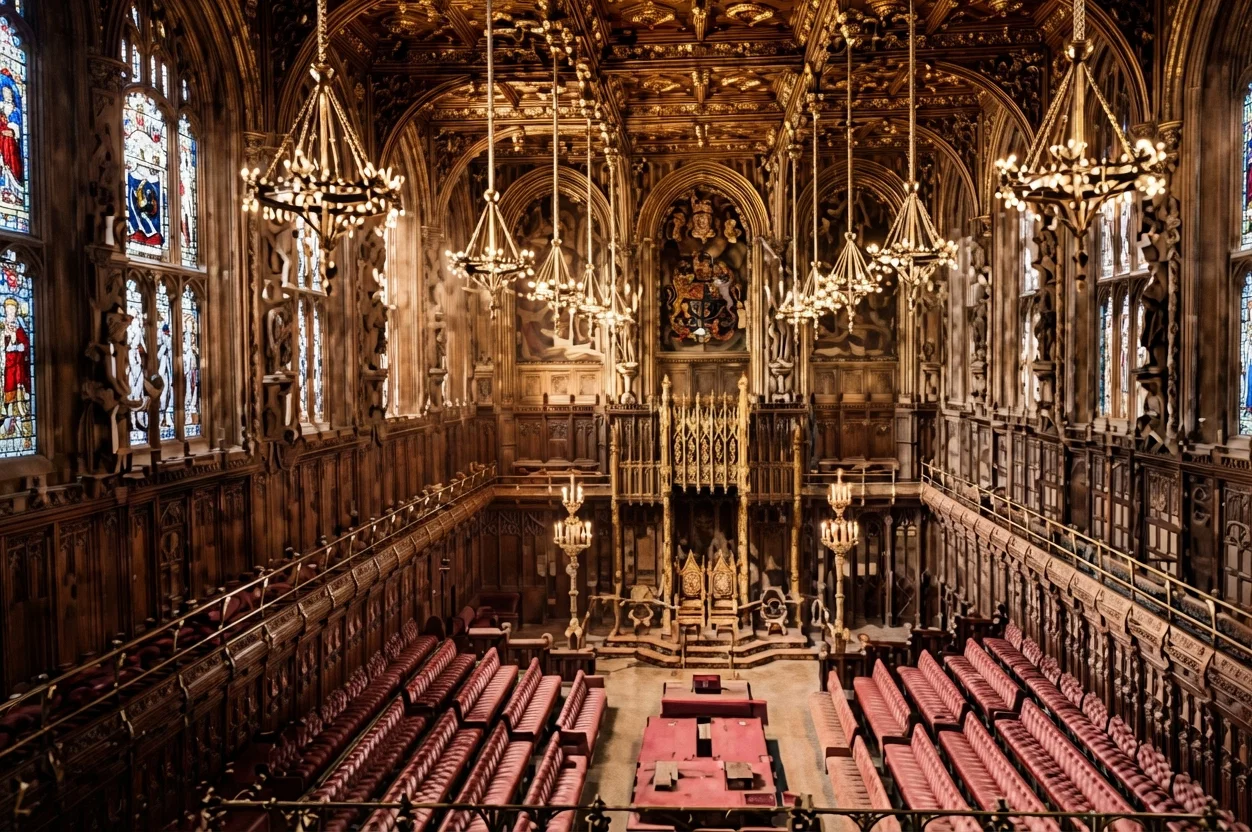
Attitude of the House of Lords on the Education Bill.
THE upper house of the British Parliament had had the measure for the liberation of the English public-school system from sectarianism, passed by the Commons at the last session of Parliament and known as the Education Bill, under consideration three weeks on November 10, and during that time, according to the London correspondent of the New York Evening Post, the measure had "been marvelously transmuted." While the lords and bishops had "fulfilled their intention to avoid any deliberate wreckage tactics," wrote this correspondent, "so strongly is their conservative and clerical attitude antagonistic to the idea of popular control that any method of bringing their amendments into harmony with the will of the House of Commons seems difficult to contrive."
The lords and bishops began their anticipated work of "reconstituting" the bill in line with the wishes of the established church and other theocratical elements on October 29, by amending the first clause of the bill, which provides that "on and after January 1, 1908, a school shall not be recognized as a public elementary school unless it be a school provided by the local education authority," by adding, "and unless some portion of the school hours of every day is set apart for purposes of religious instruction."
The effect of this amendment, while not altering the bill so far as the elimination of church-controlled schools from the public educational system is concerned, is to make religious instruction a part of the regular daily curriculum of the public-school system itself, and attendance thereon compulsory, in opposition to the legislation of the Commons eliminating religious instruction from the curriculum of the public schools, and providing that attendance should be entirely voluntary upon such voluntary religious instruction as the local educational authorities might see fit to permit in the schools. Its effect, together with other amendments by which it was to be supplemented, "is to broadly carry forward into the proposed public-school system all the denominational conditions which have hitherto existed in the church schools," declared the Westminster Gazette, following its adoption. The amendment was passed by a vote of 256 to 56, "the bishops voting as a unit with the conservatives," of course.
According to the parliamentary reporter of the above paper, "not since the Home Rule Bill has the House of Lords been more crowded" with the Tory element than it was on the day this amendment was considered and passed. He says "the Tory flood overflowed" its side of the chamber, and that "the little handful of Liberal peers were compassed on every side" by "the Tory peers and bishops, who sat with the comfortable assurance of a big majority."
The adoption of this amendment and the decisive vote by which it was carried was taken as an unmistakable indication of the stand of the House of Lords in the matter, and "as a direct challenge to the House of Commons which reveals little hope of compromise; for in this matter the Liberal Government feels that it had a direct mandate from the people, and can hardly recede from its position." Commenting upon the policy of the lords and bishops with respect to the Education Bill, following the action of October 29, the Westminster Gazette said:
"They will not kill it, but merely 'reconstitute' it in such a way that its own parents won't know it when it comes back to them dressed up in low sleeves and bishop's gaiters. . . . They tumble over each other in their zeal to transform it. . . . Their animus is such that prudent restraint is impossible."
"It is not an amended bill which they have in mind, but an entirely new bill—a bill more ecclesiastical than that of 1902, a bill which will enhance the privileges of that measure, and combine with them the money grant which was proposed in the Government measure as a compensation for the withdrawal of those privileges. . . . The effect of the changes being made and proposed is to broadly carry forward into the proposed public-school system all the denominational conditions which have hitherto existed in the church schools, with due guarantee for their continuance and extension to provided schools, and an elaborate system of checks upon local authorities who desire to be free of them."
"And, in addition to this, the extension proposed to clause 4 would also in all parts of the country permit the establishment of a special class of sectarian schools practically withdrawn from public control. If these proposals are persisted in, Mr. Balfour's bill of 1902 will be milk-and-water compared with the new ecclesiastical establishment and endowment bill which will be returned to the House of Commons in the guise of an amendment of the Government bill. No one, of course, imagines that the present House of Commons will look at a bill returned to them in this form. Peers and bishops are spending their time on proposals which every one knows will not become law, and which could not become law even if the last election were blotted out and Mr. Balfour were reestablished in the House of Commons with his former majority."
House of Lords.
With reference to the great contention of the theocratical party that "parents have the inalienable right to have their children instructed in their religion," the Gazette very pertinently said that if the matter were left to the parents "we should soon have done with the religious question, which is a controversy between people who want to decree what other people's children shall be taught."
In the course of a speech at Manchester on November 2, Mr. Asquith, of the Ministry, "said the people of the country had decided that all schools maintained at the expense of the rates and taxes should henceforward be under undisputed and unfettered control, and that the Liberal Government could not if they would, and would not if they could, infringe upon that decision by consenting for a moment to anything in any shape or form which would limit or fetter the absolute authority [independence] of the schools which belonged to the ratepayers."
"The House of Commons had decided in the course of its debate on the bill against what was called the secular system; that was to say, it had decided that it would not prohibit local authorities, if they were so minded, from giving religious teaching in public elementary schools. But, at the same time, the House of Commons had clearly intimated that the religious teaching which the local authorities had the power to supply was to be that simple, elementary, vital teaching which was acceptable, they believed, to the great bulk of the parents of children throughout the United Kingdom. The so-called unlimited right of entry for the sects into schools was not demanded, and would not be tolerated, by the country, and in future there should be in the great profession of teaching no denominational bars to the selection or promotion of the individual teacher."
Referring directly to the course of the House of Lords with respect to the Education Bill, which he declared to be one of
the Most Important Measures Before the Present Parliament,
Mr. Asquith "said the Education Bill was at present undergoing a process which the Bishop of Manchester had described as a process of reconstitution. Suppose he took the Ten Commandments and wrote the word 'not' in all those that were affirmative, and omitted the word 'not' in those that were negative, would that be a reconstitution? If so, it was a process of that description that was going on in the House of Lords over the Education Bill."
The London Times, which is disposed to be critical of the Liberal Government and its measure in this matter, declares that "its whole treatment of the subject has been marked by deference to party considerations," and that "the lords unquestionably desire and intend to place the broad issue of whether there is or is not to be religious education of some kind in the schools clearly before the nation."
Of course, the measure of the Liberal Government is a compromise so far as a consistent application of the principle of separation of church and state is concerned. The issue which the Times says the lords and bishops are trying to place before the nation is exactly the issue that should be placed before it. But, of course, they are not raising that issue with any desire to have it decided in harmony with the principle of separation of church and state. The Times says that but one peer—Lord Russell—has "declared himself to be an advocate of secularism," and that "secularism was repudiated by a majority of 414" by the House of Lords last May.
In seeking to do what the Times says they are doing, the lords and bishops are playing a little politics themselves in the matter. England is not15ready for a consistent application of the principle of separation of church and state to its public educational system; and it is an open secret that in adopting the amendment they did on October 29, the lords and bishops gleefully felt that they were placing the government in a position where it would have to accept the amendment or appear to the country to be standing for "secularism," and "ignoring a sentiment which operates in the breasts of four-fifths of the people of this country," as one bishop put it. But while in the present state of British public opinion, it can not go to the length that should be gone to, advocated by "A Fighting Noncon" (formist), who wrote to the Westminster Gazette following the action of the House of Lords on October 29, that "the proper course for the House of Commons to adopt when the lords have ruined the Education Bill is to pass a resolution declaring that no school shall be recognized as a public elementary school if any portion of the school hours of any day is set apart for purposes of denominational education." The Liberal Government is not likely to recede from that degree of separation of church and state in the public educational system which obtains in its Education Bill, and which it feels that the prevailing opinion of the nation demands and will support. It is evident that an interesting struggle bearing upon the relation of church and state is on in England between the two houses of Parliament. JOHN D. BRADLEY.