Untitled article

7%

Pacific Press Publishing Company · MOUNTAIN VIEW, CALIFORNIA · Jan 9, 1907

FromSigns of the Times, Vol. 33, No. 2.

Read the full edition

HEBREW AND HEATHEN LAWS.—No. 2.

IN their efforts to depreciate the code of laws which Jehovah gave to the Hebrews, many ludicrous blunders are made by modern skeptics. Thus Mr. Ridpath, whom we have previously quoted, soberly remarks:
“The second peculiarity of the Jewish legislation is the existence of the lex talionis as its bottom principle. It was in all parts a law of requital, or recompense, of avengement on the violator of the statute. . . . In this respect Semetic law was the same in spirit, and virtually the same in letter, as that of other primitive and half-barbarous peoples.” (“History of the World,” Volume 5, p. 301.)
In reading the above paragraph, one can not help instinctively wondering what kind of laws Mr. Ridpath would suggest as proper to be used in the government of “primitive and half-barbarous peoples.” Would he have crime rewarded by promotion, and vice restrained by license? A law without a penalty adequate to deter men from violating it, is worse than no law at all. Nations can not turn their backs to the smiters, or offer the other cheek when one has been stricken. If they did, governments would soon be dissolved as useless burdens upon the people.
But in what respect did the Hebrew code differ from that of any modern nation? Do we not kill those who kill? Do we not fine, imprison, and confiscate the possessions of those who steal, rob, and plunder? At least, we do when the law is executed, for that is the intent of the law in every modern government, Christian or pagan, civilized or uncivilized, in which a code of laws exists. H. L. Hastings, in his “Wonderful Law,” says that England, in the time of James I, had on its statute books a list of capital offenses five times as numerous as that of the Mosaic code.
It is not true that the Hebrew laws were barbarous. If any kind of torture was practised among them, which is doubtful, it was without color of legal authority. They did not thrust splinters of burning wood into the flesh of their victims, like the American Indians; nor rack, mutilate, and burn them alive, like Catholic European sovereigns; nor shoot, hang, whip, and burn them, without trial, as mobs have often done in the United States, unmolested by grand juries, and upheld by public sentiment.
A modern missionary, who is familiar with the laws and customs of India, says:
“The code of Manu stands for rigid conservatism, for the iron severity of caste, and for the lex talionis in bitterest cruelty, as thus indicated, ‘with whatever member of the body a low-born man may injure his superior, that very member of his body must be mutilated.’ (Book VIII) ‘A once-born man insulting twice-born men with abusive language must have his tongue cut out.’ (Book IX) ‘A Brahmin,’ says the code, ‘neglecting his own appointed caste duty, will be born (in the transmigration) as a vomiting demon; a soldier, as a demon feeding on excrement and dead bodies; a husbandman, as a demon feeding on putrid carrion.’” (Caroline Atwood Mason, in “Lux Christi,” pp. 12, 13.)
“The Chaldees were not law-makers,” says Mr. Ridpath. “The laws of the Chaldees and of their successors, the Babylonians, were simply edicts of the kings. They had the sanction only of force and expediency. Rational legislation was a task above and beyond the civil capacity of the ancient peoples.” (“History of the World,” Vol. 5, p. 242.)
If “rational legislation was . . . beyond the capacity of the ancient peoples,” was it not a very fortunate circumstance for the Hebrews that there was furnished to them, ready-made, a code of laws so perfect as to not only satisfy their need, but also worthy to be patterned after by the most highly civilized nations of modern times?
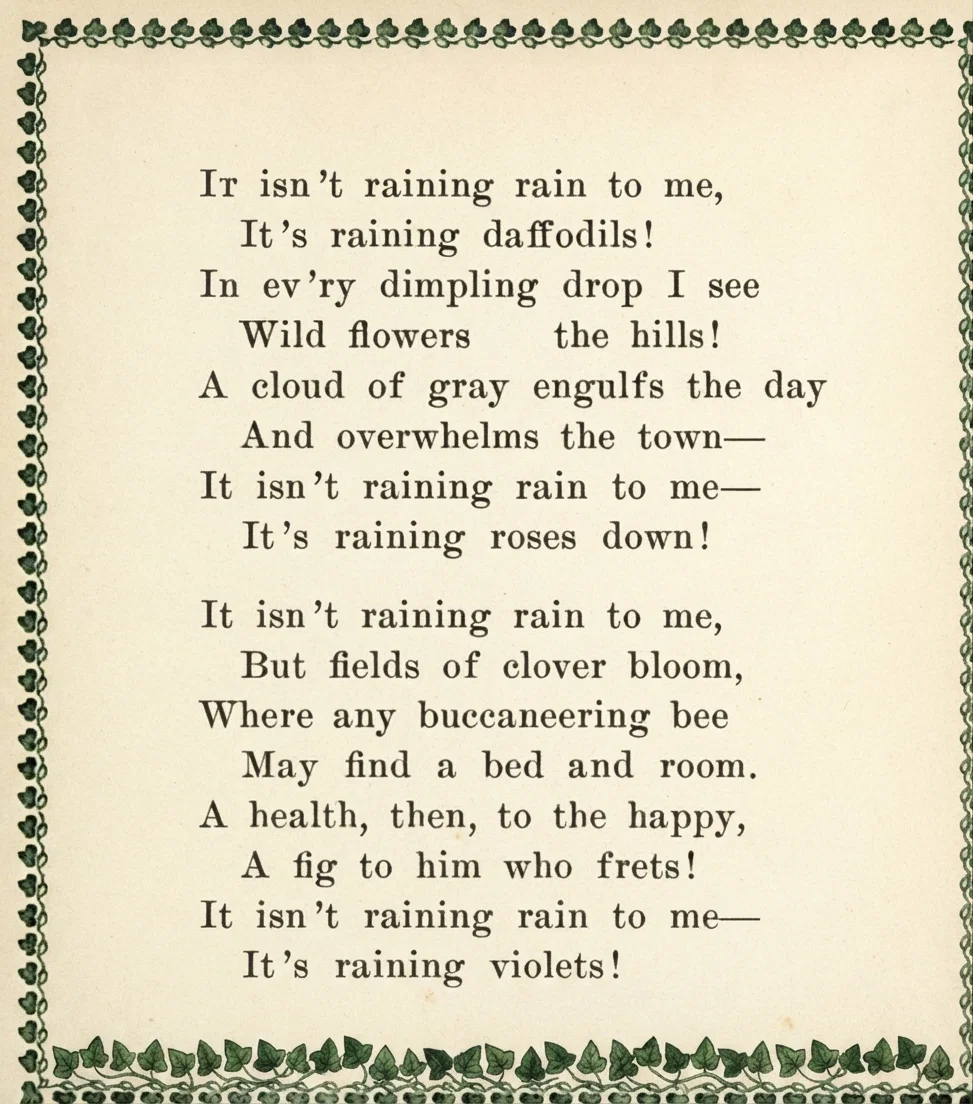
A RAIN SONG. It isn't raining rain to me, It's raining daffodils! In ev'ry dimpling drop I see Wild flowers on the hills! A cloud of gray engulfs the day And overwhelms the town- It isn't raining rain to me- It's raining roses down! It isn't raining rain to me, But fields of clover bloom, Where any buccaneering bee May find a bed and room. A health, then, to the happy, A fig to him who frets! It isn't raining rain to me- It's raining violets! -Anon.
And, since the incapacity of the people to make such a perfect code is admitted, must not every candid person acknowledge the derivation of that law to have been from a higher source than the people?
Of ancient Rome, Draper says: “Conquest and rapine, the uniform aim of her actions, never permitted her, even at her utmost intellectual development, to comprehend the equal rights of all men in the eye of the law.” (“History of the Intellectual Development of Europe,” Ed. 1869, p. 198.)
Of the Greeks, he tells us that a large and influential society of philosophers taught that “the wise will give himself no concern as to a meritorious act or a crime, seeing that the one is intrinsically neither better nor worse than the other,” and that “there is nothing absolute in justice or law.” (Id., pp. 100, 102.)
Albert H. Darrow. Prescott, Ariz.