THE controversy between Mr. Bellamy Storer and President Roosevelt the last month will, we hope, be of help in orienting officials of the government regarding their duty AS officials and WHILE officials. We will not take the time, nor do we wish to enter into the unpleasant details of the quarrel. The main facts for our purpose are as follows:
1. Mr. Bellamy Storer and wife are, or were, personal friends of President Roosevelt; since his daughter's marriage indirectly related.
2. Mr. Storer and his wife are ardent, converted Catholics, with great political ambitions.
3. Mr. Storer and wife, and President Roosevelt are warm mutual friends of Archbishop Ireland. The late President McKinley was also a warm personal friend of the archbishop.
4. The archbishop, we suppose, desires to become a cardinal; or, at least, many of his friends desire it, and have worked for it, among them Mr. and Mrs. Storer, the late President McKinley, the late Mark Hanna, Secretary Taft, and others.
5. From personal friendship, and doubtless also from Mr. Storer's ability, he was appointed minister to Belgium, and Spain, and ambassador to Austria-Hungary, with ambitions for France and England.
6. When in Austria, he was recalled on the charge that he had involved the administration with the Vatican in an endeavor to secure the appointment of Archbishop Ireland to a cardinalate.
7. Smarting under his recall, Mr. Storer has made public much of the correspondence which has passed between himself and the President. This correspondence shows, as the Washington "Post" of December 9, puts it, "that INTIMATE RELATIONS have existed between the White House and the Vatican since the battle of Manila Bay, when grave church problems in the Philippines confronted this government."
Judge Taft, while in the Philippines, wrote Mr. Storer that he greatly desired to see Archbishop Ireland advanced, and that other liberal Catholics should bear sway in church affairs, believing that this would be of mutual benefit to the United States and the Catholic Church. Under date of April 30, 1899, Mr. Roosevelt, then governor of New York, is said to have written Mr. Storer as follows:
"I need not say what a pleasure it would be for me to do anything I can for Archbishop Ireland. You know how high a regard I have always felt for him; he represents the type of Catholicism which, in my opinion, must prevail in the United States if the Catholic Church is to attain its full measure of power and usefulness with our people and under our form of government."
8. Mr. Storer tells us that when Mr. Roosevelt became President he seemed to fear that some of his former letters concerning Archbishop Ireland would be made a wrong use of, and so he wrote to have the letters returned. Cardinal Rampolla had in his hands copies of some of them, and the President feared that a resolute effort had been made to try to mix up facts and to show that as President, "I have been endeavoring to interfere with ecclesiastical matters."
9. Mr. Storer was appointed ambassador to Austria-Hungary in October, 1902. The following summer he visited the President and Mrs. Roosevelt at Oyster Bay. During his visit the relations of the Catholic Church with America were discussed by the President, and the President was warm in his praise of Archbishop Ireland, and told Mr. Storer that if he went to Rome, he, the President, "would like to have me [Storer] see the pope and say to him that the archbishop was his friend, and that he would be pleased to hear that he had received the honor of promotion to the cardinalate," and Mr. Storer says that Mgr. O'Connell was commissioned by the President to say the same thing to Pope Pius X, which he did on Sept. 24, 1903. And the pope transmitted a message saying the President's wishes would probably be fulfilled.
Mr. Storer's memoranda of the President's verbal message reads as follows:
"He said to me, and he authorized me to say to your Holiness that the Archbishop of St. Paul is his personal friend, and that he possesses all his confidence as prelate and citizen; that he desires emphatically for Mgr. Ireland all the honors of the church, and that he will see with the greatest pleasure and satisfaction the elevation of Mgr. Ireland to the cardinalate."
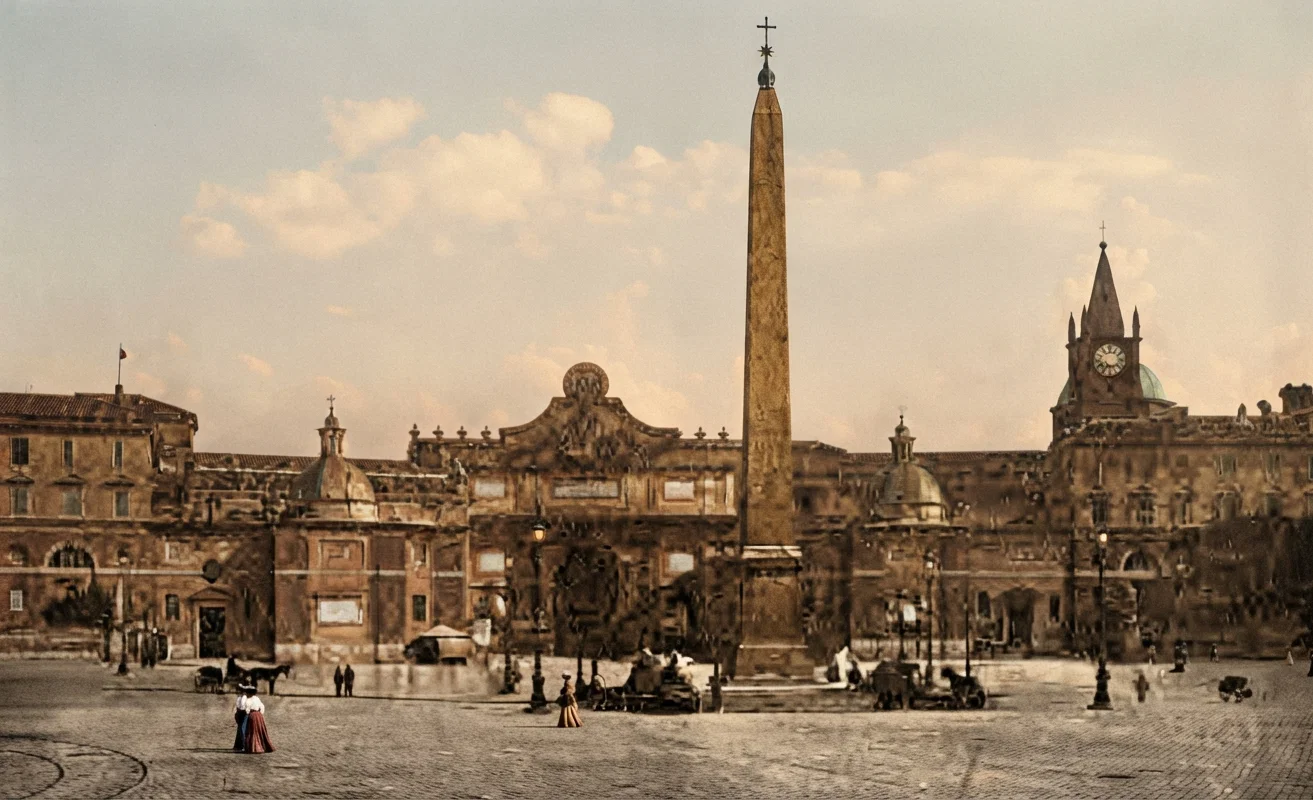
The Gate of the People, Rome.
Following this a report was telegraphed from Rome that Mr. Storer had seen the pope in behalf of Archbishop Ireland. This stirred up President Roosevelt, who wrote as follows:
"What has occurred shows clearly that it is hopeless for you to expect that the pope will appreciate the difference between what you say as an American Catholic in you private capacity, and what you as an American ambassador say. I take it for granted that you supposed you were speaking merely in your private capacity to people who would not misunderstand you, and who would not repeat what you have said. . . .
"As President it is none of my business to interfere for or against the advancement of any man in any church; and as it is impossible to differentiate what I say in my individual capacity, from what I say as President—at least in the popular mind, and apparently in the Roman mind—I must request you not to quote me in any way or shape hereafter."
Mr. Storer says that this letter filled him with astonishment, and especially since what he had spoken had been by the President's request.
On Dec. 13, 1903, the President wrote him another letter which reads as follows:
"Let me repeat to you that in reference to matters affecting the Catholic Church, events have absolutely shown that while you are ambassador, you must keep absolutely clear of any word or deed in Rome or elsewhere which would seem to differentiate your position from that of other ambassadors. The mere fact of a report in the newspapers about your calling at the Vatican had a very unfortunate effect. . . .
"While I am President and you are ambassador, neither of us in his public relation is to act as Catholic or Protestant, Jew or Gentile, and we have to be careful not merely to do what is right, but so to carry ourselves as to show that we are doing what is right. I shall ask you not to quote me to any person in any shape or way in connection with any affair of the Catholic Church, and yourself not to take action of any kind which will give ground for the belief that you as an American ambassador are striving to interfere with the affairs of the Church."
All that Mr. Roosevelt has said, he declares, is the mere expression of his own personal regard for Archbishop Ireland, as he would express a similar wish for any other friend of any other denomination; and in a letter to Mrs. Storer, he declares again:
"In the first place I wish to be explicitly understood that, tho since I have been President, I have been approached at different times by prelates of your church and even by laymen in your church with requests that I ask of the Vatican or indicate a preference for the appointment of some person as cardinal. I have always positively and unequivocally refused, directly or indirectly, thus to ask for the appointment of any man as cardinal, and it would have been a gross impropriety for me to have made any such request, while it is an outrage to represent me as having in any shape made it.
"To Archbishop Keene, to Mgr. O'Connell, and to other men who have approached me on behalf of Archbishop Ireland, I have said I had a very high regard for the archbishop, and that I should be delighted to see him made a cardinal, but that I could no more try to exercise pressure to have him made a cardinal than pressure to get the archbishop of Canterbury to establish an archbishopric in America.
"Other persons have spoken to me, saying that Ireland could not be made a cardinal unless another cardinal was made in the Eastern States, and that they hoped that two cardinals (usually mentioning15Ireland and Farley) would be appointed, one in the East and one in the West. I always answered that I had a great regard for both men and would be delighted to see them made cardinals, just as there were Episcopal clergymen and Methodist clergymen whom I would be delighted to see made bishops, but that I would no more interfere as you desire me to interfere, and as you yourself have been trying to interfere, under any possible circumstances."
Summing it all up, it seems to amount to just this: Mr. Roosevelt in his warm, impulsive way desired to see Ireland wearing the cardinal's hat, and so expressed it, believing that would be a fine thing for the archbishop and a good thing for American politics, because he thought Ireland was a true American. Mr. Roosevelt showed the same ignorance of Rome's designs that many other Protestants do. He has since learned, as before quoted:
"It is impossible for me to differentiate what I say in my individual capacity from what I say as President—at least, in the popular mind, and apparently in the Roman mind."
If Mr. Roosevelt had read ecclesiastico-political history, and read it aright, he would have learned that it was Theodore Roosevelt's opinion as President and not as an individual that Rome was after. We are glad that he has come to see it, and expresses himself as to his relations and feelings as strongly as he does. The President positively denies that he sent a message to the pope by Mr. Storer, or received a message from Mr. Storer reporting his deliverance of the message to the pope. Secretary Loeb affirms this.
Dr. Michael Walsh, former editor of "Catholic Herald," friend of Archbishop Ireland, the late Mark Hanna and President McKinley, declares that if Pope Leo XIII had lived, "Archbishop Ireland would have become a cardinal long before now." He also tells us that there were several working for him, among whom were President McKinley and Mark Hanna. A Republican politician told him (Dr. Walsh) that "whatever Ireland asks, McKinley will do if it is in his power." Dr. Walsh, however, does not believe that President Roosevelt had given any intimation officially that he desired Ireland's promotion. But he thinks Ireland's chances for the red hat are now ruined.
The lesson ought to be (but it is too much to hope) that the United States Government ought to have naught to do in any legislation, grant, treaty, or contract, thru any of its officials or branches, national, colonial, or otherwise, with any ecclesiastical body whatsoever. But can the politicians stand the temptation, when so many of them are desiring office, and Rome is in the field to sell support for favors demanded?
As the Lord has foretold us in His prophetic word, we are rapidly nearing that time when all the world shall worship the beast—that system of State and Church, the strongest manifestation of which is in the Papacy; and many of our statesmen and politicians, consciously or unconsciously, are doing all they can to help forward the ruinous climax.