FRANCE AND THE VATICAN

8%

Pacific Press Publishing Company · Mountain View, California · Jan 23, 1907

FromSigns of the Times, Vol. 33, No. 4.

Read the full edition

FRANCE AND THE VATICAN.

[Under the above title the Argonaut, of San Francisco, of date December 29, gives the following, to us, very fair statement of the relations between the Papacy and France, and we reproduce for the benefit of our readers. It may help to correct some of the statements of the daily press.—Ed. S. of T.]
SEVERAL readers have requested us to state briefly the questions at issue between France and the Vatican. Altho the situation is very complicated, and much clouded by disputes as to the exact issues, this is a fair statement in brief according to our understanding.
Napoleon in 1801, as First Consul of France, made a contract with the Vatican called the Concordat. Prior to that time, after the fall of the monarchy, the French Revolutionary Government had practically overthrown all public religious observances. By the Concordat it was provided that France should officially recognize the Roman Catholic Church; that the Government of France should select all Roman Catholic bishops in France; that these selections should be subject to the approval of the Vatican. And here is one of the disputed points—whether the Vatican had a veto or whether lack of approval meant a veto. The Concordat also provided that the governmentally selected bishops should appoint the lesser clergy, and that the State should pay the salary of the archbishops, bishops, and lesser clergy. Thus the Roman Catholic Church in France became practically a part of the State. Its prelates and ministers were appointed by the State and were paid by the State. The State also paid out the people's money to the Protestant and Jewish congregations, but naturally, a much smaller amount than the scores of millions paid out to the Roman Catholic clergy.
For more than a hundred years the Vatican has chafed under the Concordat, and there have been perpetual complaints from the pope over the unfairness of that document. The Republican government therefore determined to begin the separation of Church and State by ostensibly acceding to the complaints of the Vatican. There were many Roman Catholic schools thruout France which were conducted by religious orders, were not supported by the State, and not under the Vatican or diocesan rule. As they were outside of the Concordat, they did not come under the protection of that document. In 1901 the Waldeck-Rousseau government passed the "Associations Bill," directing all these religious corporations to file lists of their members, pupils, financial conditions, etc., whereupon licenses would be issued to them, legalizing their existence. As these religious corporations had no standing under the Concordat, and were only indirectly under Vatican control, there was no legal impediment to this action. The French Government allowed it to be understood that the cause for its action was the inculcation of ideas hostile to republican government in these religious schools.
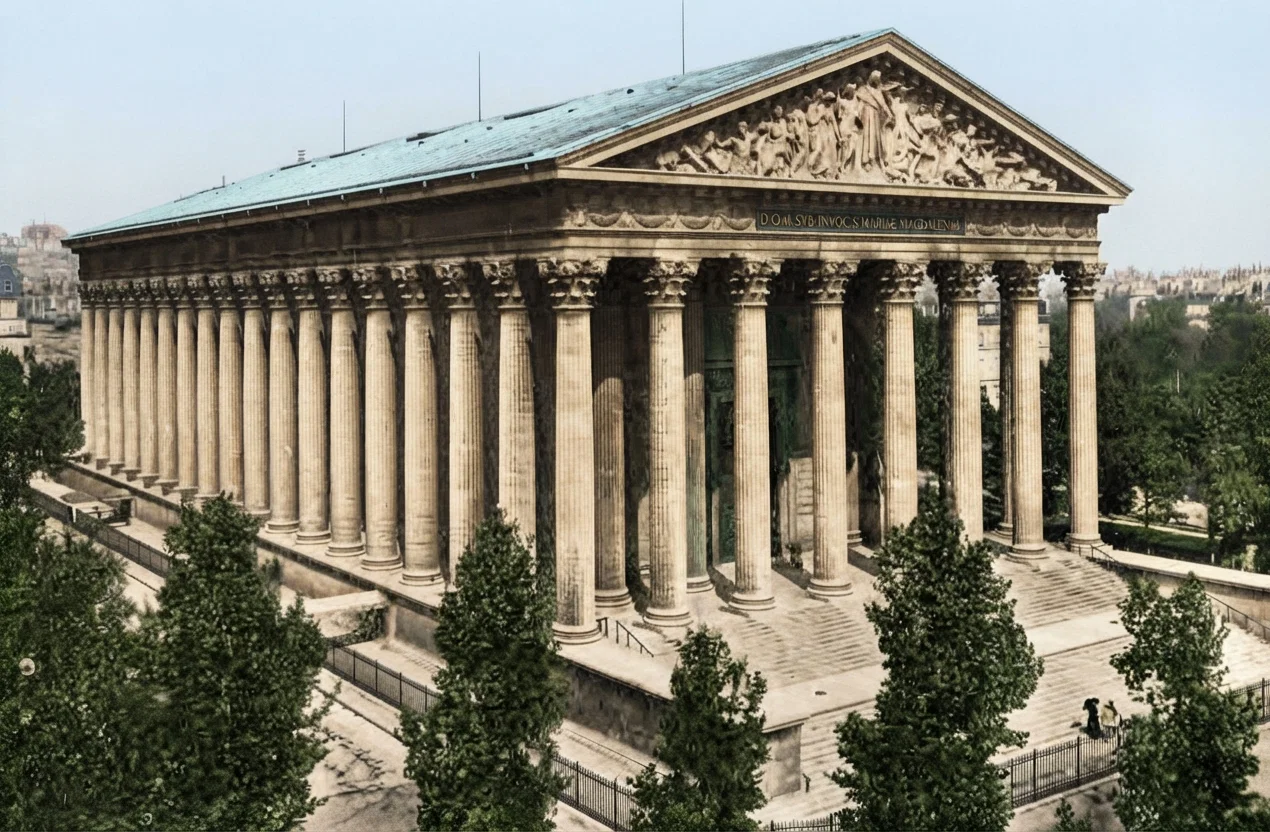
The noted Church of the Madeleine, Paris, which Napoleon attempted to turn into a "Temple of Glory." Cost, $3,000,000 in building, from 1764 to 1832; 354 feet long, 141 feet broad, and 100 feet high; bronze doors 16 feet wide, 34½ feet high.
The religious corporations very generally refused to comply with the law. Out of 17,000 monastic or religious organizations nearly 8,000 were dissolved because they defied the law. Many of them established their schools in the United States and other countries.
An incident which seems to Americans a trifle greatly envenomed the dispute between the French government and the Vatican. President Loubet while in Rome visited the King of Italy and did not visit the pope. The reason is plain. The Vatican holds that the Italian government is a usurping one, and that the Roman States belong to the Pope as their temporal sovereign. If President Loubet had visited the Vatican, the pope would have insisted on being treated as reigning sovereign of the Roman States; this would have implied that President Loubet believed the King of Italy to be a usurper. France and Italy are friendly. Hence President Loubet wisely did not call at the Vatican.
The final step in the separation of Church and State began about a year ago, when the
Chamber of Deputies by a two-thirds majority formally adopted the bill separating the Church from the State. This bill provides that the State does not recognize, salary, or subsidize any particular form of worship; that where church property was originally purchased with money raised by individuals or congregations, religious associations should be formed, in which such property should vest. In the United States title to such property is vested in the bishops. Concerning church property purchased originally by or originally belonging to the State, the bill provides that each such piece of property shall vest in the State, and that the State shall loan it to a religious association made up of its congregation for the purpose of holding religious services; that instead of paying regular salaries from the State to the clergymen, pensions shall be paid by the State to the older clergymen only.
All of the foregoing seems to Americans simple and just. We in this country believe that Church and State should be separate. That belief is strong also in Great Britain and Ireland, as the disestablishment of the Irish Church and of the Anglican Church have been burning questions for many years. It is probable that within twenty years there will be no established church in the British Empire. Even Spain has recently shown signs of cut-
ting loose from the Vatican in the matter of the regulations concerning marriage; this is the first step toward disestablishment. Why then there should be such excitement among Roman Catholics thruout the world over this domestic concern of France, it is difficult to understand. If the French government is confirming the title of certain Roman Catholic congregations in France to the property which originally belonged to them, and if it is causing to revert to itself property which originally belonged to it, where is the harm? The Roman Catholic Church in France, as a corporation holding property, is one thing. The Vatican in Italy, as a corporation holding property, is another. Spiritually, the Church in France and Italy may be the same thing. As a property owner, taxpayer, and citizen, it can not be. This view must appeal to every Roman Catholic in the United States, where the Church has thrived wonderfully with a complete disassociation from the State. Do American Roman Catholics, for example, believe that Pope Pius X owns the Cathedral of Notre Dame on the Island in the Seine, where it has been the property of the French government since Louis VII laid the first stonein 1163? And if so, does Pope Pius X own St. Patrick's Cathedral on Forty-ninth Street and Fifth Avenue, New York City? And if so, does he own St. Mary's Cathedral in San Francisco?