European Letter

6%

Pacific Press Publishing Company · Mountain View, California · Feb 6, 1907

FromSigns of the Times, Vol. 33, No. 6.

Read the full edition

European Letter

A Catholic Congress at Fribourg, Switzerland.
AN extraordinary gathering took place in the city of Fribourg, Switzerland, from September 22 to 26. Fribourg is the seat of a Catholic university and the center of Catholicism in French Switzerland. This was the second Swiss Catholic Congress. The first Congress took place a year before in Lucerne, the leading Catholic city in German Switzerland. These Catholic Congresses are a new departure, and show a new activity on the part of Swiss Catholics. This year's meeting far exceeded last year's in numbers and importance. Most, if not all, the Swiss Catholic societies were represented. Among them were artistic, musical, educational, philanthropic societies, young men's and young women's associations, etc.
European Letter
European Letter
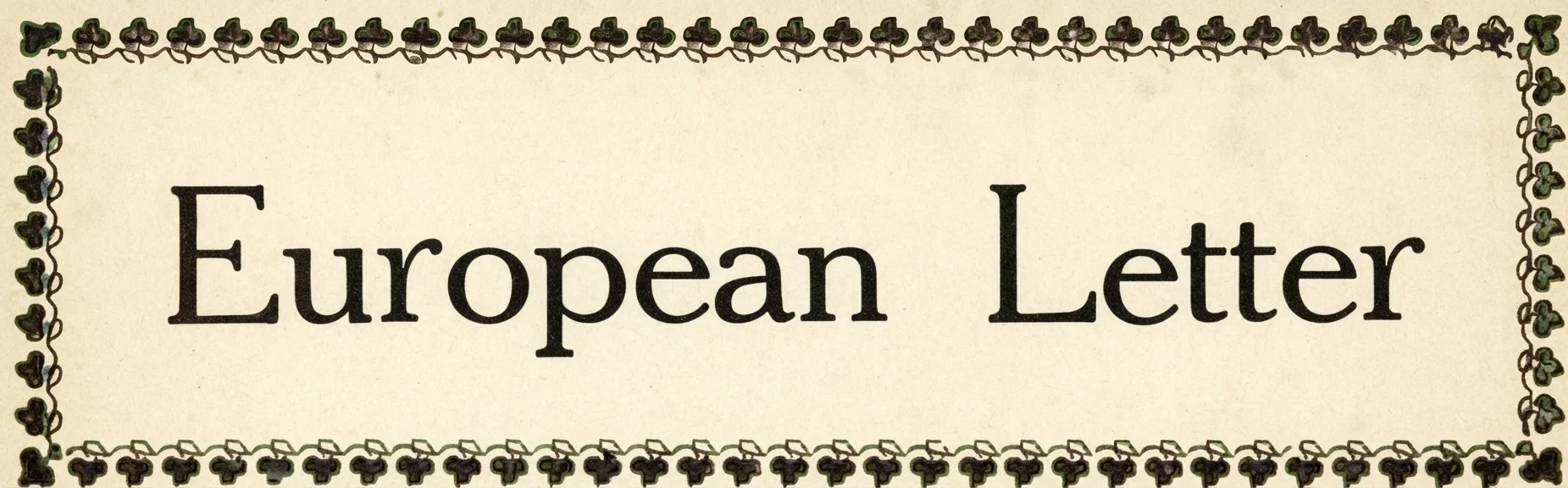
Birdseye View of the City of Berne, Swiss Parliament Buildings in Foreground.
Needless to say that the gathering of all these elements of intellectual and social life among Swiss Catholics is a powerful means of promoting union and cohesion among them, and of reviving their enthusiasm and love for the Catholic cause.
One of these societies, the Swiss Popular Association has 404 branches and 42,000 members, while the French branches have 9,000 members. The whole number of delegates present at the Congress was between 15,000 and 20,000, which, for a small country like Switzerland, is a rare occurrence. Lucerne alone sent 1,000 men. Some of the Fribourg valleys sent from 1,000 to 2,000 delegates. For a few days our leading stations and the trains going to, or coming from, Fribourg were crowded with people wearing a red and yellow ribbon on which was printed in gold: Schweiz-Katoliken Tag (Swiss-Catholic Day). About a score of brass bands came with the crowds, and as they poured into the picturesque and well-decorated city of Fribourg, their martial melodies thrilled the whole population with enthusiasm.
In the able speeches made by the leading laymen, all the aims and interests of the Catholic Church in the family circle, public and private schools, society, art, history, constitutional law, and religion were brought to view and advocated.
On the fourth day the delegates went in a body, on two special trains, to Morat, the place of the famous victory of the Swiss over Charles, Duke of Burgundy, in 1476; there a speaker denounced antimilitarism as a baneful doctrine. A telegram of devotion was sent to the pope and one of sympathy to Cardinal Richard of Paris.
On Sunday a high mass was celebrated on the square of Notre Dame Church by Mgr. Deruar, and was attended by thousands of men. In the afternoon a procession numbering 20,000 marched thru the city. Historical groups added color to the procession. Altogether the scene gave an impression of gorgeousness, power, and earthly grandeur, quite in harmony with the aims and teachings of the Roman Catholic Church.

Separation of Church and State in Geneva, Bale, and Neuchatel.
The movement in favor of separating the State from the Church is taking root in Switzerland. Geneva takes the lead, then comes Neuchatel, then Bale, then Lausanne. In the first three cities, the matter has already come up for discussion in the Legislature. The upholders of the old state of things look upon the new measure as a historical profanation, and quote the names of the Reformers with pathos. The advocates of the separation insist that the situation of the State churches is one of partiality and injustice. There are now in Geneva, for instance, 64,237 Protestants and 74,404 Catholics, of whom 45,000 are foreigners. All these are expected to help support the old establishment of Calvin by their taxes. I should add that in the 64,000 Protestants, one-third are members of free churches, who are supporting their own pastors while paying for the State pastors, and that, in Geneva, the Catholic Church is not supported by the State.
A separation bill was introduced in the Geneva Legislature, Oct. 20, 1906. A debate took place in which many good thoughts were expressed on the principle at stake. One speaker, M. de Morsier, said that "the Church is based on liberty, while the State is based on force." He added that "a national Church is allowable only when there is but one religious opinion in a nation. But to-day, there are one thousand such opinions. Even deprived of State aid, the Protestant Church, if alive, may remain a church of the people and be strong."
It is not to be overlooked that the socialist and free-thinking spirit, in these movements, is clasping hands with the dissenters. In Geneva, the Catholic Church, not being supported by the State, is halting between two opinions: a desire to see the Protestant Church left, like itself, without State aid, and a hope to become also a State Church as in other Cantons. In the second alternative, its numerical force would entitle it to a lion's share of the State money and to some church buildings. Indeed, for some time many Protestants have been looking forward with fear to the time when the cathedral of Geneva would fall again into the hands of the Catholics. The struggle between Protestantism and Catholicism on the one hand, and between infidelity and Christianity on the other hand, is thus growing more fierce in Switzerland, on the old battle-grounds of Calvin, Farel, and Ecolampadius.
This is the clearest meaning, so far, out of these movements; for those who are calling for a separation are not those who are to be blessed by it, but rather dissenters, Socialists, and infidels. The only benefit from such a separation, as enforced on the State Church people, would be an indirect one, resulting from being obliged to fight for a living and to devote more time to actual Christianity, and less to rationalistic and higher critical speculations.
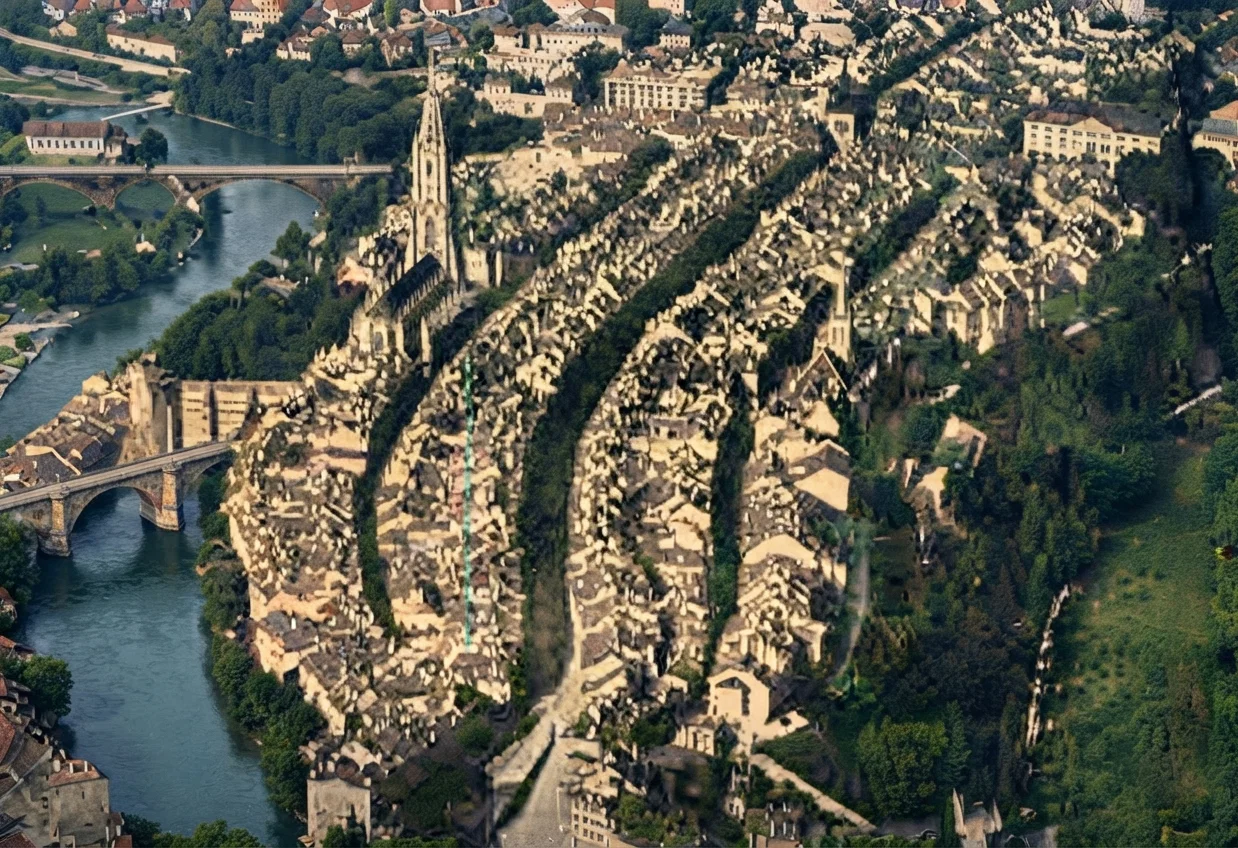
Birdseye View of Berne and the Bridge of Kirchenfeld.