WE present in this issue from several sources reports from the great calamity in Kingston. These reports come either from reliable eye-witnesses, or from reliable persons who have obtained their facts from eye-witnesses. Learning nothing, we wired for information.
LETTER FROM A. G. DANIELLS.
The following is a letter from Pastor A. G. Daniells, of Washington, D. C., President of our General Conference, written under date of January 24:
My dear Brother Wilcox:
Your telegram, sent to the "Review and Herald," the 20th, was handed to me for attention, and I have held it until we could get information from Kingston. We have just received reports from there, and I hasten to pass on the word to you. Have just sent a telegram as follows: "American brethren safe. Four Jamaicans killed. Situation terrible. Photographs to-morrow."
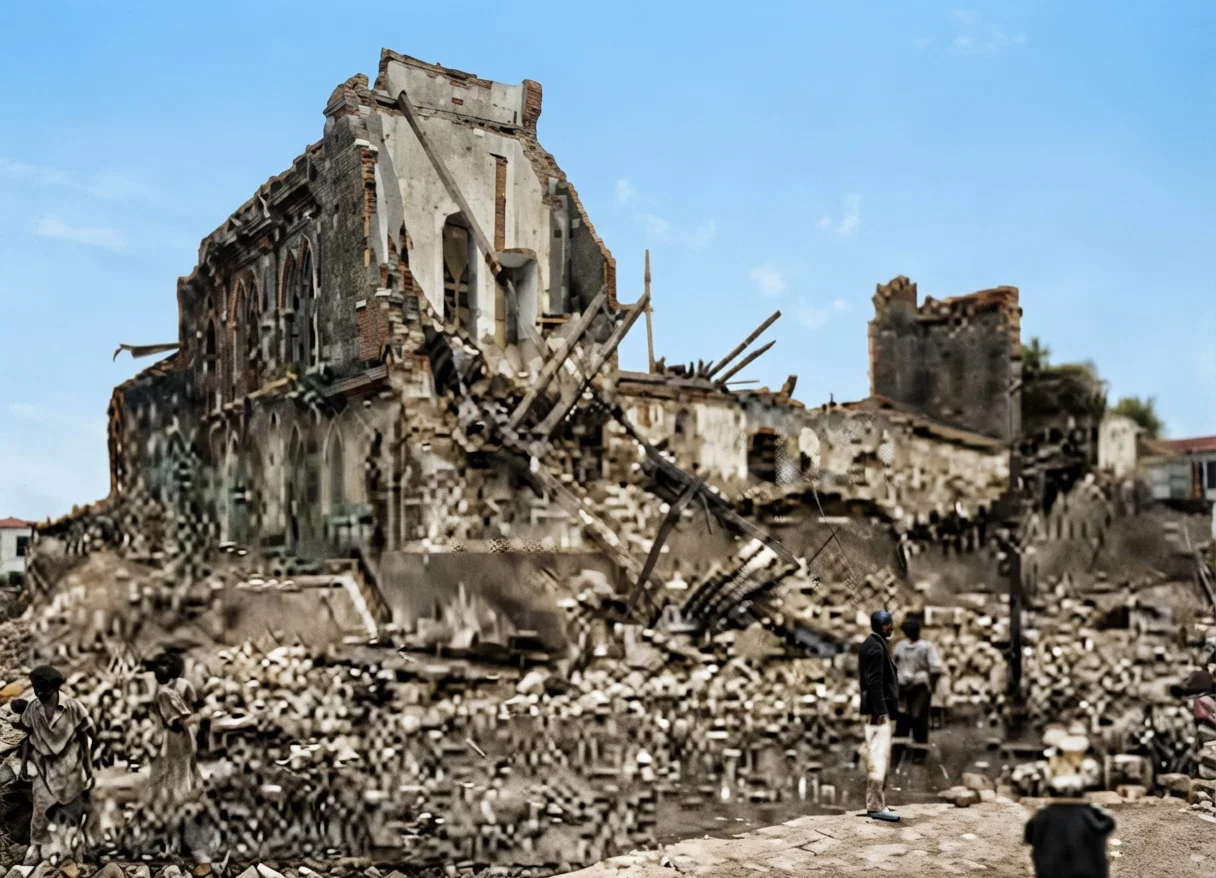
Catholic Church, Kingston.
We have just received our information from Pastor L. E. Wellman, President of the East Caribbean Conference, who has just come from Kingston. I will endeavor to give you a synopsis of the account he has given us of their experience.
The Union Conference session opened Friday, the 11th, in our church building in Kingston. There was a large delegation from all parts of the West Indian Union Conference. The American delegates were Pastors Evans, Farnsworth, Warren, and Bender, Mrs. Bender, and Professor and Mrs. C. B. Hughes. The brethren had engaged the largest hall in the city for evening public services. Sunday night the hall was packed by a deeply interested audience to hear Brother Warren speak on the subject of the judgment.
Monday morning, a large committee went from the city of Kingston to our school farm about twenty miles away. During the forenoon they inspected the school site, and held a counsel meeting. In the afternoon they were in our school building in counsel when the earthquake occurred. The building rocked and tossed like a ship at sea. The brethren rushed out quickly, but the building did not fall. The violence of the quake convinced them that a serious shock had visited the island, and they immediately started back to Kingston.
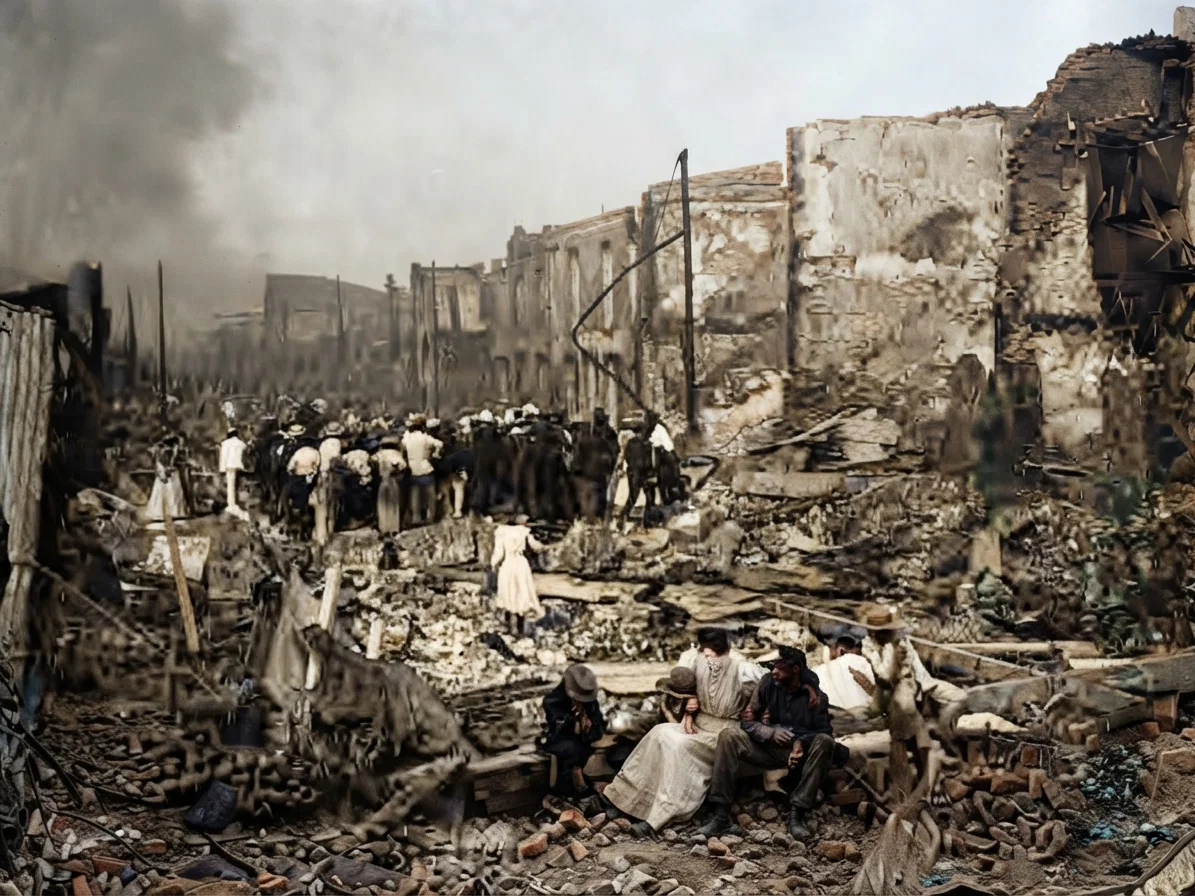
Harbor Street in Kingston, Jamaica, after the Earthquake of January 14.
On their way to the local railway station, they met evidences that confirmed their fears that a terrible disaster had occurred. The first thing they saw was the ruins of a stone church belonging to the Episcopalians. Of this building nothing was left standing.
When they reached the railway station, they found the wires all down. They learned also that the tunnels between them and the city had been partially blocked. They took the first train they could get for Kingston, but owing to the obstructions of tunnels by rocks and earth shaken down, they could not get to the city before eight o'clock at night. Within a few miles of Kingston, the lurid sky told them that the city was on fire.
Unspeakable was the anxiety these brethren felt for the large number of our people gathered in the city. Brother Wellman tells us that what they saw on arriving in the city was terrible beyond all description. The entire business part of the city was in ruins, and a large part of it was on fire. They hastened to the part of the city in which our people were located, and were greatly relieved to find that the most of them had escaped without serious injury.
Brother Norman Johnson, the treasurer of the Union Conference, had been killed; he went to the bank in the afternoon to cash a check we sent him from our Washington office, and was buried in the ruins. They were not able to recover his body. Owing to the heat, the bodies quickly decompose, and in order to avert pestilence, a large fire was built, and cart-loads of crushed, mangled bodies were drawn from the ruins and cremated. Our brother's body may have been here. If he had cashed the check, the money secured was either taken by those who found his body or burned in the fire. As far as can be learned, three other Jamaican brethren were killed. A number received injuries, but they think none will prove fatal.
Our people had met in the church for service, and were singing the opening hymn when the shock came. Immediately there was a rush for the door, but as they were in an upper story, and the passageway was narrow, Pastor Strickland, who was leading the singing, saw in an instant that they would stop the passageway, and probably trample each other to death, so he quickly placed himself
in front of the door between the people, and continued singing. This quieted the people and they kept on singing until the whole affair was over. Then they were allowed to leave the room in an orderly way. Our church building was a brick structure about 125 years old. It stood the shock remarkably well. They found on leaving the building that it was badly cracked, but it held together so that the congregation suffered no harm whatever. It will have to be taken down and rebuilt, to be made safe.
We thank the Lord for this wonderful preservation. The moment I heard of the disaster, I thought our people must have been in church at the time, and feared that we would get a heart-rending report regarding them. But the Lord certainly delivered them; for people in nearly all other brick and stone structures in the city were either badly injured or killed. There is scarcely a house in Kingston that is not ruined.
Our brethren endeavored to rally from the effects of the disaster, and continue their meetings as had been planned, but it was impossible to do so. However, Brother Wellman says that our people, white and black, behaved themselves splendidly. They were not terrified, and had no desire to run away from the13place. He said that our colored brethren exhibited a calmness and confidence in God that was truly remarkable.
The difficulties they faced in their endeavor to continue their meetings were these: no homes in which to live; scarcely any food to eat; no suitable place in which to hold their meetings; and no suitable protection from the half-crazed mobs which created pandemonium in all parts of the city. They held a number of business meetings in order to arrange their conference affairs properly, and they closed their meeting, and all returned to their homes. Pastors Luther Warren and L. E. Wellman sailed direct to New York City, and arrived there Tuesday, the 22d. Pastors Evans and Farnsworth remained a few days to counsel with the local brethren left in charge of the work. They hoped to return by way of Cuba, and we suppose they are on their way now. Pastor Bender was elected president of the West Indian Union Conference. Prof. C. B. Hughes was elected principal of the training school. Pastor Geo. Enoch was released for India.
Now, I have given you, in brief, as clear a statement as I can. On the whole, it was a great disappointment to our brethren in the West Indies to have their meeting broken up in this way. But on the whole, we thank our heavenly Father for the protection granted to our people, and that the affair terminated as well for our cause as it did. As you have recently witnessed the terrible results of a fearful earthquake, it is not necessary for me to attempt to give you a picture of the awful scenes Brother Wellman told us about. It is awful to contemplate, and I pray the Lord to be merciful to poor, sinful humanity, and bring this terrible situation to an everlasting end.