LESSONS FROM CALVARY

13%

Pacific Press Publishing Company · Mountain View, California · Feb 20, 1907

FromSigns of the Times, Vol. 33, No. 8.

Read the full edition

LESSONS FROM CALVARY.

WHAT unpromising places God has chosen for the revelations of great world-molding truths! Not so would men choose. If the Czar of Russia wished to promulgate some far-reaching and important decree, he would do it in all the pomp of sovereignty. If a world-reformer wished to lay before the public some new scheme of reforming the world, he would, if able, secure the best hall in the greatest city; he would gather about him all the influential men whose help he could obtain. Those efforts would seem necessary to insure success. Yet, after the grand display of power and pomp, either or both might fall dead upon the hearts and minds of those who listened or read.
Not so in God’s plan. “The base things of the world, and the things that are despised, did God choose, . . . that no flesh should glory in His presence.” When He would save the race from the waters of the Flood, He used a single boat builded by man to ride upon the tempestuous waters. When He would preserve His truth to the world, He used a nation of slaves. When He would instruct them in the essentials of saving truth, and the fundamental law of His government, He sent them, not to the universities of Babylon or Egypt, but to the bare, dry, desolate heights of Horeb, and illuminated its vast stretches of barren solitude with the glory of His presence.
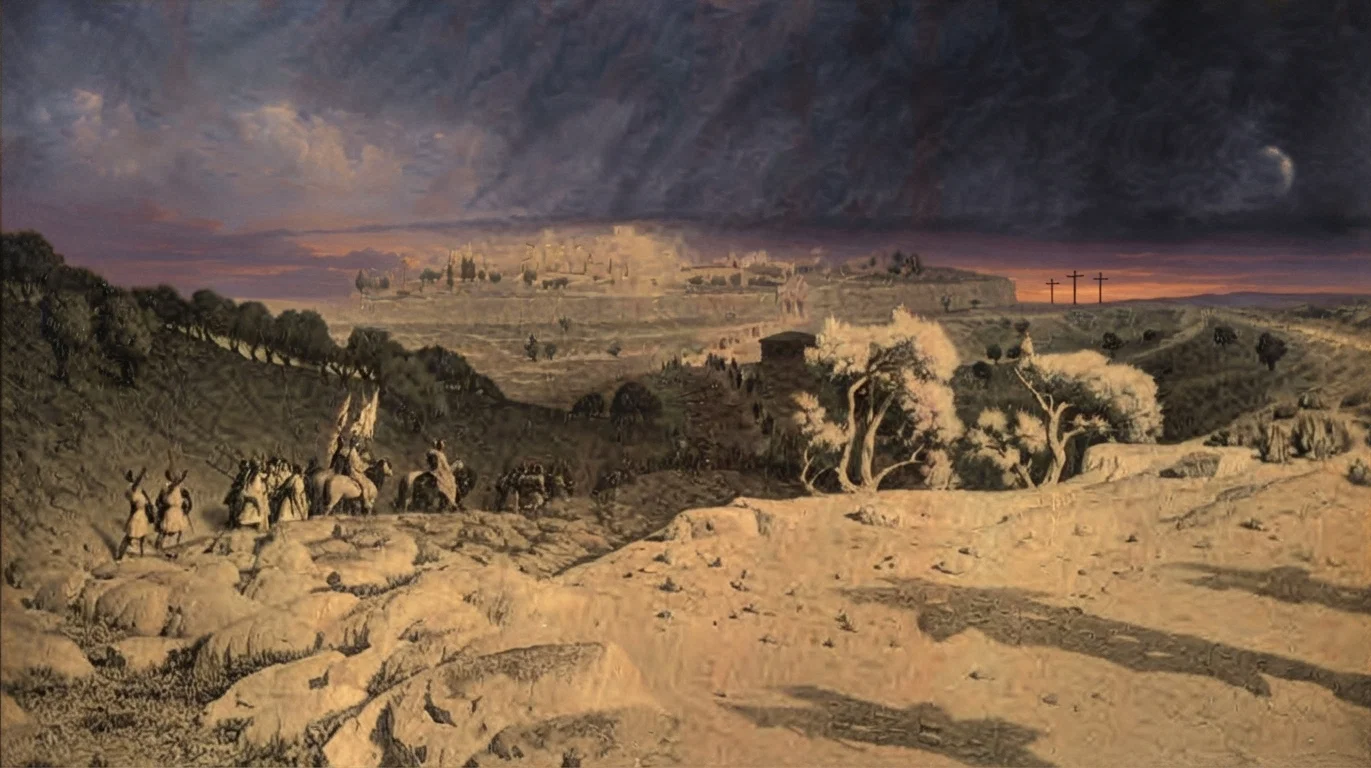
"Calvary," from a painting by J. L. Gerome.
WHEN He would reveal to man the climax of His love, in His providence it was done on some barren knoll outside Jerusalem, called Golgotha in Hebrew, Calvary in Latin, in common English, a skull. There died the Son of God who all His ministry had been saying, “God loves you,” but who in His death on Golgotha proclaimed, “Behold how much God loves you!” The barren, rugged, saw-toothed peak of Sinai met its complement in the barren, rounded knoll of Calvary. On both God revealed His love.
From Sinai blazed forth in glory insupportable the awful purity and holiness of God’s character, in the light of which man’s utter sinfulness, depravity, and hopelessness in himself stand revealed. From the quaking, flaming mount in the desert was revealed that law, the completeness and perfection of which has been the wonder of the centuries. “The law of Jehovah is perfect.” From its gleaming heights, handed down thru Moses, came the law of types and symbols, greatly elaborated, pointing to Christ, the complete Sacrifice. Those who there confessed their sins and manifested by appointed offerings their faith in the saving, healing mercy of God, stepped into the shadow of the cross and were shielded from the burning glory of God which ever consumes sin.
THE shadow of that cross reached back to lost Eden and comforted the souls who fled from Paradise, fearful of the burning glory of the visible cherubim. Christ was the Lamb slain from the foundation of the world. Calvary marks no new degrees in God’s love, no new impulse in the divineHeart. “I have loved thee with an everlasting love” was as true when Sinai blazed with His visible presence and Jeremiah sobbed his pleadings with apostate, broken Israel, as it was when Jesus Christ died upon the cross. It was only another step in the cumulative evidence of God’s love to man. It was the complete pledge of fulness of love to which poor, weak, and sinful man could ever turn with hope, and know that the very Being against whom he had sinned loved even him with a love beyond all human expression. For “He that spared not His own Son, but delivered Him up for us all, how shall He not also with Him freely give us all things.” Rom. 8:32.
BUT Calvary excuses no cherished sin. Mighty as is the love, it will not, can not, possess the heart that cherishes among its dwellers the enemy of Christ. O soul, do you know that transgression of God’s law put Christ to death—your transgression, our transgression? for He died to save us from our sins, to “redeem us from all iniquity.” Unavailing is that love to us if it do not win us away from all transgression of God’s law, the very Personification of which died upon the cross. Will you not let Love remove the sin, and place within your heart the spirit of love, so that you can say forevermore, “This is the love of God that we keep His commandments, and His commandments are not grievous”?