JOHN THE FORERUNNER

8%

Pacific Press Publishing Company · Mountain View, California · Mar 13, 1907

FromSigns of the Times, Vol. 33, No. 11.

Read the full edition

JOHN THE FORERUNNER.

EVERY reform of God has begun in littleness and humility. He has chosen for the inception and inauguration of that work lowly souls having neither recognized power nor influence in the world, rather than the decrees of kings, the actions of the parliaments of nations, the power of the armies of men, or the great influence of the universities of earth. All these have many times been arrayed against His work, but despite of all opposition that work has gone forward.
IF God should begin His work thru earth's great and learned and wise and wealthy, it is easy to perceive that they would receive the glory of its success and progress, and the human would overshadow the divine. "But God chose the foolish things of the world that He might put to shame them that are wise; and God chose the weak things of the world, that He might put to shame the things that are strong; and the base things of the world, and the things that are despised, did God choose, yea, and the things that are not, that He might bring to naught the things that are; that no flesh should glory before God."
THE reform which preceded the first advent of Jesus Christ was no exception to this general rule. As the herald and apostle of that reform, the obscure son of a humble priest was chosen. His childhood was with his parents, during which period he doubtless attended school. But his boyhood and early manhood were passed in the wilderness, the wild, rugged region in the east of Judea, west of the Dead Sea. Here, by an abstemious life of hard discipline and devotion, he learned God's greatness and man's littleness. The mighty thunder storms which swept over the mountains, the raging torrents which plowed the desert wadys and valleys, the silent star-gemmed night, the blue skies, and genial sun, all spoke to him of God's love, purity, wisdom, and power. As he read and meditated upon the law and the prophets, his soul became surcharged with the Spirit of God, the spirit of the ancient prophets; and he longed to see Israel free from her sins and meaningless traditions.
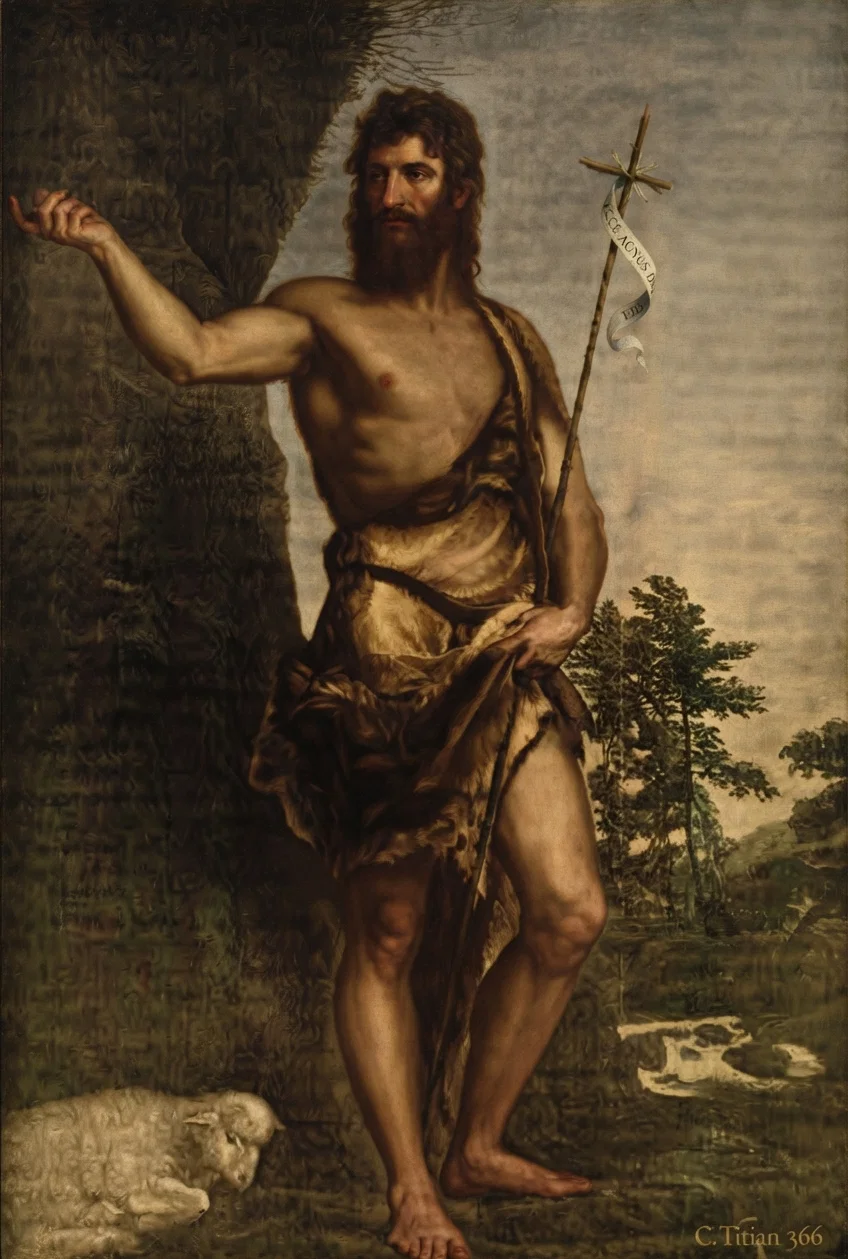
JOHN THE BAPTIST IN THE WILDERNESS.
WHEN the time came, God called him, called him to go before the face of the Anointed One, announce His coming, and plead with the "chosen people" to prepare to receive Him. Very particular is the "beloved physician" to tell the very time when the call of God came to John, and he responded to that call. Luke 3:1, 2.
FORTH from the wilderness came the messenger, clad in the garb of an ancient prophet. 2 Kings 1:8. Fearful and terrible as an Elijah he came. Simple, radical, uplifting, awful, was his message:
"Repent ye; for the kingdom of heaven is at hand. . . . Bring forth fruit worthy of repentance: and think not to say within yourselves, We have Abraham to our father; for I say unto you, that God is able of these stones to raise up children unto Abraham. And even now the ax lieth at the root of thetrees; every tree therefore that bringeth not forth good fruit is hewn down, and cast into the fire. I indeed baptize you in water unto repentance; but He that cometh after me is mightier than I, whose shoes I am not worthy to bear: He shall baptize you in the Holy Spirit and in fire: whose fan is in His hand, and He will thoroly cleanse His thrashing-floor; and He will gather His wheat into the garner, but the chaff He will burn up with unquenchable fire." Matt. 3: 1-12.
CLEAR-CUT and direct was the message. "Repent ye," demands no mere show of sorrow, but a sorrow and forsaking of sin that needs not to be repented of (2 Cor. 7: 10, 11), a reformation of life and character. It meant a turning from vain, empty tradition to the word of God, from a "public conscience" to the law of God, from sin as God defined it to the righteousness of God. It set aside the human and exalted the divine. It made of none effect the elaborate schools of the rabbis, and brought men face to face with God. It tore to tatters mere priestly succession and hereditary holiness, and made paramount and essential divine regeneration. It spared neither sinning royalty nor perversive education. The king upon the throne heard and trembled. Multitudes of the people listened, heard, repented, and were baptized. Even priests and scribes, Saducees and Pharisees, moved by the mighty spirit of unrest and inquiry, came to hear and criticise and condemn.
IN all his message was echoed the prophet's cry of seven centuries before: "Prepare ye in the wilderness the way of Jehovah; make level in the desert a highway for our God. . . . All flesh is grass, and all the goodliness thereof is as the flower of the field. The grass withereth, the flower fadeth, because the breath of Jehovah bloweth upon it; surely the people is grass. The grass withereth, the flower fadeth; but the word of our God shall stand forever." Isa. 40: 3-8. Seven hundred years had that prophecy in its specific purpose lain dormant. Seven hundred years rolled by and God gave it life, "when the fulness of the time came." God is everything; man is nothing only as he is connected with God.
JOHN was the embodiment of his message. In the words of the Master, no greater prophet was born; in the conduct of the man, none was more humble nor self-effacing. When the committee of priests and Levites sent from Jerusalem came to examine him, they asked, "Who art thou?" He told them he was not the Christ, not that prophet, not Elijah. He did not even mention his noble, honorable ancestors, running back to Abraham. "I am the voice of one crying in the wilderness, Make straight the way of the Lord, as said the prophet Isaiah." He knew his mission and his message. He was not a reed shaken by the wind. He was content to eliminate himself, and be a voice, merely a voice for God. For the glory of the Master he wrought. His disciples, jealous of his fame, tell him that the greater number go to Jesus. He responds: "A man can receive nothing, except it have been given him from heaven. Ye yourselves bear me witness that
I said, I am not the Christ, but, that I am sent before Him. . . . The friend of the bridegroom . . . rejoiceth greatly because of the bridegroom's voice: this my joy therefore is made full. He must increase, but I must decrease." Blessed humility which could see his own life and light fade out in the greater glory of the Master.
GOD has a message for this time, which must go as did that of John's in "the spirit and power of Elijah." It is a message of prophecy which slumbered for eighteen long centuries. Its time is now due. It must be given in lowliness, in meekness, in humility, in self-effacement, yet in fearlessness and power. That message is, "Fear God, and give Him glory; for the hour of His judgment is come; and worship Him that made the heaven and the earth and sea and fountains of waters." Rev. 14: 6-14. From glory and worship of the human it calls to the divine; from the fear of man it calls to the fear of God; from the contrary decisions of the creeds and councils and parliaments of men to the judgment of God; from the education in the mire of evolution to the Maker of heaven and earth. It tells the sad story of Babylon's sickness, her moral fall and union with the world. It warns of the awful consequences of the rejection of the message, the unmixed wrath of God, the burning up of the chaff. Matt. 3: 12. But it tells that which may be true to every one, the glorious development of characters which "keep the commandments of God and the testimony of Jesus" at the coming of the Master. Reader, will you be one to heed this message?