ONE of the maxims of Confucius runs, "If you visit a foreign State, ask what the prohibitions are; if you go into a strange neighborhood, inquire what the manners and customs are." In this statement the sage has epitomized the social life of China. With the Chinese many of their forms and ceremonies are all but sacred, and custom is of more binding obligation than imperial edict.
While the knowledge of the customs of the people and the etiquette of its society is of advantage to the sojourner in any land, it is a positive necessity to successful intercourse with the Chinese. Disregard of these by the foreigner, either thru ignorance or inattention, marks him a barbarian, and brings a shock to the Chinese senses not easily overcome. The merchant class, who come with money, may on this account be more easily pardoned, but the diplomat who would win favor can not afford to be indifferent. Much more he who comes as an ambassador of heaven, bearing a message to the hearts of this people, needs to study his avenues of approach that he may not cause offense.
To the Chinese oriental, traditional custom is everything, and perhaps no more common reply to the foreigner's interrogations is given than, This is our custom. Reason there need be none; a better way there could not be; custom has settled it all, and is not to be questioned. This was illustrated in the case of two little girls who often came to our house to play. They were in the habit of laying hands on everything, examining wearing apparel, peeping into boxes and drawers everywhere, much to the annoyance of the family. One day when this general "doing" of our domicile began, they were told foreign custom does not permit visitors to handle things about the house. Thus reminded of their breach of manners, the offense has not been repeated, altho the little visitors continue to be frequent callers.
Invitations to Homes.
One of the most delicate tasks is the acceptance of invitations to the homes of the people, but how may one better learn to know them than by association in their homes. Evidently this is part of our ministry, and invitations must not be slighted even tho their acceptance cost us effort and sometimes mortification. A genuine interest in, and unselfish love for, the people for whose sake we have chosen voluntary exile from kindred and friends, will help us in winning our way with a people as truly our antipodes socially as they are longitudinally.
On one occasion the acceptance of an invitation to a certain home led the way to the homes of a large circle of relatives, and finally opened to us the lady's family home, one of the finest official residences of the city, with its inmates of more than twoscore of women, most of whom have a fairly good knowledge of characters, and a number of whom in the occasion of return calls have expressed themselves as anxious to study the Scriptures.
Of the Niceties of Chinese Etiquette
it were presumption for a novice to attempt to speak, when by the folding of his note paper, the intonation of voice, the attitude of his person, the movement of his hands, as in a multitude of small things, the host may slight or openly convey insult upon his uninitiated guest, degrading him alike in the eyes of attendants and guests, while to the unsuspecting foreigner he is apparently all courtesy.
One of our number expressed to his teacher, who was also a Christian evangelist, the satisfaction he felt in the consciousness that little by little his tongue and his ear were yielding as he continued the study of the language. "I begin to feel that in the end I shall be able to make myself understood by this people," he said. "Yes," replied the teacher dubiously, "but, sir, do you know you have a much more difficult problem yet before you in the study of the people, their disposition, characteristics, and customs, before you can effectively labor for them?"
The Queue.
Upon one's first arrival in China, one universal custom most strikingly attracts his attention—that of the queue among the men. The head is shaved back to a circle around the crown, where the hair is grown long and plaited into a long, black braid which hangs down the wearer's back. While this is acknowledged to be a troublesome mode, and was in the beginning enforced as a badge of the hated Manchus' supremacy, having once become an established custom, the Chinaman thru many inconveniences clings to the queue. He winds it about his head or stuffs it away in his pocket or tucks it under an outer garment when it becomes too troublesome in the course of his duties, but only as a last resort will the conservative man submit this useless appendage to the barber's razor.13Their hair is said to be a mark of wisdom, and hence one sometimes sees a few pitiful stray hairs reverently laid together, falling from an almost bald pate; but queue of some sort there must be. In general there seems to be a preference for a heavy braid, and where nature fails to provide abundantly, false hair is braided in, and the sum of both lengthened by the addition of silk thread or cord to suit the wearer's taste.
Among the common classes every man looks just like all the others to the newcomer, the only difference being that some are clothed in blue and others in brown cotton garments, and it is only after some sojourn among them that he begins to single them out as individuals and to realize facial differences.
Foot-Binding.
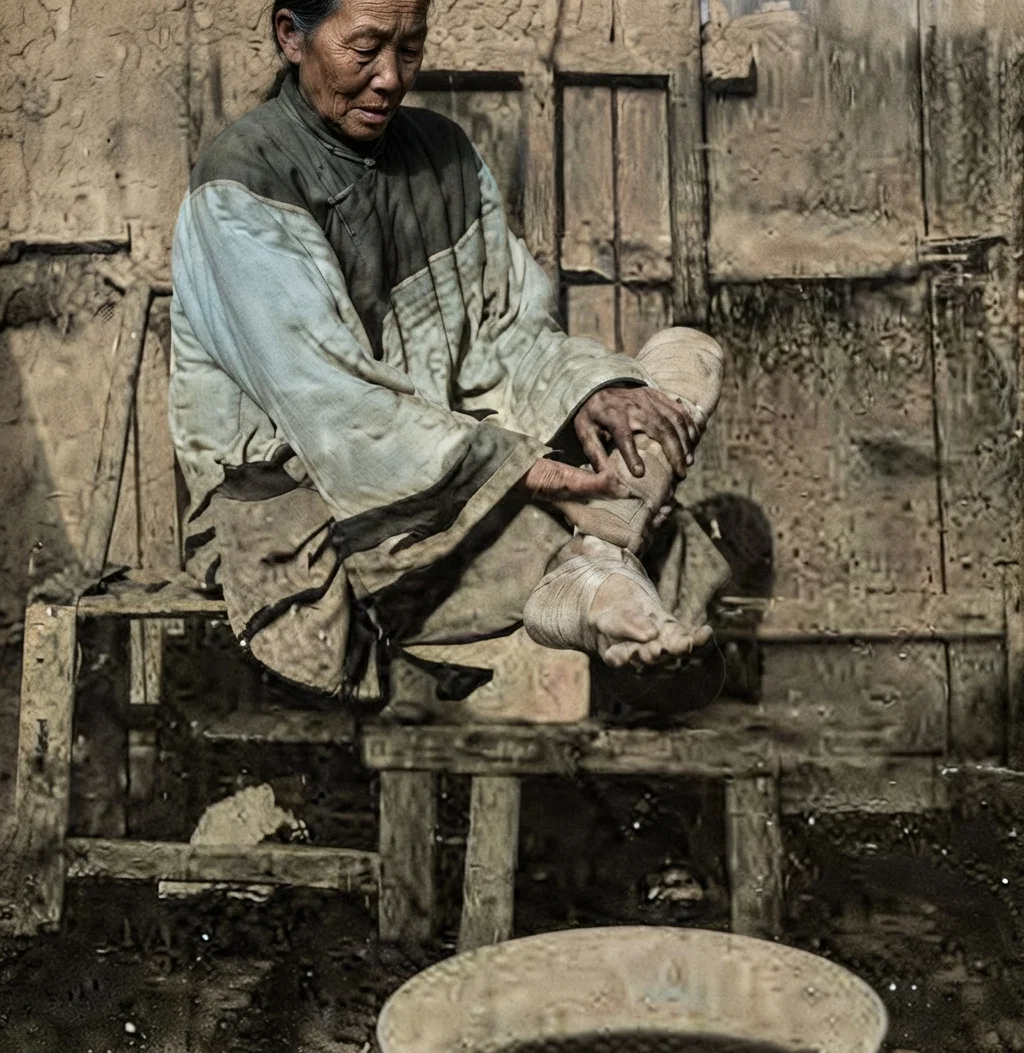
Altho foot-binding is universally known to be a Chinese custom, the first actual sight of the victim of so ridiculous a practise is sure to bring the exclamation, O, there is a bound-footed woman! Pitiful object, too, she is stubbing along on two dwarfed stumps, more nearly resembling the forefeet of a goat than the natural human members.
In early childhood the foot is bound so firmly that as partial development must take place the heel and ball of the foot touch, the toes being doubled under, and the arch of the foot thrown up in a hideous hump. The entire deformed mass is wrapped much as the surgeon binds a wound with strips of cloth, sometimes of bright colors, wound round and round, and the feet are thrust into tiny shoes, "golden lilies" the wearer loves to call them. Some of these shoes are known to the writer to be not more than two and one-half inches long.
"I was quite disappointed in the little shoes you sent," wrote a gentleman who had made request for some of these small shoes. "I had hoped for some the actual size of those worn by the women of China. I can not believe a woman could stand in such shoes as those you sent." But they can and do, thousands, even millions, bearing thru life the misery of such needless torture. For the shoes sent were given us by one of the girls in our Canton school for girls, and were made and worn by her aunt, who is also known as a visitor there.
One of the teachers in this same school is at present fulfilling her tasks in a pair about the same size. At the first week's end she asked leave of absence for a day with her sister, saying a servant was waiting for her, much as one might speak of horse and carriage. Leave having been granted, the teacher composedly took position on the strong woman's back, and was carried merrily off two or three miles, thru the narrow, crowded streets, to the opposite side of the city. Nor was there anything unusual or undignified in the sight of the Chinese in such a procedure.
This practise, like the wearing of the queue, altho universally condemned, is slow to take its leave. But to the satisfaction of the better thinking people, it is surely losing ground, especially in the southern provinces, where in this present time the percentage of small children continuing the practise is small. And yet we do see mothers, who themselves have enjoyed the freedom of natural feet, falling back to foot-binding in the rearing of daughters.
The Town of Kulangsu, Opposite Amoy, China.
"Your own feet are free, why have you bound A'Foon's?" I asked my neighbor.
"Because girls with natural feet do not marry so well in our country village," was the frank reply. This is the real obstacle to absolute reform.
Three imperial decrees have not been able to overcome the hoary custom. Manchus do not practise foot-binding, but while the present dynasty forced the token of the queue upon its male subjects, it has been powerless to loose the feet of its women.
Similar to Scripture Customs.
Some Chinese customs and practises strongly remind us of glimpses of oriental life in the Scriptures, as, when traveling, we pass the public wells at watering time, and see the villagers "come hither to draw," we recall the scene at Samaria's well, or remember the fugitive Jacob, weary and thirsty, by Haran's spring. Here, maidens and matrons, less picturesquely, carry the water home in large wooden buckets suspended from a yole, or yoke, on the shoulders.
Farther on we stop at an inn. The doors are swung open, and we enter to find ourselves in an open court enclosed by low buildings for the accommodation of travelers. Here also are the mangers for provender, the trough for watering, and the shelter for beasts; and we think of the crowded inn at Bethlehem.
Again, we hear the clanging of discordant music mingled with the wailing of the mourning women. We peep thru the open door to see the family in sackcloth garments, with pieces of the same coarse material tied around the head, sitting unwashed and uncombed, eating, if at all, with their fingers, in exhibition of grief, the food supplied by friends; and we are reminded of scenes pictured in the New Testament of the chamber where Dorcas lay, and the room where the ruler's daughter slept.
Marriage Customs.
Parents negotiating thru go-betweens for the marriage of their son to a girl whom he has never seen, make us wish for a host of Eliezers in China, so that more often it might be said as then, "She became his wife, and he loved her." Also, in China the whole affair is often one only of pecuniary or social advantage to the contracting families. The bride goes weeping, and instead of a father's blessing, there follow her, as she passes out from under the parental roof in the bridal chair, gorgeous in red and gold, borne by beggars, the wailing voices of her sisters, who mourn her as lost to them. And so she is; for by this transaction of marriage, she becomes the property of the family to whom she goes; and unless the mother-in-law is better than custom requires, or her own obstreperousness of disposition makes her a terror in her new home, her position is but little better than that of a slave in her husband's family.
The number of wives a Chinaman may have is limited only by his desire and his means; and in wealthy families the favorite wife's apartments are sometimes so richly furnished as to remind one of the palace where Esther became queen. "My uncle is a very rich man, he has nineteen wives," a young man said to us sometime ago. "Only the young one lives with him in his new house. The others stay in the old family home inside the city wall." Let it be said, however, in fact there is only one real wife, the first one, women later chosen,—"little wives,"—sustaining rather the relation of concubines. All the children, by fiction of calling it so, belong to the first wife. In some of these homes the trials of Abraham intensified many times over are in process.
The worker for God in China is richly repaid for all the sacrifices he has made as he sees the Gospel breaking down the power of time-honored customs; women are educated and elevated; children are loved and trained; homes are created; distrust and strife give place to confidence and peace in the circle of the church of Christ.