CHINESE EDUCATION

6%

Pacific Press Publishing Company · Mountain View, California · Apr 10, 1907

FromSigns of the Times, Vol. 33, No. 15.

Read the full edition
CHINA
CHINA

CHINESE EDUCATION.

(Concluded from last week.)

The Preparatory Course.

THE Chinese boy has, upon entering school, for his first book, the Trimetrical Classic (compiled A.D. 1050), written in rhyme in lines of three words each, in all, 1,068 words. It is indeed the first book, but far from what would pass for a primer among foreigners. It begins with the nature of man, and the importance of proper methods in education. The opening sentence contains a disputed doctrine in the heathen world, and it is profound enough to severely tax the mental powers of a Shakespearean student: "Men at their birth, are by nature radically good; Tho alike in this, in practise they widely diverge. "As gems unwrought serve no useful end; So men untaught will never know what right conduct is." Following this introduction, several instances of youthful learning and precosity are cited, tending to show the value and necessity of education. Again the subject changes, and the primer class is taught categories of numerical series; such as the three powers, heaven, earth, and man; the five cardinal virtues; the six kinds of grain, etc. Next is a bit of Chinese history in the tersest form possible; and the book ends with some very interesting and helpful examples of olden-time youths in pursuit of knowledge. In one instance a youth is said to have tied his book to the horns of his ox as he pulled the plow; another studied his book at night by the light of a glowworm.
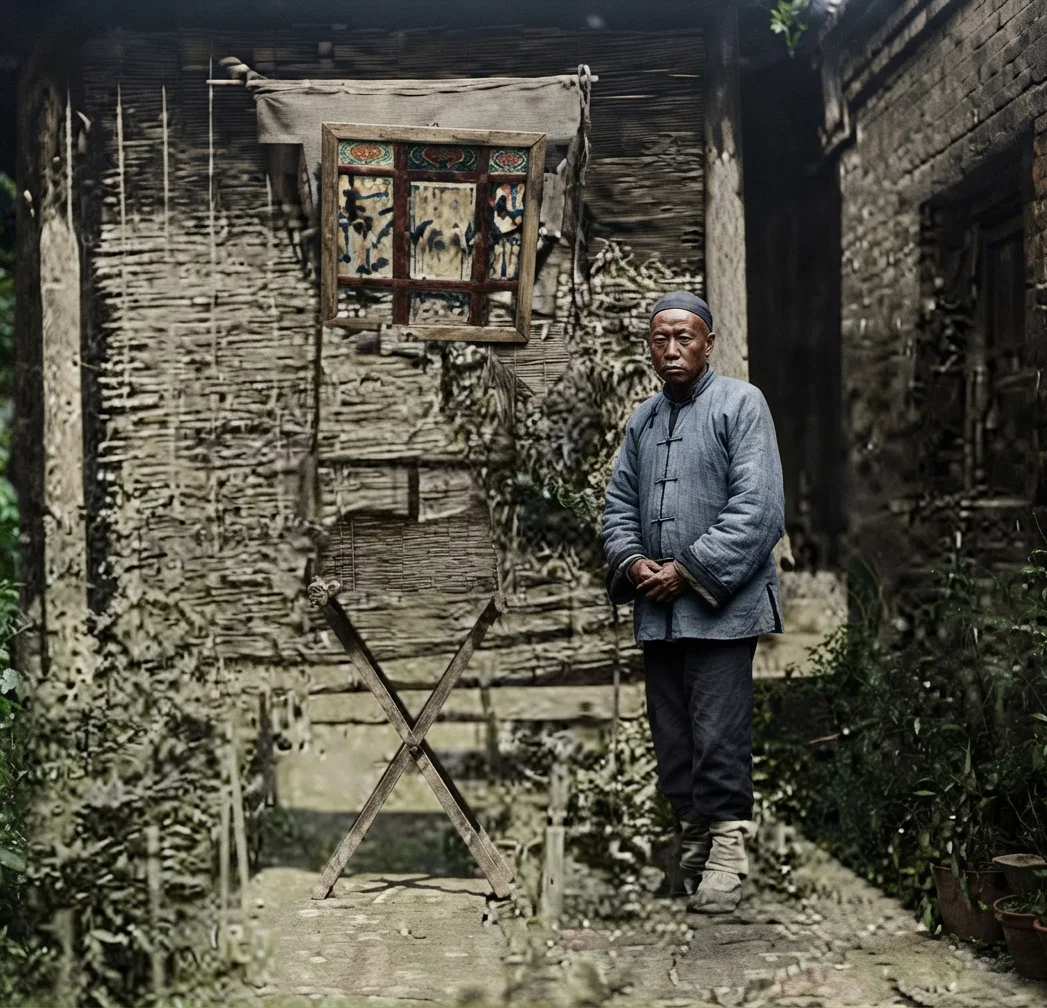
Chinese Doctor, Taken in Dr. Miller's Yard, Honan.
Next the boy is introduced to a little book entitled, "A Century of Surnames," being a list of family or clan names commonly in use. Its value lies in the fact of imparting a knowledge of Chinese characters in so far as they are used to designate persons.
The third in the list of books studied by the little Chinese schoolboy, is the "Millenary Classic," made up, as its name implies, of just one thousand characters, no two of which are alike either in form or meaning. It is said to have been written at the instance of the emperor, about A.D. 550. As to its subject matter it is very similar to the first book. It begins by giving a bit of Chinese history, and then it discourses about the power and capacities of man, his social duties and mode of conduct, the virtue of the ancient monarchs, agriculture, and private and literary life.
Book number four, "Odes for the Children," also in rhyme, deals with much the same topics. It gives unstinted praise to literary attainments. Allusions to the changes of the seasons and to the beauties of nature occur.
Next in the course is a small book entitled, "The Canons of Filial Piety." It is regarded as one of the best books in the language, and its influence has been very great and enduring. As the name implies, its purpose is to inculcate filial piety.
The sixth and last of this series of preparatory books is the "Juvenile Instructor." In point of subject matter it is very similar to the five preceding books. Its place and standing among the Chinese is quite clearly indicated by the words of one of its fifty commentators, "We confide in the 'Juvenile Instructor' as we do in the gods, and we revere it as we do our parents." It teaches the duties to rulers, kindred, and fellow man; and also the duties we owe to ourselves in the matter of study, demeanor, food, and dress. It concludes with a collection of sayings, or maxims, of wise men which are in turn illustrated by examples of good and virtuous men.
The influence these six school books have exerted on this race is almost inconceivable. No doubt they contain the very kernel of all Chinese literature; and since the vast majority of Chinese men do not for various reasons pursue their studies beyond these preparatory works, it follows as a matter of course that the entire race is leavened and molded by the spirit and matter of these books.

Higher Education.

This is Chinese elementary education; higher education is the same in spirit, and deals with the same subject matter, tho of course in a deeper and more searching way. Here we have the "Four Books," and the "Five Classics," nine works altogether. They were either written or edited by Confucius or his disciples before the time of Christ. It is not overstating the case to say that these books constitute the sacred writings of the Chinese race.
The aim and end of all Chinese education is the Mandrinate (political preferment) or trade. Education in China never leads to the liberal professions, as in foreign lands, for the simple reason that there are none such here.
Chinese education has made this race a peace-loving people. Until within the last few years, China has never failed to assign to war and all its attendant evils a subordinate place.
Like all mere human educational systems, this one of China's has many serious defects, chief of which is the failure to seeGod as the source of all wisdom, the spring of true intellectual and spiritual life; and in this it is only natural and inevitable that she should fail to measure the worth and the possibilities of the human soul. Here Christian education begins and ends; and on this very point China, beyond a peradventure, justly urges in this hour greater claims upon us than any other people in the world. J. N. ANDERSON.