The Bible.—A Symposium

5%

Pacific Press Publishing Company · MOUNTAIN VIEW, CALIFORNIA · May 1, 1907

FromSigns of the Times, Vol. 33, No. 18.

Read the full edition

The Bible.—A Symposium

Where We Got Our Bible.

MORE and more, as the enemies in the church are casting the dust of higher criticism upon the Sacred Record, men are asking where our Bible came from. There is not space in this brief paper to discuss the merits or demerits of their human judgment. Its object is to tell the reader in brief and simple story some of the great, important facts about the Book we call the Bible.

The Meaning of "Bible."

The word "Bible" is an Anglicized Greek word, Biblos, meaning book. Altho the Bible is composed of many books, yet the term Biblos came to be applied to the collection of books, as one book, the Book of books, preeminently above all other books.
The Bible is divided into two parts: the larger part, called the Old Testament, or Covenant; the smaller and latter part, the New Testament, or Covenant. This division of the Book is not of inspiration; it is a division made by men, because of changes in times and people. The Biblical term frequently used is The Scriptures, and with the scriptures of the Old Testament, and doubtless some of the Gospels, Peter classes the epistles of Paul. 2 Peter 3:15, 16. Almost invariably the term, "the Scriptures," in the New Testament, refers to the Old Testament writings, as the New Testament was then being written.
The Old Testament contains thirty-nine books, some of them combined by the Jews so as to make twenty-two, the number of the letters in the Hebrew alphabet. A threefold division was made of the Old Testament, called in Luke 24:44, "the law of Moses, the prophets, and the Psalms." These parts were called by the Jews, the Law, the Prophets, and the Hagiographa (Writings).
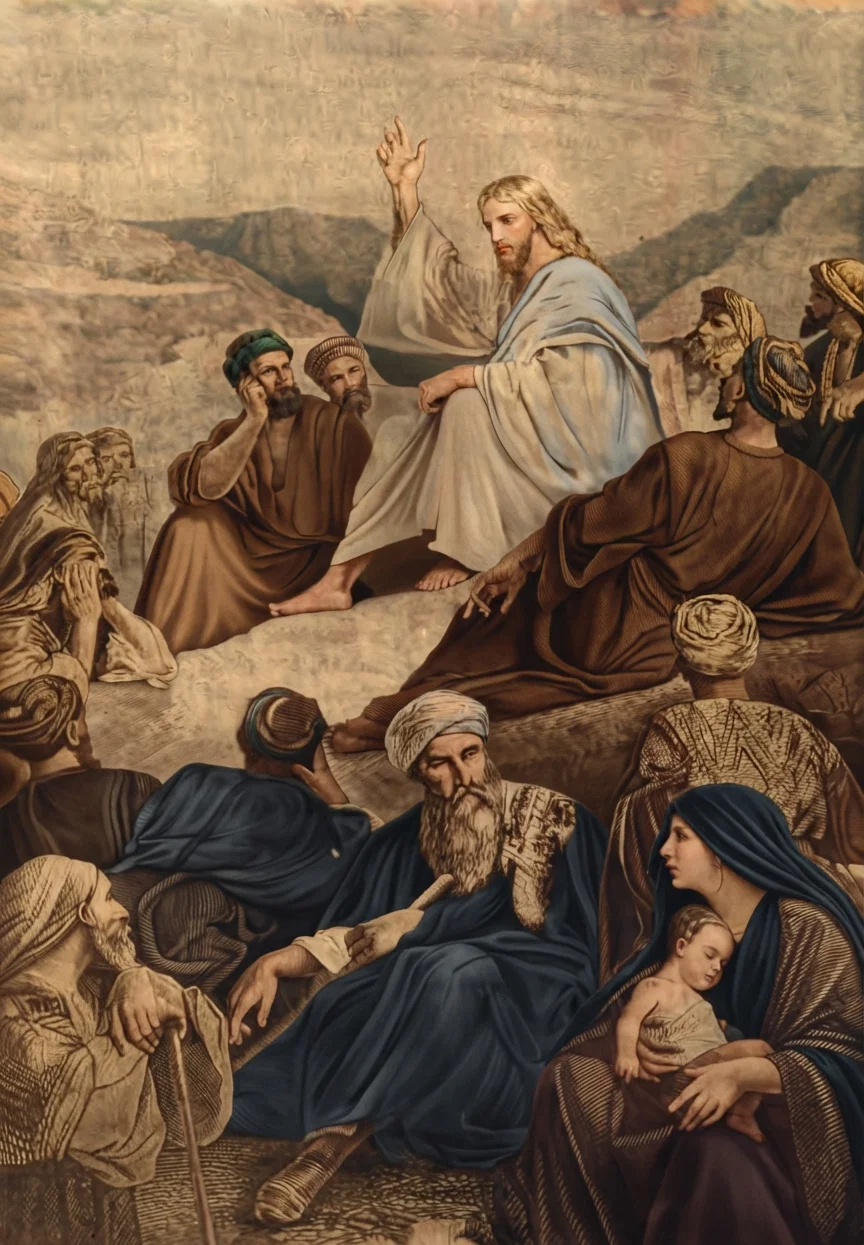
Bida. THE SERMON ON THE MOUNT.
The Law (the Pentateuch) consisted of the first five books of the Bible, or "books of Moses"—Genesis, Exodus, Leviticus, Numbers, Deuteronomy.
The Prophets, including also certain historical books, consist of Joshua, Judges, Samuel, first and second, Kings, first and second, Isaiah, Jeremiah, Ezekiel, and the twelve minor prophets as one book. Total number in "the Prophets," eight according to Jewish reckoning, twenty-one as given in the English.
The Writings (Hagiographa) consisted of Psalms, Proverbs, Job, Canticles, Ruth, Lamentations, Ecclesiastes, Esther, Daniel, Ezra, and Nehemiah, Chronicles, first and second, thirteen in all, or, as reckoned by the Jews in Palestine, eleven; in Alexandria, nine. The latter reckoned Ruth with Judges, and Lamentations with Jeremiah.
These thirty-nine books are not found in their chronological order, Jewish tradition and usage in reading in the synagog having its effect. The chronological order of the books of the Old Testament apart from the law and the historical books including Chronicles would be about as follows: Jonah, B.C. 860; Joel, Hosea, Amos, 800 to 780; Isaiah, Micah 780 to 740; Nahum, 713; Zephaniah, Jeremiah, Habakkuk, 630 to 620; Daniel, Ezekiel, Obadiah, Ezra, 600 to 536; Haggai, Zechariah, 520; Nehemiah, 446; Malachi, 390.

The Scripture Canon.

The word canon means primarily a straight staff, rule, or rod. Then a guide or model. Naturally it came to be applied to a normal principle, a rule of action; and as the Scriptures were considered the divine standard of action, the word canon was applied to them.Originally, before sin entered, man talked with God face to face, as in Eden. When sin entered, man could not endure God's glory, and the Lord sent His angels to talk with him. As man's heart became hardened more and more, God spoke His law from heaven, inscribed it upon two tables of stone, and gave it to His people. He gave it that man might know what sin was, and how far he had departed from the right standard. To further develop and explain the principles of this fundamental code, and to direct in worship and sacrifice, God gave other laws by Moses. These laws and the records of God's dealing with His children from the beginning, largely written by Moses, constitute the Pentateuch, or five book of Moses.
This became the standard by which all spiritual truth and conduct were judged. As prophet after prophet spoke and wrote, as new doctrines were promulgated, they were tested by the law. "To the law and to the testimony: if they speak not according to this word, it is because there is no light in them." Isa. 8:20. See also Deut. 13:1-5. God's law was the great test. And so it is recorded in the New Testament in the words of Jesus in that wonderful Sermon on the Mount, that it is the will or law (Ps. 40:7, 8) of God which is the test of character, and he who is not in harmony with that will is the doer of iniquity or lawlessness. Matt. 7:21-23. The Master is careful to let us know that His teaching does not contravene the law. Matt. 5:17-20. And among the last writings of the New Testament we read: "He that saith, I know Him [God], and keepeth not His commandments, is a liar, and the truth is not in him." 1 John 2:4.

The Compilation of the Old Testament Books.

The collection and arrangement of the Old Testament Scriptures was doubtless begun by Ezra, and continued by men of the Great Synagog who succeeded Ezra. The Old Testament Scriptures were endorsed and referred to by Jesus and His apostles as unquestionable authority. The Apocrypha, held by the Catholic Church, was never in the Hebrew canon. Altho the Jews exalted tradition and teachings of men till the word of God was made void in their hearts, they superstitiously preserved the Scriptures which condemned them.

The New Testament Canon.

The New Testament books were written in the very time of the apostles of Jesus Christ Himself. The possession of the gift of discernment of spirits in the church and their loyalty to the Scriptures and the law of God preserved the church from spurious writings.
The history of the collections of these writings is not as clear as their internal evidence. Peter speaks of Paul's epistles as tho there had been a collection made of them. Each church doubtless made collections for itself. The earliest uninspired record is attributed to Caius, a Roman presbyter in the last half of the second century. He recognizes all the books except Hebrews, James, the two epistles of Peter, and perhaps 3 John. The Peshito Syriac version of about this time includes Hebrews and James. There is a continued chain of evidence down to Tertullian, who uses the term New Testament for the first time, and calls the whole Bible "the instrument of both testaments."
The Church of Rome boasts that she has preserved the Scriptures. She did so precisely as the backslidden Jews did, thru superstition. The priceless manuscripts were hidden in monasteries and libraries, when they ought to have been seen in the life of the church. But these manuscripts were largely from the Greek, Syriac, and African churches. Rome once rejected the epistle to the Hebrews. Was she then infallible? She afterward accepted it. Was she then infallible also? Her claim to the authority of the Scriptures is utterly baseless. The commercial companies which send ships from England for the dark lands of earth, bearing brandy and Bibles, could with as good logic affirm that by their authority and wisdom and infallibility the heathen had received the word of God.
The Scriptures of truth tho given thru men are above men. All may prove false, as God's people proved false before Christ, as the church has apostatized since Christ, but God's wonderful providence has been over His word, and preserved it from pagan destruction without and atheistical philosophy and tradition within. ABDEL.