THE space that can be made to accommodate a family is well illustrated by two instances. Next door to our house in Canton is a large wholesale live-fish market. Between these houses there was originally an opening of about four and one half feet in width at the front, tapering to a brick's length in width at the rear. After a few days of pounding, grating, and grinding noises, as we supposed incident to repairs on the market's tile roof, we were surprised to find that a dwelling of two stories had been constructed in this crack between
the walls, which were also made to do service for the new domicile. There is living-room and a kitchen below, with sleeping-room on the second floor. When the street door is shut, the only outside ventilation is supplied thru what we would call, were it supplied with glass, a window in the front of the upper story. This must be closed to keep out rain. One man, two women, and two boys live in this home and carry on a restaurant business, serving meals from 5 A. M. to 8 P.M. to the fish-men, on tables set in a hollow square on the street pavement in front of their door.
Another less pretentious dwelling was constructed for one of the employees of the market, about the same time, against a jog in the wall at the opposite side of the market building. A frame was extended around the two open sides of this niche, thin boards nailed on for walls, and a tile shanty roof extended from the brick wall of the market house. Inside a partition separates this tiny house into two rooms—one exactly the size of the family bed, the other, used for living, dining, and all general purposes, is not so large. All the light and air that enter come thru the door, which thru the sultry nights of a tropical summer must be shut and barred while the inmates sleep.
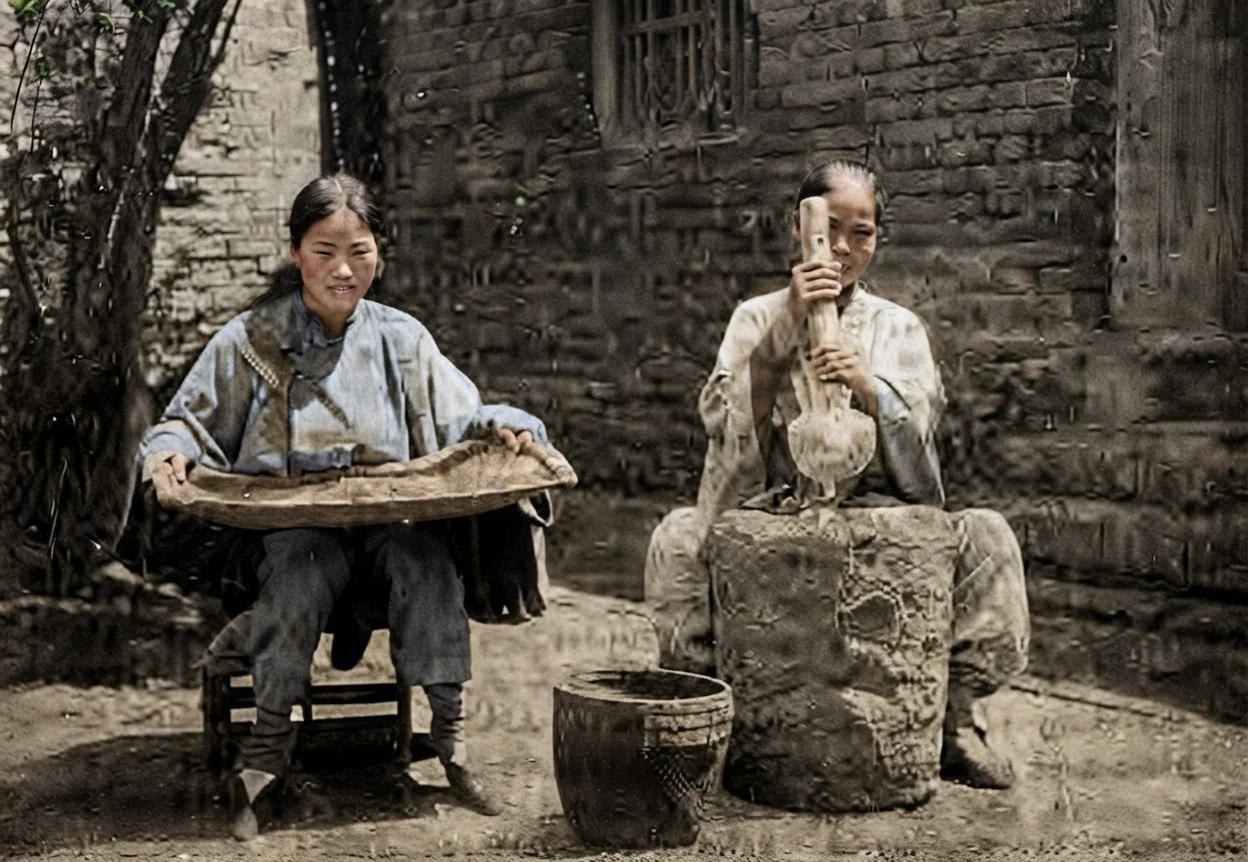
Women Working with Grain in Honan Province, China.
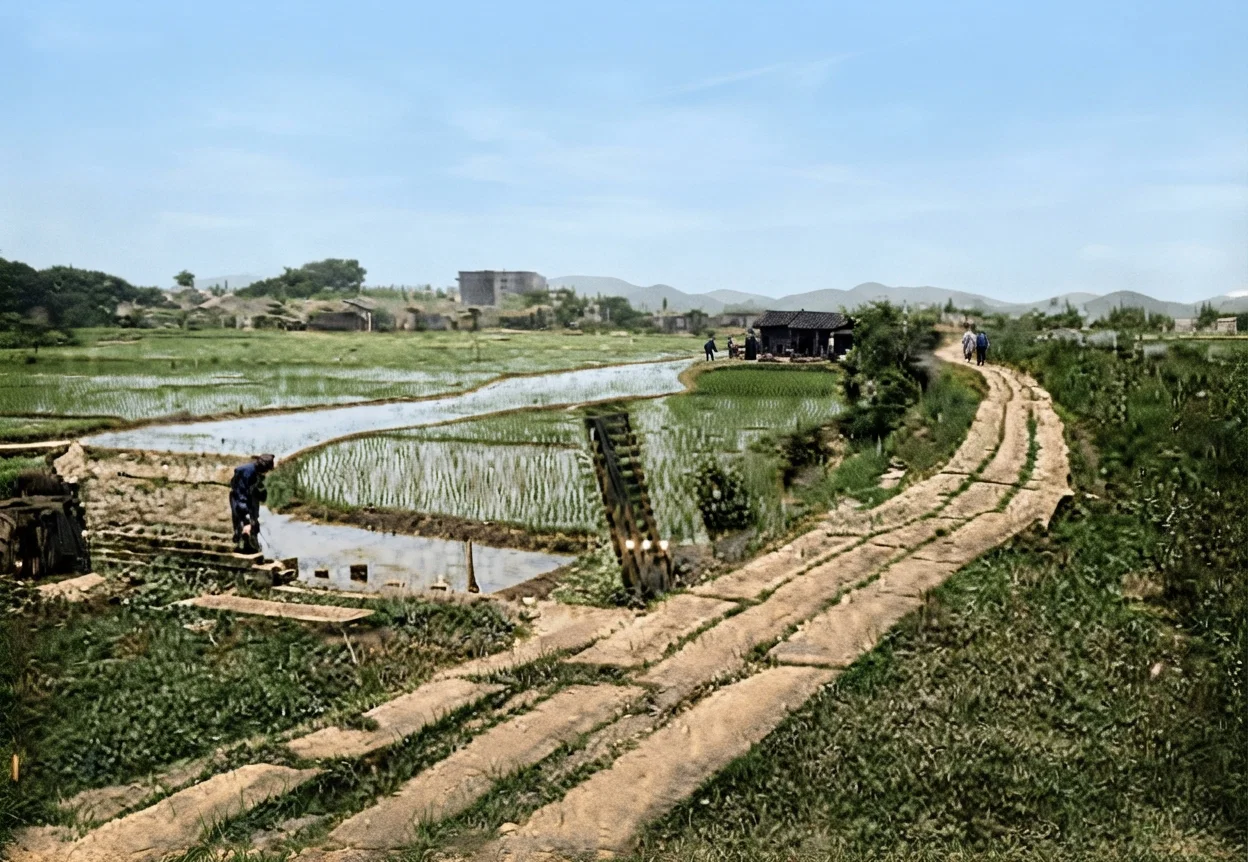
Among the Rice Fields of South China.
These are not slum tenements but the homes of men employed with a large and prosperous business concern.
The Wealth of China.
And yet it was stories of the wonderful wealth of the court of Kublai the Grand Kahn, as told by the celebrated Venetian on his return to Italy after a sojourn of more than twenty years in China, that quickened the world's commercial pulse and set sailing eastward an ever-increasing number of ships, until the question of "the open door" in China is one of the burning questions of the present hour.
As Marco Polo testified, the carved ivories, the polished stones, the beautiful wrought gold, rich creations of silk looms, exquisite embroideries, are all here, but the very people who produce them do so in squalor and poverty, employing still the same methods of hand labor which even in his day were traditional.
As one sees the silk weavers at work in their dingy, dark little homes festooned with dust-laden cobwebs overhead and spread with the grime of natural earth for floor beneath, while the reeling and spooling is carried on in the same room by women and children, whose garments and general appearance are in keeping with their surroundings, he wonders how it is possible for the man at the loom to preserve the fabric clean. Patiently he sits and throws the shuttle to and fro, each shift of the warp wearing deeper the hole made in the earth, as with steady step the treadles move up and down, while the beautifully designed brocade appears to form itself.
The Soil of China
even after these millenniums of cultivation is still extremely productive under the careful tillage of the most painstaking husbandmen. Where but in China would one see the farmer with two long-spouted buckets suspended from a yoke, watering his wheat fields after nightfall, or with the hoe carefully loosening the soil around the thrifty stools of springing grain, before the sun has risen to its heat? And where else would one see toil better repaid in golden grain than on the beautiful rolling plains of central China? And yet beyond what he himself15can use or can dispose of in his immediate vicinity, it profits the farmer but little, since without facilities for transportation the value of his produce is consumed in the effort to market it.
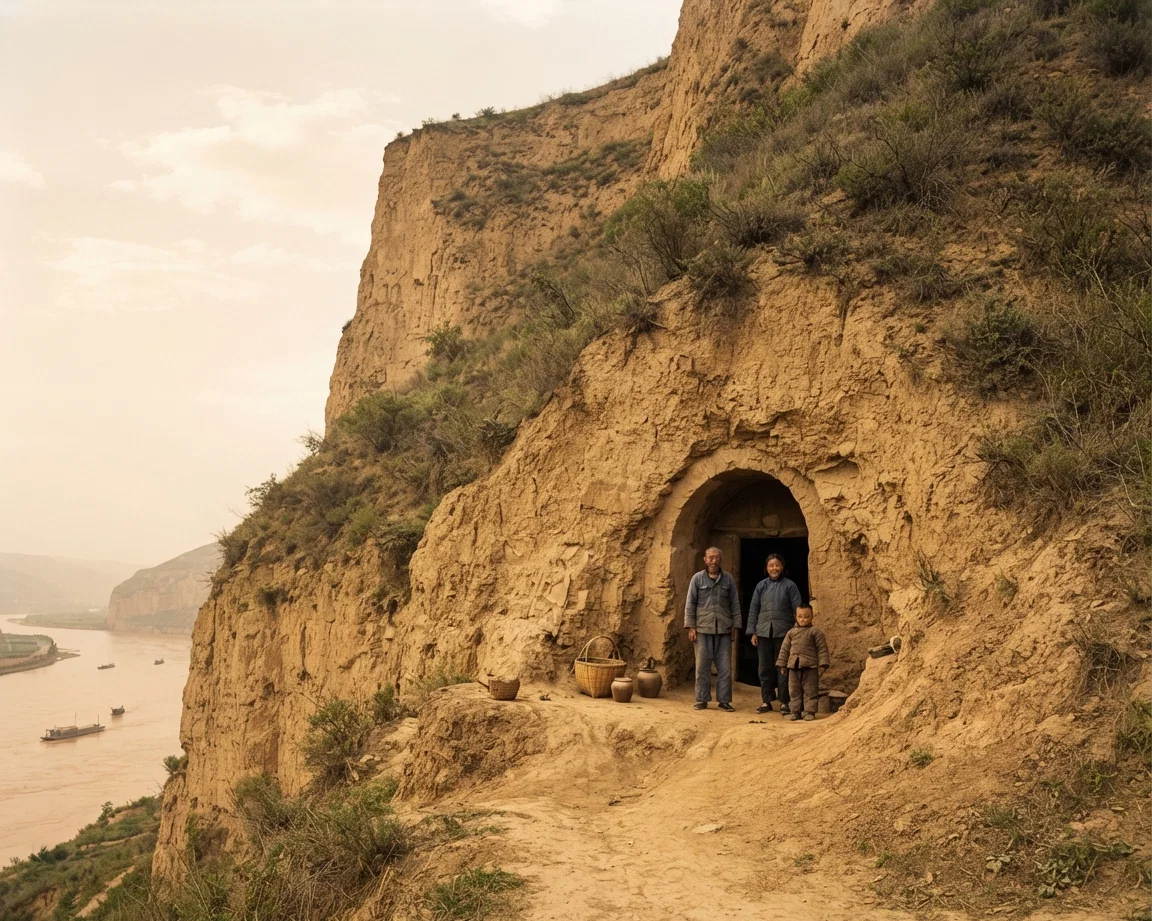
Cave Home on Yellow River, in Loess Deposit.
The same is true of the cotton crop in the slightly more southern belt. The farm hands, and that includes every member of the family old enough to pull weeds and not too old to carry a basket in which to gather every conceivable kind of fertilizer, toil thru the summer to secure the crop. All the early winter will be occupied with ginning, spinning, reeling, and weaving, all of which is done by hand; and after the New Year, the strong men of the family start out with wheelbarrow loads of the cloth to travel over roads not easily imagined and more hardly described, to dispose of the year's product in the village markets.
From village to village they travel, sometimes stopping at an inn waiting for market day, and again winding the serpentine path till at last they reach home with their barrows and a few needed articles taken in exchange for cloth. Above the payment of their traveling expenses, the venture is considered fairly successful. Should there be a few strings of cash with this lot, there will be real rejoicing in the mud-walled, thatch-roofed home of the thrifty toilers.
Peopled by such a nation, frugal, contented, industrious, patient beyond belief, intelligent and enterprising if allowed the least opportunity for advancement, any kingdom might consider itself wealthy. Aside from the wonderful resource in her people, China has untold wealth in her metalliferous deposits.
The province of Shansi is said to be one vast area of coal-beds of a very superior quality—enough, as one authority estimates it, to supply the whole world at its present rate of consumption for thousands of years. The population, who by dint of industry are but able to barely wrench a subsistence from the thin deposit of soil on the top, have no way of turning to account the untold wealth easily within reach were they but allowed modern methods of mining and transportation.
With coal and iron in abundance, gold, silver, copper, tin, mercury, and lead in paying quantities, it has been ventured that the mineral resources of China not improbably excel those of any country in the world.