THE work of Jesus Christ in the great scheme of salvation is made up of different steps and acts. He stepped down from the throne of Deity and gave Himself for the salvation of His creatures. He became an Angel-messenger of God—among the angels. He stoops lower, and is incarnated, a Man among men. He met the climax of His eternal sacrifice by His death upon the cross. He arose again. He ascended on High. He ministers as priest before God. He comes again in glory transcendent, supernal.
Of all the steps or events in that great drama of love and power there is nothing more important than His second coming; for around it cluster all the hopes of the redeemed; and if it be not consummated, all the work of the past is for naught.
Small wonder, then, it is that the devil has done his best, or worst, to make of no effect the second coming of Christ in the minds of men. He has belittled it by His first falsehood, "Ye shall not surely die." He has brought upon it reproach by leading men to teach above that which is written. He has connected with it fanatics of every sort, and has made many believe that the doctrine was responsible for the fanaticism. He has thrown round about the doctrine a mysticism, an indefiniteness, that is entirely foreign to the word of truth. It is made to mean death, and spiritual revival, and Spiritualism, and Christian Science, and New Thought, and "the secret rapture" (whatever that may be), and still other things. The devil is at the bottom of it all with all the various schemes, if by some means he may deceive all. "Be not deceived" is the repeated injunction of the Master.
His First Advent.
How will He come the second time? Let us first ask, How did He come the first time?—Literally, personally, visibly. Men saw Him, handled Him, talked to and with Him, ate with Him, walked with Him. He was a literal, personal Being. No believer in the word questions this as regards His first advent.
He lived here upon this earth thirty-three years. He wrought miracles, preached the word, saved souls from sin, died on the cross, was raised from the dead, the same literal Jesus. Forty days after His resurrection He ascended to heaven. Clouds of angels of God met and escorted Him on His way. Two remained behind to instruct and comfort His disciples who sorrowfully watched their ascending Lord. And this is what the angels told them:
"Ye men of Galilee, why stand ye gazing up into heaven? THIS SAME JESUS, which is taken up from you into heaven, shall SO COME in LIKE MANNER as ye have SEEN HIM GO into heaven." Acts 1:11.
Note the emphasis. It is the "same Jesus," not another, not a representative. The "same Jesus" with whom they had associated for over three years, who died upon the cross, whom they had seen laid in the tomb, who rose again, the same Jesus is coming again.
They had seen Him rise Master over earth's attraction, and received by a cloud of angels. This same Jesus shall so come in like manner; even as they saw Him ascend, so shall He come again.
And this scripture is confirmed by many others. Listen:
"Behold, He cometh with clouds; and EVERY EYE SHALL SEE HIM." Rev. 1:7.
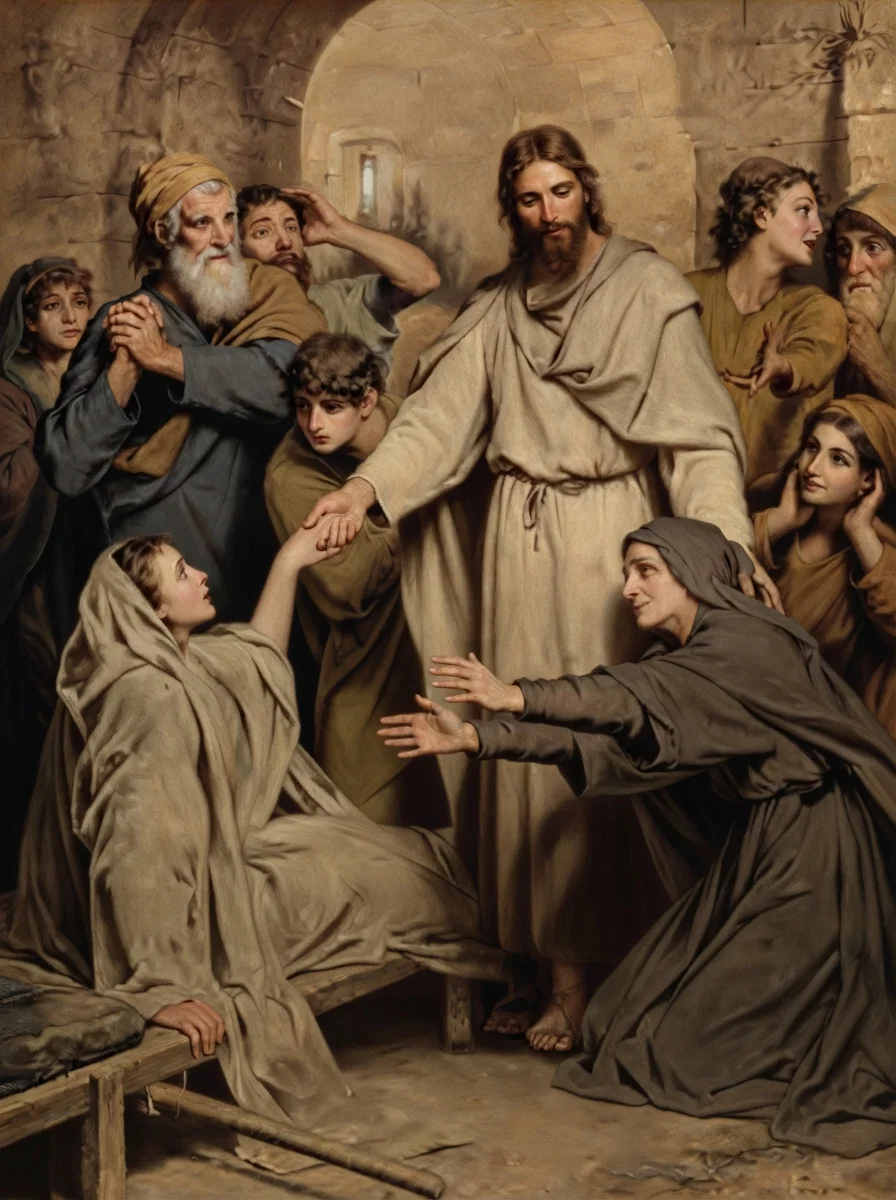
Jesus Restoring Life to the Young Man of Nain. 'This same Jesus' is coming again.
"Then shall they SEE THE SON OF MAN COMING in a cloud with power and great glory." Luke 21:27.
"The Son of Man shall come in the glory of His Father with His angels; and then He shall reward every man according to his works." Matt. 16:27.
What more testimony can we ask? Yet, notwithstanding this, there are those who teach that when Christ comes the second time for His people, it will be a secret coming, known only to His people. That, they tell us, is the parousia (pronounced, par-oo-see-ah), or presence of Christ. Some even contend that He is now here gathering out His bride; and that by and by He will come with His bride in a visible form.
But neither the Greek terms nor the Scriptures in general give any such idea as that. There are six different Greek words used of the Master's coming as follows: (1) The verb erchomai and its derivatives; it simply means to come, to go, to pass, without particular reference to manner. The noun denotes the simple act of coming, going, passing.
(2) The verb ephistemi, meaning to place upon, over, close by, to stand by or near, to come suddenly upon. Used of the judgments of God, in Luke 21:34; 1 Thess. 5:3. (3) Heko, defined to mean "to become, to have arrived." It simply means that the coming to which it refers is accomplished. (4) Parousia, meaning "presence, a coming, arrival, a being present, presence of persons." It means personal, bodily presence. See 2 Cor. 10:10; 7:6. The word is rendered in our Common Version by "coming," and "presence" only. (5) Apokalupsis, meaning disclosure, revelation, manifestation, appearance, uncovering, making known; the Greek title of the book of the Revelation. (6) A word not translated "coming," but "appearing," and "brightness;" namely, epiphaneia, "glorious display."
These last three words, when used of Christ's second coming, are erroneously applied to different comings, when they are descriptions of different phases of the same event. There are, in connection with Christ's priesthood, closing events which may be and are spoken of as comings, but not to be confounded with His visible coming for His people. A study of Christ's priesthood and the sanctuary question will make this clear. Without a knowledge of His priesthood, all is dark and confused. One of those "comings" is when Christ comes in before His Father to receive the kingdom (Dan. 7:13, 14). The other "coming" is when His priestly work is closed and He comes to reckon with His servants before He comes in glory. Matt. 25:19. This is not a coming to earth or for His servants. It is a judgment act previous to Christ's coming, when probation shall close, the beginning of the day of God's wrath, known only to Him. Rev. 22:11, 12; 2 Peter 3:10; Matt. 24:42-44, 46; 25:10, 19; Mark 13:35; Rev. 3:3, et al. Then Christ is no longer priest, but comes into relationship to His people as judge.
But His second personal coming of promise and declaration is revealed under the parousia, the epiphaneia, the apokalupsis. The first word referring to His personal presence, the second to the forthshining of His glory, the third to His true disclosure as King of Kings, the glorious Son of God. That the personal presence (parousia) of Christ is not a secret affair, note the following Scriptures:
"For this we say unto you by the word of the Lord, that we that are alive, that are left unto the coming (presence, parousia) of the Lord, shall in nowise precede them that are fallen asleep. For the LORD HIMSELF shall descend from heaven, with a SHOUT, with the5VOICE of the archangel, and with the TRUMP OF GOD: and the dead in Christ shall rise first." 1 Thess. 4:15, 16.
"Whom the Lord Jesus shall slay with the breath of His mouth, and bring to naught by the manifestation of His coming [the epiphaneia of His parousia; literally by the FORTHSHINING of His PERSONAL PRESENCE]." 2 Thess. 2:8.
"For as the lightning cometh forth from the east, and is seen even unto the west; so shall be the coming [parousia, presence] of the Son of Man." Matt. 24:27.
Certainly none of these scriptures indicate a secret, quiet, still coming. It is over a quaking earth, with trumpet tones and outbursts of supernal glory that Christ comes the second time—literal, personal, visible, "this same Jesus" will come. Then men will see Him revealed in all His divine glory, unveiled. "Every eye shall see Him." Some in the light of that glory will pale and die. Others with glad hearts, having His glory within, will say, "Lo, this is our God; we have waited for Him, and He will save us."