A RE we on the eve of a new era of peace and good-will among the nations? Are armaments to cease? Will the swords be beaten into plowshares and the spears into pruning-hooks, and will the nations learn war no more? Will the pen, indeed, be acknowledged to be mightier than the sword, and is peaceful diplomacy to take the place of bloody encounters by land and sea, and arbitration to give the final word in all matters of dispute?
These are some of the questions that come into mind as we contemplate the opening of the second peace conference. It must be acknowledged that this large representative body of delegates from forty-five countries of the world is not without its significance. The great powers are here, and so are the less important ones. The delegates number nearly twice as many as the first peace conference in 1899, and there is reason to believe they have come to this gathering with a serious purpose to achieve, if possible, solid and practical results. Such a meeting as this would have been out of the question twenty years ago; it could hardly have been held in the nineteenth century. It is, then, a twentieth century development.
What does it all mean?
Are we face to face with a great millennium?
Or is it all a solemn mockery? Is it a case of "words smoother than butter," and "in the heart a drawn sword"?
Underlying Principles.
The sequel will have to decide. But it is safe to lay down some general principles at the very outset. The nations of to-day are more closely bound together by the ties of art and commerce than ever before in the history of the world. Modern facilities of travel have contributed much to bring representatives of different countries into close contact with one another and thus make for mutual friendliness. This is, moreover, a decidedly commercial and materialistic age. A religious war of the kind waged during the Middle Ages is hardly conceivable at the opening of the twentieth century. Ideals are rapidly shifting; ambitious men are seeking the material prizes offered by business and the more lucrative professions, to the neglect of the army and the church. The labor movement is exerting quite a strong influence against militarism, and the socialists are all for peace.
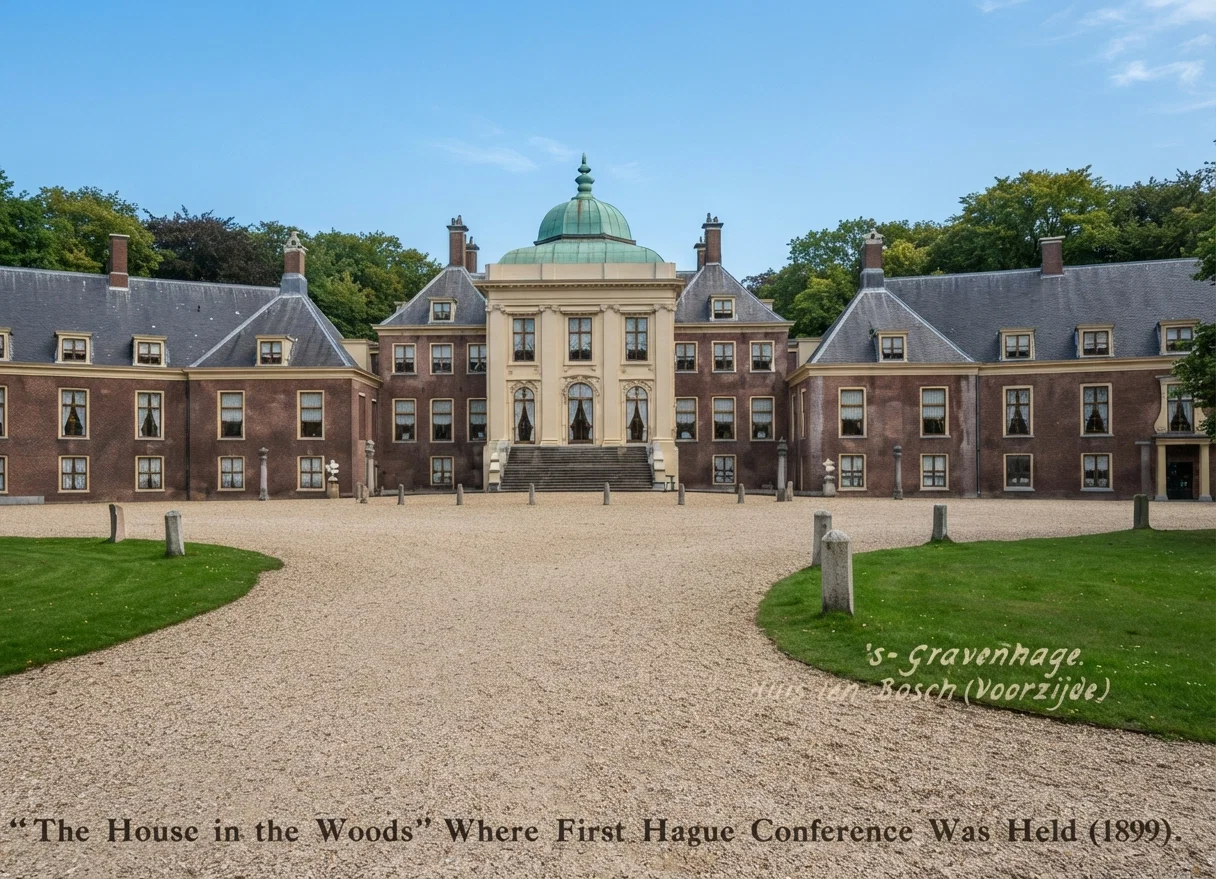
"The House in the Woods" Where First Hague Conference Was Held (1899).
Business Reasons.
Then, there is in general more at stake than there ever has been before. It takes a lot of money to carry on even a successful war, while an unsuccessful one may mean serious financial embarrassment or even ruin. Thus business men, if only for selfish reasons, are inclined toward peace. Furthermore the boundaries of the various world nations are pretty well fixed. Wars of aggression are discountenanced by general consent, and would not be tolerated. Hence, while there is much to lose in a war to-day, there is little to gain.
These are some of the general tendencies of to-day which operate in behalf of peace and amity among nations. They are not evidences of a higher idealism or a more thorough-going morality. They are, perhaps, best described as natural forces which arise out of modern conditions. Taking courage from this manifest tendency of society, the world over, certain peace organizations in England, America, and on the Continent have increased their efforts in behalf of the ideals for which they stand, making their appeal to common sense and the logic of circumstances to convince the man in the street of the utter foolishness of war. These various societies have doubtless done much to prepare the way for the international conference now sitting. Certain it is that the officers of such societies are far more optimistic of the good to be achieved thru an international court of arbitration, having power to settle all differences between nations, than have the members of the conference itself.
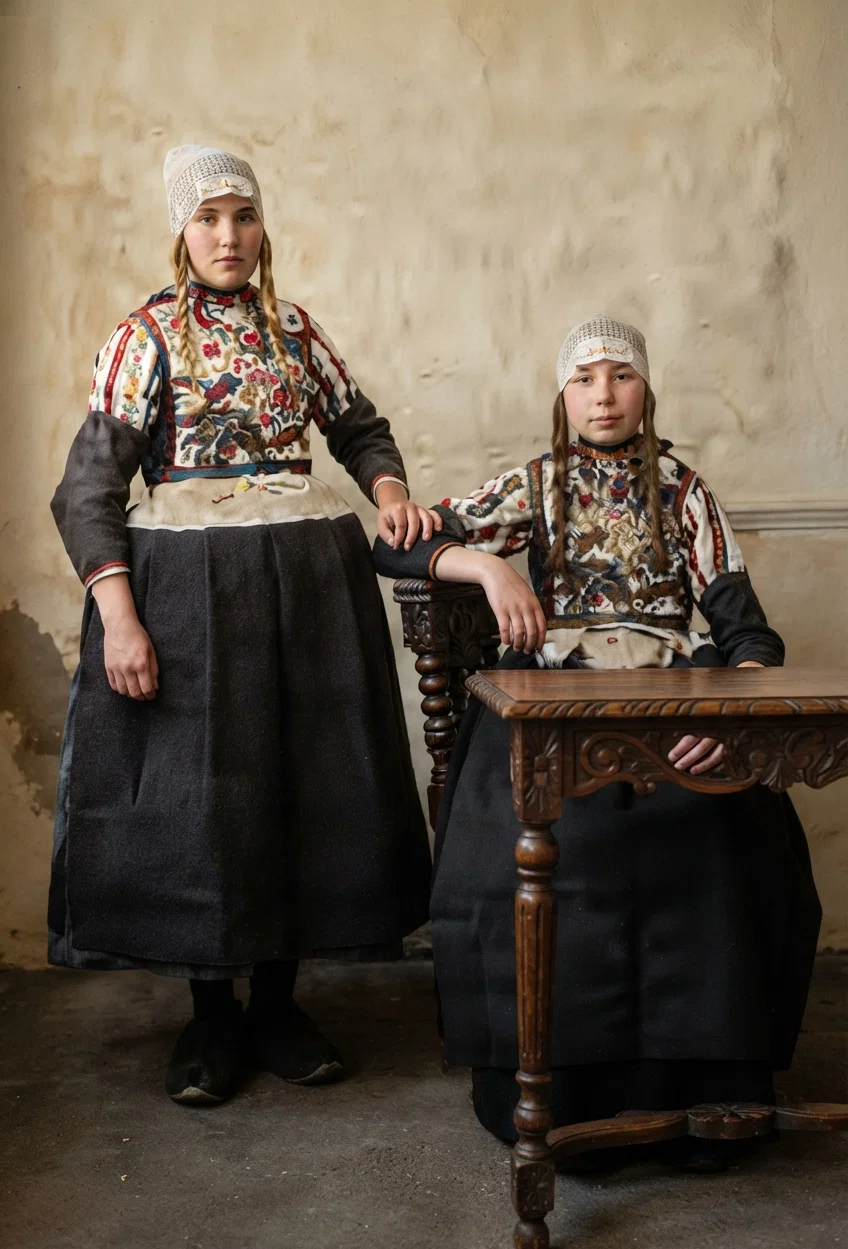
Dutch Peasant Girls, Isle of Marken.
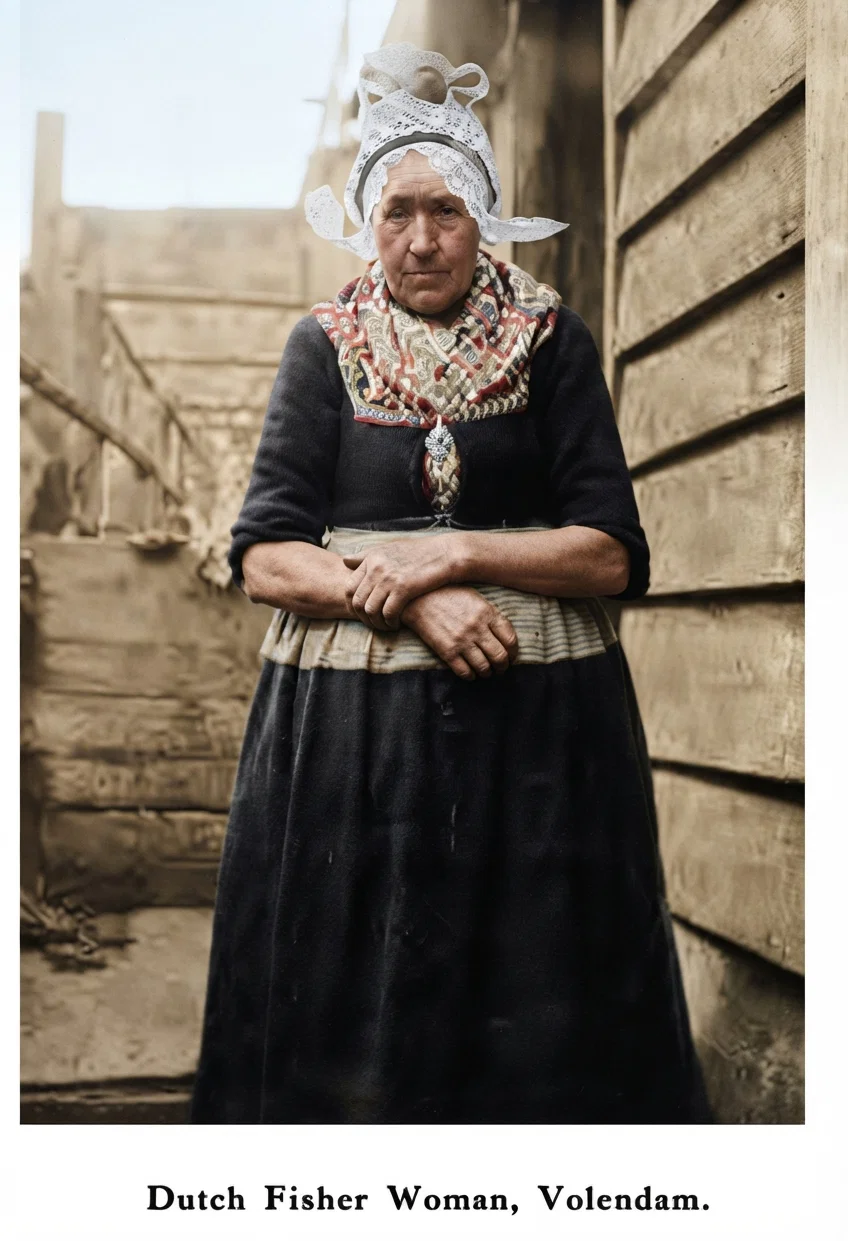
Dutch Fisher Woman, Volendam.
Uncertainty of Political Relations.
Aside, however, from general tendencies everywhere at work, there can be no doubt that at least one great world power is more peaceably inclined to-day than in 1899. England is not proud of the Boer War, the burden of the cost of which will rest heavily on the country for years to come. The people are disposed to peace, and so also is the present Liberal Government. Probably Russia is also less inclined to war-like aggression than in the nineties.
But there are also some disturbing elements. There is nothing certain about the political relations of the great world powers except their tendency to violent extremes—in short, their extreme uncertainty. The French were hooting Englishmen in the streets during the South African War; now they love them so warmly that they almost feel jealous when England shows friendly feelings toward other nations. These powerful elements of uncertainty must be reckoned with in any estimate of the future of Europe.
Of the great world nations, Germany, perhaps, represents the largest amount of ambition, coupled with a good degree of power to realize that ambition. Her population and her wealth are both increasing much more rapidly than those of England, and she aspires to colonial possessions beyond those she now occupies. She is also building up a great navy. England is looking on with jealous eyes. There are not wanting Englishmen who view Germany's development with real concern, and believe it absolutely necessary in order to maintain the balance of the powers that England should continue to strengthen her land and naval forces.
Turkey and Austria.
Then the Turkish question may become critical at any moment, and there is no knowing what situation will be precipitated in Austria when the present emperor dies. Thus while general tendencies move in the direction of peace, this does not give any real assurance that we may not be engaged in gigantic struggles in the near future.
It must also be remembered that while trade and commerce assuredly make for peace, they may also become occasions for severe wars. Business interests sometimes clamor for war. The eagerness of the Uitlanders to have a part in the government of the Transvaal in order to facilitate the piling up of large fortunes, precipitated the South African conflict.
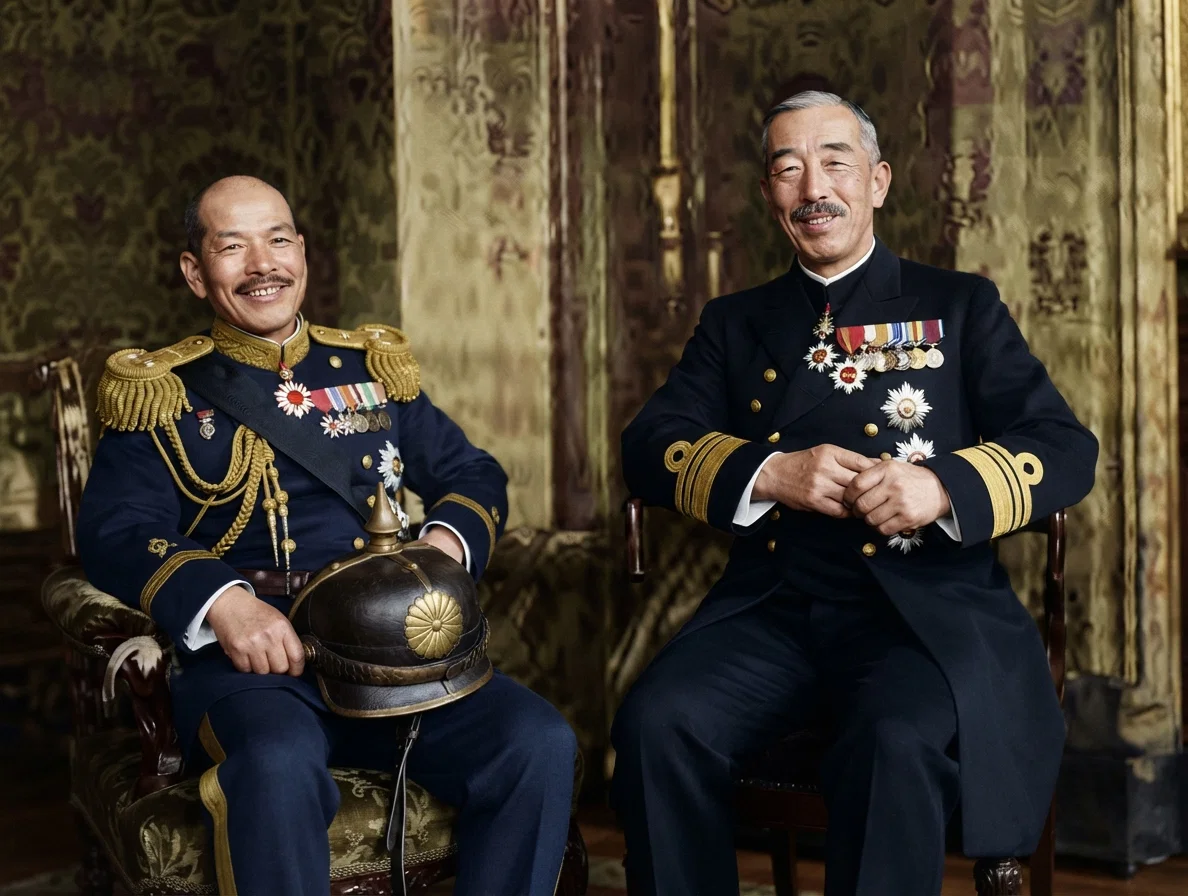
Major General Akizama, and Admiral Sjimamoera, Leaders of Japanese Delegation.
In a Nutshell.
To sum up the situation in a nutshell, the European outlook at the immediate present is favorable to peace; but a very slight shifting of the political chess-board might change the whole situation in the twinkling of an eye.11
Such, then, is the general situation at the opening of this second peace conference. Forty-five nations have sent their delegates, and the afternoon of June 15 witnessed the formal opening. It will not be needful here to go into the details of that meeting. It was very quiet and formal. The only business done was the sending of telegrams of thanks to the Czar and to Queen Wilhelmina. The presidency of the conference was entrusted to the ambassador of Russia, M. de Nelidoff, as expected, and this statesman delivered an address which may be taken as a sort of keynote to the conference. Satisfaction was expressed that so large and representative an assembly had convened. It was an idea of peace that had led so many powerful governments to send their most eminent men to discuss together the dearest interests of humanity.
The Task of the Conference.
The task before the conference was twofold: First, to seek for the means of settling amicably differences which might arise between states, and thus preventing armed conflicts. Secondly, if war did break out, to "soften its consequences" both for the combatants and those indirectly affected. These two problems had seemed to some incompatible, but the speaker did not so regard them. The first peace conference had accomplished something under both these heads, and it was for the second one to take up the work where their predecessors left it and carry it as much farther as they might.
Since 1899 thirty-three conventions of arbitration had been concluded between the different States. Four grave and complicated cases had been carried to the Hague Court, and the Commission of Inquiry created by the act of 1899 had busied itself with one serious case which might otherwise have had most dangerous consequences.
Reference was also made to Andrew Carnegie's generous gift of a building for the accommodation of a permanent conference.
At this point M. de Nelidoff introduced a word of caution. "Let us not be too ambitious," he said. "Let us not forget that our means of action are limited, that the nations are living beings just like individuals, with the same passions, aspirations, and failings. . . . Let us above all not forget that there is a whole series of cases in which honor, dignity, and essential interests are engaged for individuals as for nations, and where the one like the others would never wish, whatever be the consequences, to recognize any other authority than their own judgment and their personal feeling."
He went on to say, however, that these stern facts should not discourage us from "dreaming of the ideal of a universal peace." Is it not, he said, the essential condition of all progress to pursue an ideal toward which one ever tends, and yet can never reach? "Let us set to work bravely, then, the clear star of universal peace and justice, which we shall never reach, guiding us always for the good of humanity."
The speech was warmly applauded, and judging from the general attitude of the delegates and the remarks different ones have dropped from day to day, it represents very nearly the feelings of the conference.
Opening Speech of 1899 More Sanguine.
It will be remembered that the opening speech of the 1899 conference was far more ambitious and in a bolder spirit altogether.
The president of the first conference spoke out against the increase of armaments and adopted quite the tone of peace promoters in general. Nevertheless it is a well-known fact that the fervid opinions expressed at the opening did not take definite form in the conference, and that the ultimate results of that first coming together of the nations were reduced to working agreement in some minor matters relating to warfare as well as to providing the court of arbitration. The opinion was expressed the other day by a well-known citizen of this city that the second peace conference, tho it starts with a more modest program, would doubtless do a great deal more. This remains, of course, to be seen. There is a rumor that M. de Nelidoff's opening speech as originally written, contained a more ambitious program, but that on hearing at the last moment of the dismissal of the Douma he sat up the better part of the night previous to recast the address.
No Religious Services.
The conference was opened, by the way, without religious service of any kind. This, while wholly correct, is a little surprising in view of the custom of introducing a religious ceremony in connection with the launching of a battleship, or giving its colors to a regiment. In the former case, the engine of destruction glides into the water followed by the seemingly very inappropriate benediction: "May the Lord bless you and keep you and give you peace." The conference has done well to start its work clear of any religious entanglements, and the omission of any formal religious ceremony at the opening will not prevent Christians everywhere praying most earnestly for success to attend this effort to make wars fewer and less barbarous.
The Ridderzaal, in which the sittings of the conference take place, is a historic building looking a great deal like a church. It is about six hundred years old, and stands in the Binnenhof, with the upper and lower houses of Parliament on the right and left hand respectively. The Ridderzaal itself is ordinarily used for combined meetings of the two houses.
It would have been hard to find a better location for the conference. The Hague reminds one in its quietness and ease and freedom from bustle of a great, over-grown village. But it has magnificent environs, and the canals, shaded with enormous trees, and the exquisitely clean streets and inviting shop windows and bright, clean-looking children, and especially the picturesquely dressed peasants from the surrounding country and from the Isle of Marken, altogether make a picture of which one never tires.
The conference held its second meeting last Wednesday behind closed doors. It then organized itself into four departments, and divided the work. Telegrams were read from the Czar and the Queen of Holland expressing their deep interest in the success of the gathering. M. ELLSWORTH OLSEN.