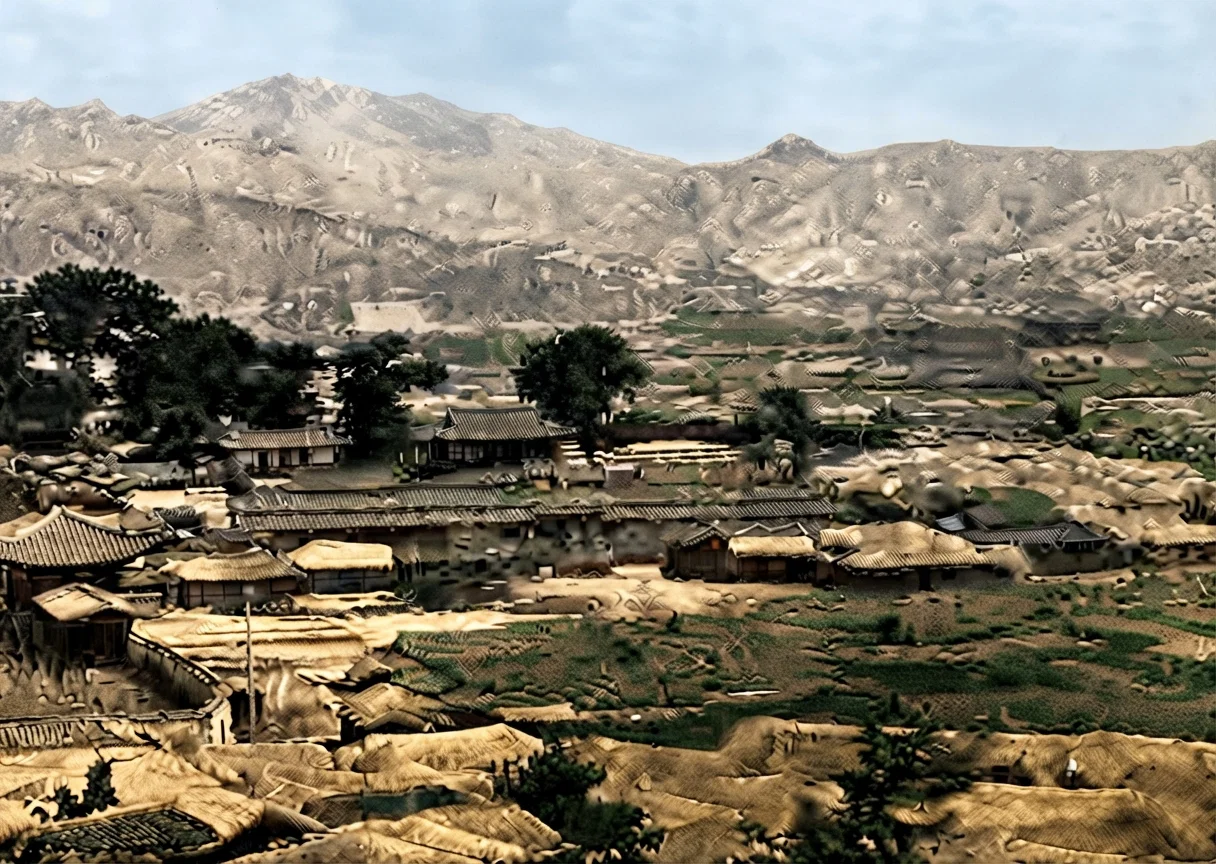
KOREA, the Land of the Morning Calm, once known to the outside world as the Hermit Nation, is a peninsula projecting from the eastern shores of Asia. To the northwest lies Manchuria, toward the southeast the shores of Japan are almost in sight, but a hundred and fifty miles distant; and at the extreme north the boundary line touches the territory of Russia for a distance of eleven miles. The area is somewhat more than eighty thousand square miles, or about twice the size of Ohio.
The surface is very mountainous. The main range lies to the east of the center, so that the eastern slope to the sea is quite abrupt. The western slope is longer and more gentle, and is much broken by lower transverse ranges, between which are wide, fertile valleys.
Agriculture.
The soil in the lowlands is on the whole quite fertile. But the hills and mountains in the southern half of the country have a desolate, barren appearance, being devoid of timber, except for a few scrubby pines. Farther north, along the Yalu and Tumen Rivers and their branches, quite extensive forests are found. Agriculture is by far the most important occupation. The country is believed to be rich in mineral resources, but these have not been much developed. The same may be said of the valuable fisheries along the extensive coasts.
Climate.
The climate has been described as one of the most healthful in the world. The winters in the southern part are quite mild, but farther north are more severe; even in Seoul, the capital, zero weather is sometimes experienced. The summer months are hot and rainy, but the climate on the whole is dryer than that of Japan, and so less enervating.
Race Composition.
The Koreans are evidently a Mongolian people, as indicated by their yellow color, black hair, and oblique eyes. But one often sees a face with distinctly Aryan features—oval face, high forehead, straight, well-formed nose, and thin lips. Consequently the theory has been advanced that the Koreans are a composite race, formed by the mingling of a Mongolian people with some offshoot from India. The physique is good, the average height being considerably above that of the Japanese.
There is good evidence that the Korean nation is of great antiquity. Pyeng Yang was the ancient capital, and the authentic records of this city are said to date back three thousand years, making its early rulers contemporaries of David and Solomon. These early records tell how Kitze with an army emigrated from China in the twelfth century B.C., built Pyeng Yang, and made it his capital, and established a dynasty which continued for seven centuries. The name of Kweja, one of the early rulers of this dynasty, is a household word in Korea to this day. His tomb is still shown in a small grove of pines, just outside the walls of Pyeng Yang.
Chinese Influence
A very natural result of the geographical position of Korea was that from very early times and for many centuries Chinese influence predominated. The Manchus invaded the country, and brought Chinese civilization with them. It is said of the Koreans that “their literature, superstitions, system of education, ancestral worship, culture, and modes of thinking, are Chinese.” Not only this, but for centuries Korea was under the suzerainty of China, and paid an annual tribute.
The Koreans also had intercourse with the Japanese from very early times, and from them their island neighbors received a knowledge of Chinese literature, art, and civilization in general. But the relations between these neighbors were not always peaceful. Jingo, an empress of Japan, is said to have conquered Korea in the third century, A.D.
Seoul, the Korean Capital.
And altho the Japanese did not hold the Koreans in subjection, this early conquest was never forgotten. It was made the pretext for the unwarrantable invasion of Korea by Hideyoshi in the sixteenth century. The war which followed continued for years, and cost the Koreans three hundred thousand men. The sudden death of Hideyoshi put an end to the strife, but did not end the hatred of the Koreans toward the Japanese; for it continues unabated to the present time. Not that the Koreans have such remarkable memories; the hatred has been kept alive by various acts of aggression and oppression from that time to this.
With all these facts in mind, it is easy to see how Korea became a bone of contention between China and Japan. The latter was ever jealous because of the suzerainty of China. These two would-be friends of Korea finally agreed by treaty that neither would interfere with the internal affairs of Korea without the knowledge and consent of the other. In 1894, rebellion was rife in Korea, caused by the intolerable oppression of the people by the official class. In order to suppress this uprising, the Chinese government despatched troops into Korea. The Japanese claimed that this was done in violation of their treaty with China; and war between these two powers was the result. At its close China acknowledged the independence of Korea, thus bringing to an end the long period of Chinese suzerainty.
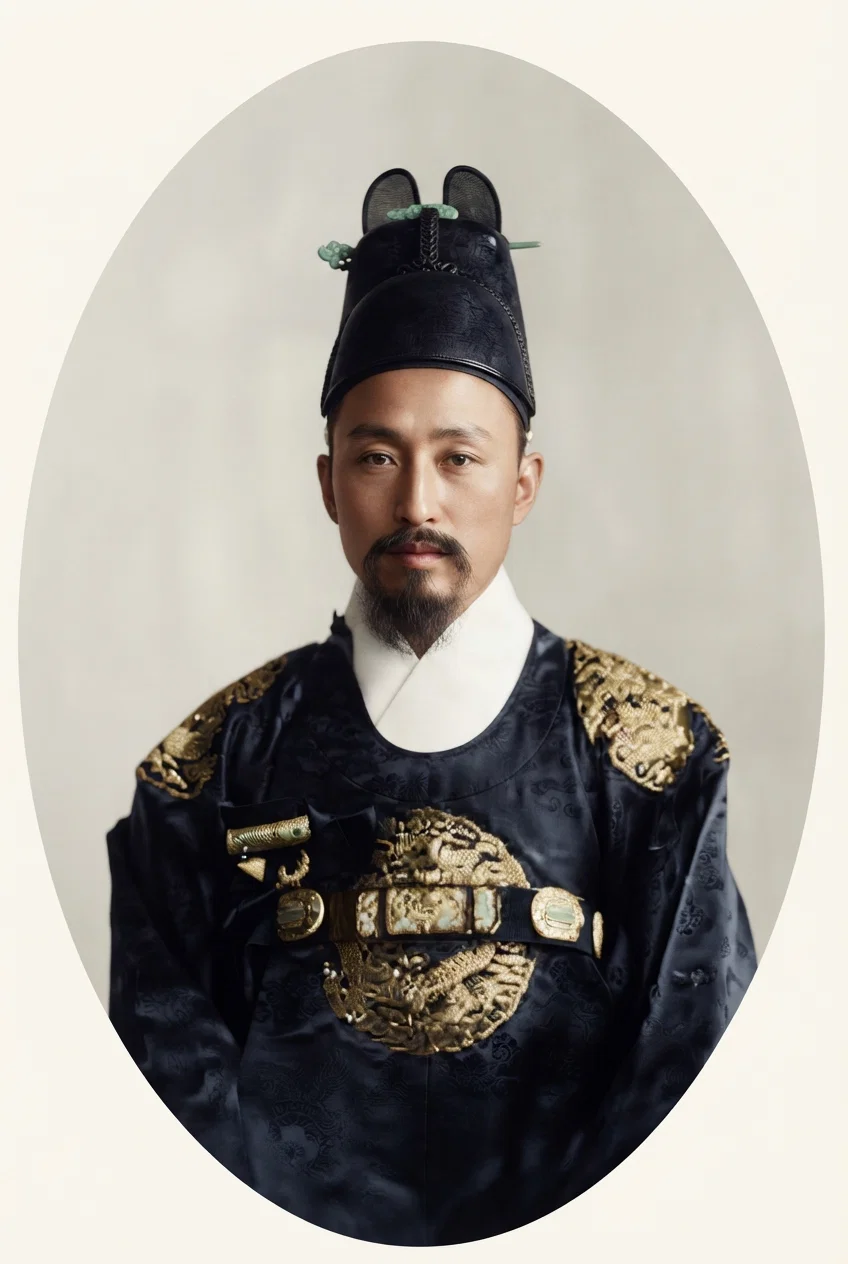
The present reigning dynasty of Korea has occupied the throne for over five hundred years, or since 1392. The government is an absolute monarchy. The country is divided into thirteen provinces, and these are subdivided into three hundred and sixty districts. The monarch is assisted in the government by a cabinet of ministers, or heads of administrative departments. Cabinet ministers, provincial and district governors, and a host of other officials, all receive their offices by appointment. And the guiding theory of the ruling class seems to be that the government exists for the enrichment of the governors rather than for the good of the governed. Accordingly there is a general scramble among the upper classes to secure desirable appointments; and when these are secured, the only limit to official rapacity is the poverty of the common people who13pay the taxes. In courts of justice bribery is very common.
Official Corruption.
This rank corruption in official circles, reacts upon all classes of society. The spoils of office are looked upon as the rightful inheritance of the upper classes, and the members of these classes live in hope of sometime securing their share. Existence while not in office is made possible by a system or custom that requires a man in prosperous circumstances to support in idleness those of his indigent relatives and friends who throw themselves upon him for maintenance. There is no shame attached to this really shameful parasitism; and because of this the results are all the more deplorable. Many a man of real ability fritters away his time and opportunities in this helpless state of dependence.
The Laboring Class Affected.
The effects upon the laboring classes are no less deplorable; for they are the objects of all this official rapacity. They are the “ultimate sponge” in the grand system of “squeezing.” Unjust extortion is carried to such an extent that men of means dare not advertise their wealth by building decent houses to live in, or by investing their means freely in profitable enterprises. And the laboring classes content themselves with eking out a bare existence, knowing that anything beyond this would simply go to enrich the ever watchful officials. The effects of such a condition can easily be imagined. There is a sad lack of thrift and enterprise, and a corresponding degree of poverty.
These conditions have prevailed so long that for some time the outside world has regarded the government as being on the verge of collapse. The country was opened to foreign intercourse in 1884; and since that time the king has called to his assistance a number of foreigners as advisers, some of whom have rendered most excellent service by introducing much needed reforms, and checking the rapacity of dishonest officials. These results serve to strengthen the opinion held by many that, much as the government needs reforming, the people are themselves unable to bring about the needed reformation. And this accounts for the policy of “benevolent assimilation” that is being pursued toward this unfortunate country at the present time.
As an indication of what the Koreans might become under just and equitable laws, attention has been called to the condition of certain communities of Koreans who have migrated into Russian territory. Almost without exception they are in a prosperous condition, living in well-built houses on well-tilled land. In business they compete successfully with the powerfully industrious Chinese. And these Korean emigrants are by no means the pick of the country; for previous to their migration they became reduced to great straits of poverty, and left their own country in the hope of bettering their condition. The inference is that their countrymen generally would prosper equally well under as favorable circumstances.
All this pertains rather to the temporal prosperity of the nation. But there is a deeper and more vital need than this. The social and moral standards of the people should be raised. In other words, what Korea needs most is the uplifting, purifying influence of the Gospel of Christ. And the events of her recent history have opened the way for the entrance of the Gospel in a most remarkable manner. No other country in the world illustrates more forcibly the fact that we are now in the time of the Lord’s preparation. The cry of the down-trodden in Korea is ascending to heaven, and is being answered by the gathering out of souls prepared for the everlasting kingdom of peace and righteousness.
Tokyo, Japan.