AHAB, JEZEBEL, ELIJAH

8%

Pacific Press Publishing Company · Mountain View, California · Apr 17, 1907

FromSigns of the Times, Vol. 33, No. 16.

Read the full edition

AHAB, JEZEBEL, ELIJAH.

A Present Lesson from the Ancient Past.
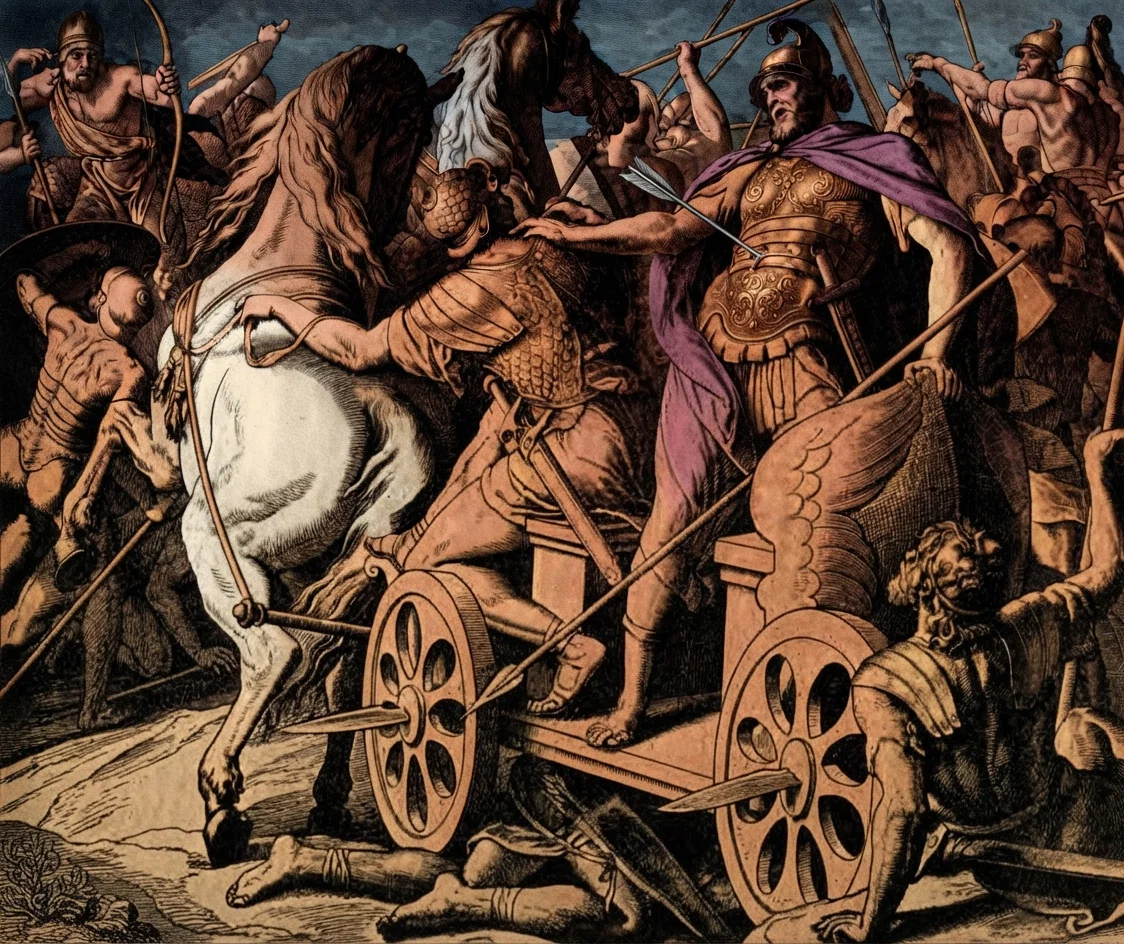
(Read from 1 Kings 16:29 to 22:40.) THERE is no more striking lesson recorded on the pages of Sacred Story than that of King Ahab and his times. Apart from the weak and vacillating king, there are two other figures which loom large in the graphic picture, Elijah and Jezebel. Both of these figures are used by Inspiration as types of later persons and movements, either for the work of God or against it.
THE DEATH OF AHAB.
THE DEATH OF AHAB.
THE kingdom of the Ten Tribes was a stormy one from the time they rebelled against Rehoboam, the son of Solomon. Had the pampered son of the great king acted wisely, the Ten Tribes would have remained with him, and the energetic, ambitious agitator, Jeroboam, might have been content to have filled some important office under him. But Rehoboam refused the reasonable demand of the people and Jeroboam became the first king of the turbulent Ten Tribes. Succeeding his stormy reign came that of his weak son, Nadab, who after two years' reign was slain by a traitor, Baasha, of Issachar's tribe. Slaying all the unworthy house of Jeroboam, the people submitted to his rule; He was succeeded after twenty-four years' reign by a drunken son Elah, who reigned two years, and who was slain in a drunken debauch by one of his chief generals, Zimri. That he might have no rival in reign, Zimri slew all the house of Baasha. But his inglorious reign lasted only seven days, when Omri, the other chief general, conquered him, and the poor traitor committed suicide.
IN a brief time Omri had possessed himself of the kingdom, and ruled strongly for twelve years. He made a center for the kingdom, by building Samaria, its capital city. But he held with all who had preceded him to the worship of the golden calves, set up by Jeroboam. The son and successor of Omri was Ahab, a weak man who wanted to be popular and wanted to do right, who at times believed and wanted to serve God, but who wanted to please men, and make as magnificent royal display as did the kings around him.
EVIDENTLY the ambitions of Ahab were in his military father before him. The king of Israel was a friendly visitor at the court of Sidon, and the king of Sidon at the court of Israel. The kingdom of Israel under Omri was at the height of its glory and Ahab was the crown prince. An alliance of the two houses would be considered a desirable thing by both kingdoms to fortify them against many possible foes; how could that alliance better be strengthened than by a union of the royal families. And so Ahab took for his wife and queen, Jezebel, the daughter of Ethbaal, the king of Sidon.
"Wo worth the day!" Ethbaal, whose very name means "living with Baal," was himself a murderer of his predecessor, a priest of the licentious Astarte, and a devoted worshiper of the sun-god Baal. His daughter's name belied her character. "Jezebel" means "chaste; free from carnal connection; unmarried." As shown by the worship she fostered, she was licentious, stern, cruel, fanatical. In her designing hands Ahab became a veritable puppet for working all manner of wickedness, till he did "more to provoke Jehovah the God of Israel, to anger than all the kings of Israel that were before him." Jezebel established on a royal scale in Israel's court the whole Phoenician idolatry. Four hundred and fifty prophets of Baal, the sun-god, four hundred prophets of Astarte, the licentious Sidonian Venus, goddess of love, were supported by her. She slew without stint the true prophets and servants of Jehovah, and her royal example corrupted all Israel.
God in His goodness sought to win to his duty the recreant king. Ben Hadad the King of Syria came against him with a mighty army, and boasted against the God of Israel. A prophet of Jehovah warned and reproved the king, and God gave him a mighty victory, so that the king knew that it came from Jehovah. But greater disobedience followed. Then came famine, predicted by "Elijah the Tishbite," who appears with startling suddenness upon the scene. He is no royal flatterer. He makes no long introduction. His message strikes home mightily by one having authority to give it. "As Jehovah, the God of Israel, liveth, before whom I stand, there shall not be dew nor rain these years but according to my word." And then he was gone. We may imagine the sneering king and queen and courtiers; but the months pass. No clouds cover the brazen sky. No dew glistens in the morning sun. Vegetation perishes. The brooks and rivers go dry.Food becomes scarce. The infatuated king curses the prophet instead of repenting of his sin. Nay, more, he hunts thruout his kingdom and other kingdoms to find and kill him, but God preserves the life of His servant, by the ministration of ravens if need be, by a poor widow of Sidon later, to whom He makes the prophet a blessing.
ONCE again, after the land had dried for three and one-half long years, God sends His prophet. Troubler of Israel, the wicked king calls him. Elijah throws back the charge upon him and his wicked house. After this came the test at Carmel before the people "limping between the two sides." Let Ahab's army and priests come to Mount Carmel and pray for rain. Let two bullocks be brought. Let them choose. Elijah, the one prophet of Jehovah, will be there to pray, and will prepare for sacrifice the other bullock. Let the God who answers by fire be the God for Israel. They come. The priests of the sun-god prayed. From morning till noon they prayed. From noon till sun's decline. To show the vanity of their worship the prophet mocked them. But no answer came. The brazen heaven gave forth no fire as it had for years no rain. They grew frenzied in their worship. They leaped upon the altar; they cut themselves with knives, till the blood gushed out; they cried till the skies echoed back, "Baal, hear us;" but there was neither voice, nor any to answer, nor any that regarded.
THEN came the prophet of God. Calmly he built an altar of twelve stones in the name of Jehovah. He dug a trench about the altar. He placed upon the altar, properly prepared, the bullock. He caused them from the mountain spring to pour water upon the sacrifice and altar till they were drenched and the trench was filled. Then in a brief prayer, translated into sixty-five English words, He asked Jehovah to vindicate His own name and His prophet's commission. "The fire of Jehovah fell," consumed altar and sacrifice, and licked up the water in the trench. Then the poor, limping, double-minded people cried, "Jehovah, He is God; Jehovah, He is God." Then came the slaying of the false prophets, and the coming of abundant, fruitful rains in answer to the sevenfold prayer of the prophet.
BUT the poor, weak king has no power to break from his imperious wife. She vows vengeance upon Elijah, and the prophet flees for his life. Again and again does God seek to reach the king. Once the poor man humbles himself, and finds respite of judgment. But he still loves sin; he is still dominated by Jezebel; he still hates God's prophets, till at last he perishes in a battle as predicted by a prophet of God whom he imprisoned. That last scene the artist has endeavored to portray. By disguise the king sought to make of none effect God's word; but the arrow of death pierces his armor, and he dies, and in a little time his seed becomes extinct.
FOR the weak governments and rulers of subsequent generations, Ahab is a type, who, knowing what is right, what is true, what is just, yield their ambition and fear of offending to unholy religious influences brought to bear upon them by idolatrous or backslidden religionists. Jezebel stands as a type of a backslidden, error-drunk, ambitious church, whose connection with God has been severed by unbelief, and who hopes to substitute for her lack of divine power, the power of a manipulated State—fornication with earthly government. Thus is she set forth in Rev. 2:20-23. Her children still live in religious bodies to-day. We still have put forward "the wild solar holiday" of the worship of the sun-god Baal, the State-fostered Sunday. We have the clamor in the church that it shall be supported by law. We have our weak politicians yielding to the clamor. We have repeating on a world-wide scale the apostasy in both Church and State—that of Israel of old. We have God's message of protest (Rev. 14:6-14), recorded over and over again in various forms in His Book, against the awful apostasy. O, for more of the power of Elijah behind the message. He who bears it or they who bear it will not claim to be an Elijah, or "Elijah the Restorer." Rather, like one of God's servants of old, of whom Elijah was a type, they will be content to be a "voice" crying in the wilderness of sin and error for men to turn from all tradition, all human creed, all State power, all which is not of God, to "keep the commandments of God, and the faith of Jesus." Reader, have you heard that message? It is not of man; it will not exalt man. It is of God. But, O, it will save men from sin and wickedness and death unto God and eternal life.