[This article is a little late in reaching us, a little late in publication, but it is from an eye-witness, recording an event which may occur to-morrow anywhere on the earth.—ED.]
MONDAY afternoon, January 14, 1907, the people of Kingston, Jamaica, in utter ignorance of the great disaster which was soon to overtake them, were busily engaged in their usual occupations. In every part of the city, streams of shoppers, sightseers, visitors, pleasure-seekers, and men of business were to be seen passing to and fro. The business section of the city was nearing the hour of closing, and in session at the Old Minco on Hanover Street, sat the members of the West Indian Cotton Conference, a body gathered from all the British West Indies Islands, together with many notables of the British Isles themselves.
A number of schools were in session at the time. At the Seventh-day Adventist church on Text Lane, a session of the Bible Institute in connection with the West Indian Union Conference was being held. The hotels were filled with tourists, the factories were in full swing; in fact, the city was busier than ever before, with the conferences gathered within its precincts and the heaviest tourist traffic known in its history.
Kingston, tho in many ways quaint, old-fashioned and ancient, is a city of extraordinary beauty. Its very quaintness, its peculiar houses, and its air of old-time superiority are in themselves things which attract the eye and bind the heart to the delightful place. The city was built after the destruction of Port Royal by earthquake, June 7, 1692. Its streets run mostly at right angles, are narrow with few exceptions, and closely built up with houses peculiar to Jamaica itself. Most of them are brick inlaying among the poorer and middle classes, and brick, stone, and cement among the richer portion of the community. Of these latter, many beautiful mansions may be found which would do credit to any city either European or American. In several portions of the city may be found parks, some of which, well-kept and abundant in their display of tropical plants and flowers, are gems of beauty. To the eastward at Rockfort is a seaside garden of great attraction, and to the north of the city at the foot of the hills which flank the western end of the Blue Mountains, is a delightful park and botanical garden known as Hope Gardens.
Protestant Episcopal Church, East Street, Kingston, Jamaica.
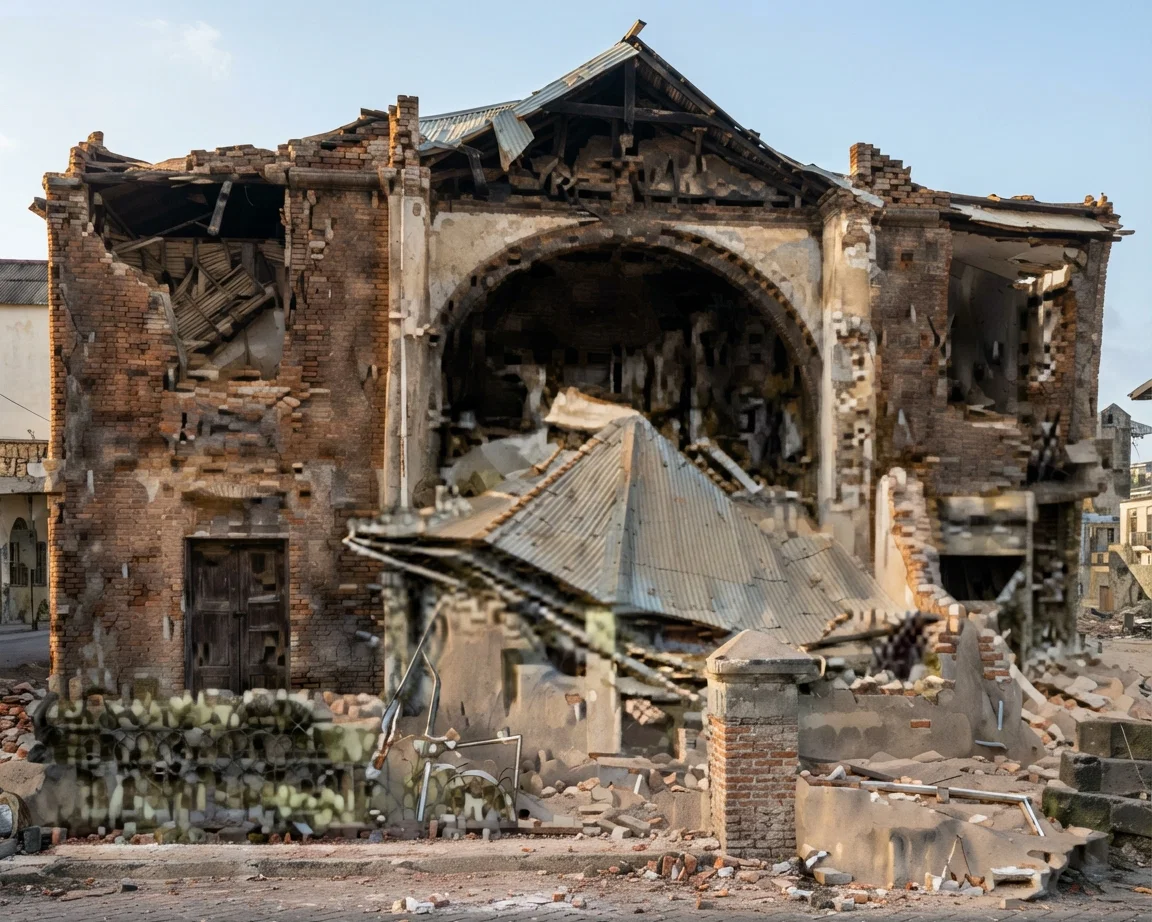
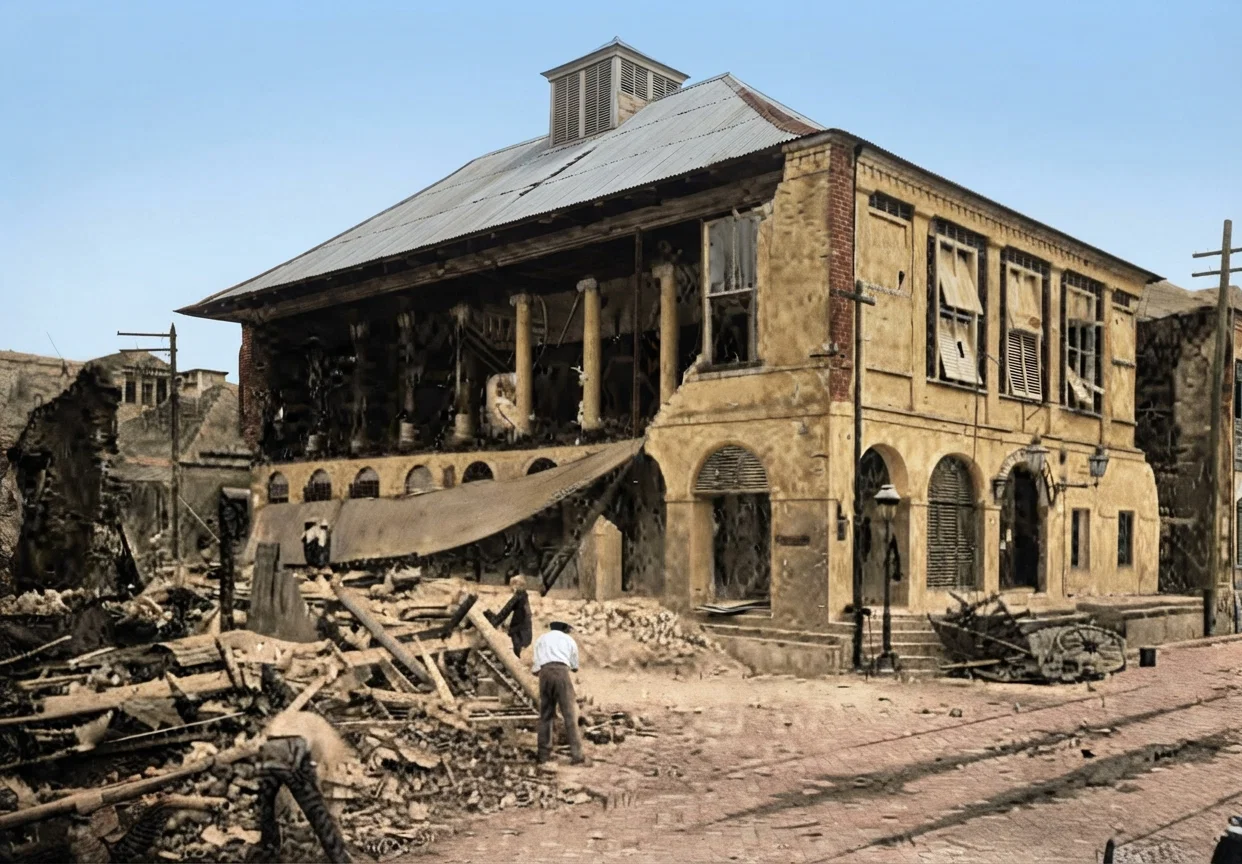
Such was Kingston in the early hour of Monday, Jan. 14, 1907. At 3:32 p.m., as registered by the clock in the Parish Church tower, there came a terrific shock from below, which in the short space of twenty seconds made the fair city of so many beautiful memories a blot on the face of nature, a ruin irreparable, chaotic, supremely awful. Only to those who passed thru those trying moments will it ever be more than an empty dream. To them it is a nightmare of horror never to be forgotten.
We were standing in a small wooden office building on Text Lane conversing with some friends thru an open window when, without warning, the earth, the building, the very firmament, seemed to be shaking together.
We were almost thrown from our feet, when a short lull came, and we rushed to the open court on the street, about forty feet away. Ere we had gained half the distance, more violently than before, the earth again seemed to be moved by a power incredible, and all around us buildings began to give way. The arch of the porch of the Seventh-day Adventist church gave way with the last violent jerk, and it seemed as tho for a moment the whole building with its living freight must follow in inevitable destruction. However, a merciful Providence kept it safely, and the one hundred fifty worshipers, with the exception of three who fell with the front arch, escaped uninjured.
We looked about us, and on every side saw the ruin of homes without number. Here the whole side of a house had fallen out, there the building had collapsed entirely; in other places buildings and heavy brick walls had fallen, burying men, women, and children beneath them. Yet from our situation we did not realize the extent of the disaster. Having provided for those who had been injured at the church, we went to our home, finding it practically ruined, the east wall down, the walls perilous, but none of the inmates injured.
Fire had broken out almost immediately in the business section, and fearing lest our services might be needed in places where men and women were buried, we started to go to the aid of those who were in need. As we went cityward, the horror of the situation grew upon us. Great crowds were hurrying to and fro with no knowledge of what they were doing, wandering aimlessly here and there, and crying upon God for mercy. The uninjured seemed to be crazed with fright, paralyzed with fear, and were doing nothing toward the work of rescue. We reached East Queen Street and were arrested by a cry from an adjacent yard that five children were buried beneath a brick building there. Hurriedly we made ready for work and rescued three poor little ones, mangled, maimed for life, from the ruins. They were but a few of the hundreds similarly buried that day in every part of the city.
We went on toward the heart of the city. Everywhere was ruin. Every street was lined with a terror-stricken multitude. Some had collected their few treasures and were making for the parks, fearing lest the fire should reach them, as it was rapidly spreading. On every side was confusion, uproar.
As night drew on, the light of the conflagration kept the city illuminated. In our part the dazed inhabitants still wandered about. Many too dazed, too utterly broken to make their way to the parks, were sitting on the curbing in the streets, guarding the little that they had managed to bring from their delapidated homes.
The Holocaust.
It was early seen that the business section with hundreds beneath the ruins was doomed to burn. The fire brigade, a few at least, did all that was possible to stop the flames, but only managed to do so after they had swept out to Orange Street, and east to Duke Street as far as the post-office and treasury building, and north almost to the Parade Gardens. Many within this section, pinned down by falling walls and debris, met a horrible fate as the fire crept over them. Tuesday, in passing thru this district, one might behold the half incinerated bodies of these unfortunates in attitudes which betokened a violent struggle for freedom as they attempted to avoid the devouring flames.
The power of the earthquake was incredibly awful. Buildings with massive walls, considered absolutely safe, were crushed into powder. The great structures, which nearly every one had counted on as withstanding just such conditions, went down into ruin, while some which were considered unsafe withstood the violence of the shock. It seemed almost as tho the power which shook the earth desired15to show men the little value which could be placed upon their opinions.
Noted Buildings Destroyed.
The well-known Myrtle Bank Hotel is a complete ruin. Its walls are nearly all a mass of brick on the streets or within the courtyard. Here a large number of the victims of the earthquake lost their lives. Fortunately, a large number of the guests, Americans and English, were elsewhere at the time, and very few among them were either killed or injured, the majority of the fatalities being among the employees.
The magnificent hotel at Constant Springs, tho not ruined entirely, was so badly cracked and broken, especially its towers, that it will cost thousands of pounds to put it in a safe condition.
The Roman Catholic Cathedral and Art Gallery on Sutton and Duke Streets is a great brick heap. Works of art were destroyed, and several persons met death under the crumbled walls of the formerly magnificent structure.
Cope (Wesleyan) Chapel, tho presenting a good front, is a ruin, both its sides having fallen in.
Among the other public buildings either badly damaged or destroyed are the theater, Scotch Church, Free Church, Episcopal Church, Parish Church, the Jewish Synagog, Government printing-office, Government buildings, many school buildings, including the Minco, High School, the Malabar Training College, the Government House, or Governor's residence, the hospital and barracks at Up Park Camp, the station of the West India Regiment, together with thousands of residences thruout the city.
The Monetary Loss
will reach nearly $30,000,000. Of this it is said one-fifth only is insured, and it is questionable if there will be any possible way of collecting even this portion, owing to the earthquake clauses in the policies. Thousands lost every cent they possessed, and every item of clothing except what remained upon their persons.
The Sacrifice of Life.
Men can never tell all the sad story connected with this portion of the fell destroyer. Ruins still cover the forms of those who were crushed to death by the walls of falling buildings. Many burned to ashes beneath the ruins will never be known to men. Only an all-seeing eye in the courts of God beholds and records their resting-places. The latest returns give the registered dead as 1,800, and the probable total as 2,000. Without doubt, even this estimate is small, and will be found so when the records are completed. Had the earthquake come at a time when the people were in their homes, the loss must have been much greater, judging by the awful ruin in which many of these homes are found.
Are These Things "Judgments of God" as so many of the distracted people pronounced them on that fatal day? Are they not rather the result of sin upon an earth cursed by its awful load of guilt? Are they not the breakings forth of that punishment which will eventually come to this sin-cursed planet because of transgression, as mentioned in Isa. 24: 5, 6, 18, 19? We assuredly can not say Kingston is more wicked than the other cities of the West Indies, or of the world; there is the same wickedness, the same cause of sin, everywhere. Let us remember our Master's words when He said, "Think ye these Galileans [Jamaicans] were sinners above all Galileans [West Indians], because they have suffered these things? I tell you, nay; but except ye repent, ye shall all likewise perish." See Luke 13: 1-5.
Not to Jamaica, San Francisco, Valparaiso, alone come these lessons. God is thus warning the whole earth; and our telegraph wires, our newspapers, our periodicals, and books, are presenting the awful facts to every nation. These warnings came to nations in the past. Babylon had its handwriting on the wall; Jerusalem had its prophetic utterances foretelling what would befall her. To-day God is warning us. Will these awful lessons, these fearful sights and scenes, awaken in us a desire to be right, or implant anew right principles in our hearts? S. A. WELLMAN.