WEDNESDAY, the 17th, was a busy day for the Conference. During the morning there was the business session and reports of committees, and resolutions were adopted voicing the will of the Congress.
The recommendations are five: (1) that conferences at The Hague shall be held not occasionally, but periodically, with a permanent court there open to all the nations; (2) that the coming conference shall draft a new general arbitration treaty providing for the reference to The Hague courts of international disputes which can not be adjusted by diplomacy; (3) that when a dispute arises whose subject-matter does not fall within the terms of an arbitration convention, the disputing nations, before resorting to force, shall invoke the services of an international commission of inquiry or the mediation of one or more friendly powers; (4) that private property shall be as inviolate on sea as on land; (5) that the British proposals for the consideration of armament limitation at the coming conference shall be supported.
In the afternoon there was a great meeting in the hall addressed by many eminent men, the last of which was Mr. William Jennings Bryan, twice a candidate for the Presidency of the United States. He said: "War is not a necessity, and I could not worship God with all the ardor I do if I believed that He had made my advancement depend upon my taking my brother's life. I prefer to build society upon the foundation of human brotherhood rather than upon the doctrine of hatred and ill-will."
Some Pertinent Statements.
"We all expect a great deal from the coming Hague Conference, but what does a great deal mean? Perpetual, universal peace, disarmament?—No, nothing, alas, of that kind. Progress goes only step by step forward knowing that many other steps will be the work of the future. Other generations, other conferences, will follow with new aims, new successes."
"I have come to hate the word disarmament as the devil hates holy water. No government will propose it at The Hague Conference. All that will be asked for is that the reckless increase of armament should stop."
"With the individual sinner a declaration of reform is often conclusive evidence of a sincere change of heart, but with the chanceries of the world, works meet for repentance must be brought forth before they can be believed. It is not so much a matter of world importance what those taking part in international conferences agree to do or not to do, as it is whether or not after adjournment they really try to keep the peace."
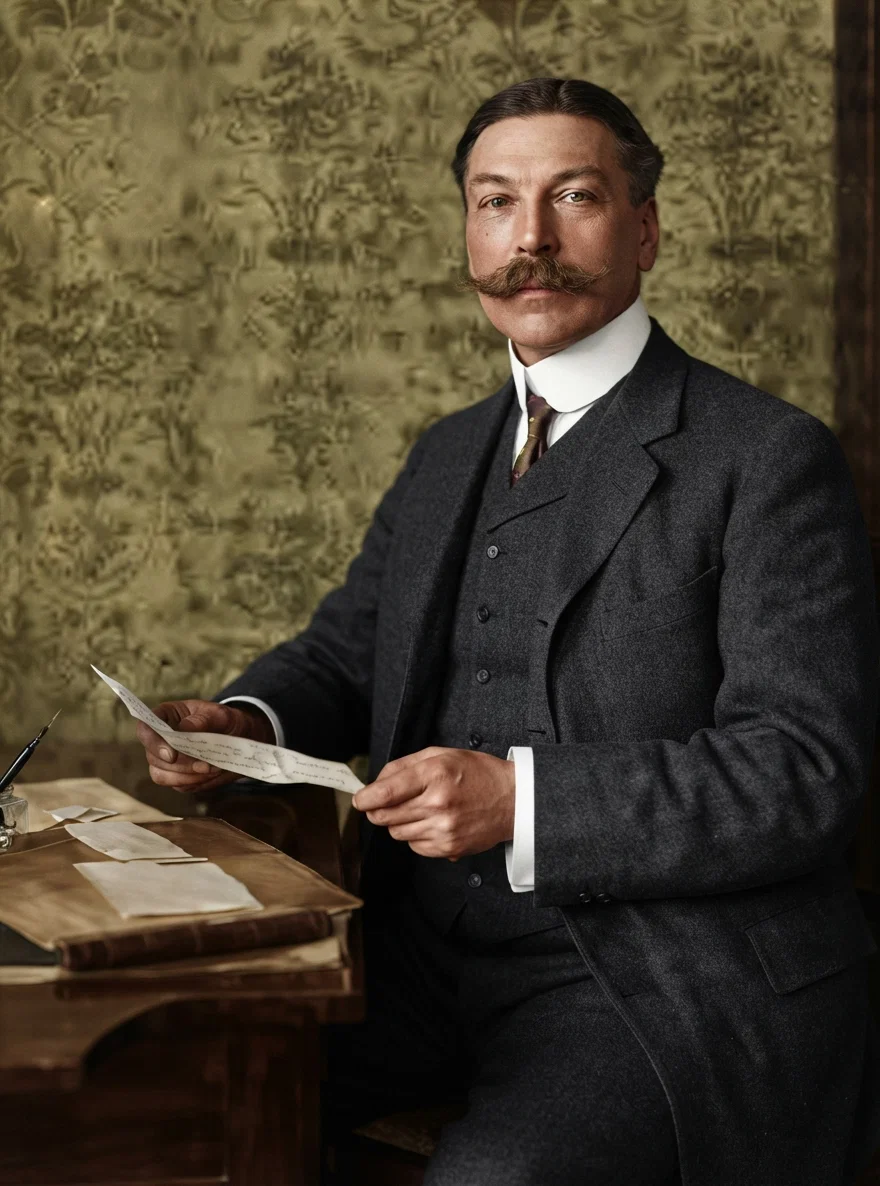
Stereograph, Copyright 1907, Underwood & Underwood, New York "Maarten Maartens" (Mr. J. M. Vander Poorten-Schwartz), the noted Dutch Publicist.
"Washington must lead out in the peace movement of the world."
"The best way to establish peace is to have an international force that punishes the nation that disturbs the peace."
"You can no more secure universal peace by resolution than you can make mankind perfect by an act of Congress."
"We are going to have international peace even if we have to fight for it."
"War will pass away and the Prince of Peace at last stand upon the mountain-tops."
"The world to-day is burdened with armament until armed peace has become more expensive than actual war was a generation ago. These vast armaments on land and water are being defended as a means not to wage war, but to prevent war. It is one of the purposes of this great Congress to show that there is a safer way, a more economical way, and a way more in harmony with the culture and enlightenment of the twentieth century, to preserve the peace of the world and secure it on a more permanent foundation. This way is as simple as the 'Yea, yea,' of man, and it requires only the consent and the good-will of the governments. To-day they say: 'Si vis pacem, para bellum!' If you want peace, prepare for war. This Congress says in behalf of the people: 'Si vis pacem, para pactum!' If you want peace, agree to keep the peace."
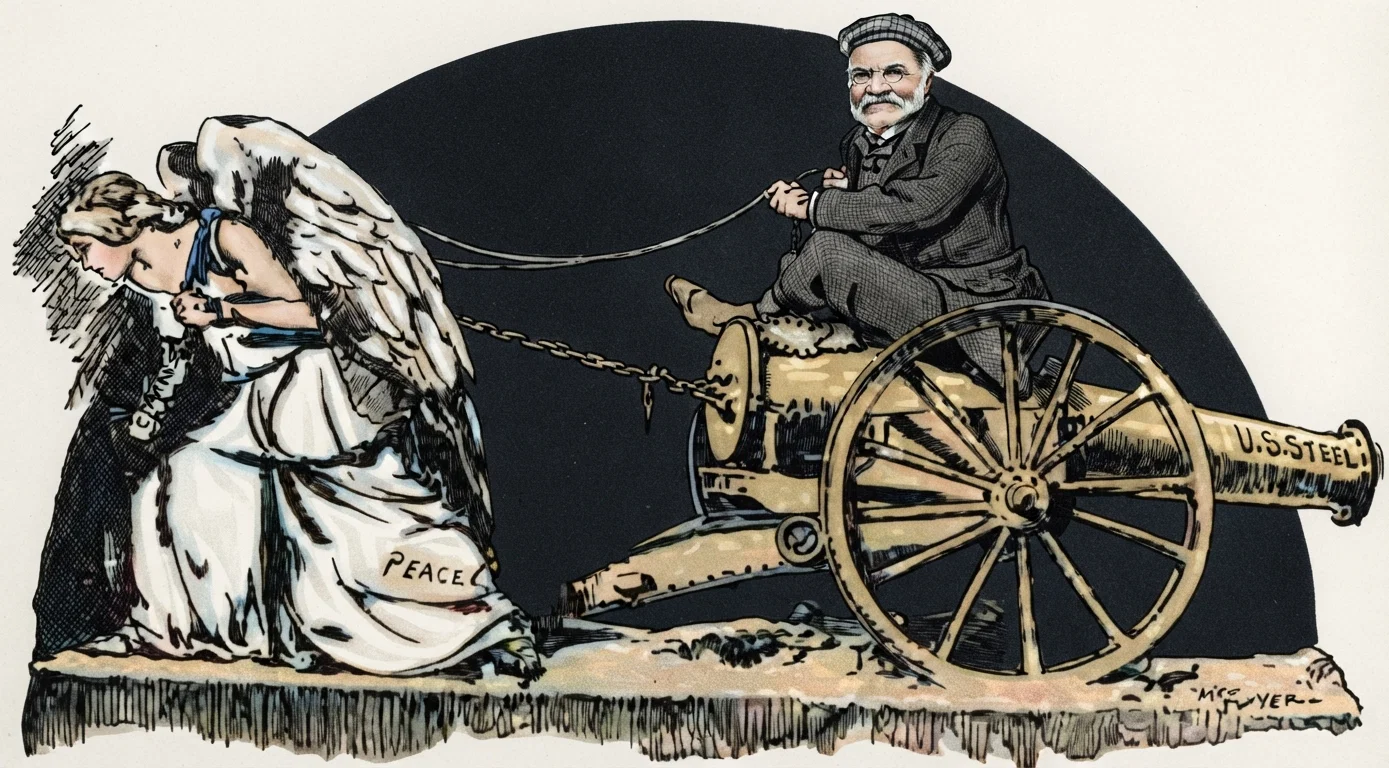
A Proposed Statue of Mr. Carnegie for the Peace Palace, which we reprint by Courtesy of the New York "Times," an illustration of how the Secular Press views the matter. The cartoon by Mr. Mayer speaks for itself.
"If the scholars of America, the men who shape public opinion, do their duty, every one of those measures will be embodied in a Hague convention before our next college year opens in September. American public opinion is able in this thing to tip the balance."
"The day is here for a universal republic which shall bring peace to all the earth. The question then arises: What nation should be the leader in this universal republic? What nation is best fitted to be the executive power enforcing the laws of The Hague Tribunal? My countrymen, there is only one nation in all the world fitted to assume this position. It is the United States."
It was plain to be seen that the UNITED STATES GOVERNMENT was to be made to play the leading role in the DRAMA of peace—for such it will be, a veritable world drama, if peace is to be fought for—and in the event of a federation of nations based upon a constitution of the world, the NATIONAL HEAD of the federated nations, as must result from A PERMANENT TRIBUNAL of the nations. We, of this generation, are evidently destined to see the fulfilment of Bishop Berkeley's poetic prophecy:
"Westward the course of Empire takes its way:
The first four acts already past,
A fifth shall close the drama with the day.
Time's noblest off-spring is the last."
Surely, we are living in a day of startling climaxes and peculiarly significant events! To see a FIFTH universal kingdom consequential to the setting up of a permanent and constitutional tribunal at The Hague, a world-government and still further on a world-church, should surprise no one! For everything indicates it as a near possibility, a rapid development! "A FIFTH SHALL CLOSE THE DRAMA WITH THE DAY!"
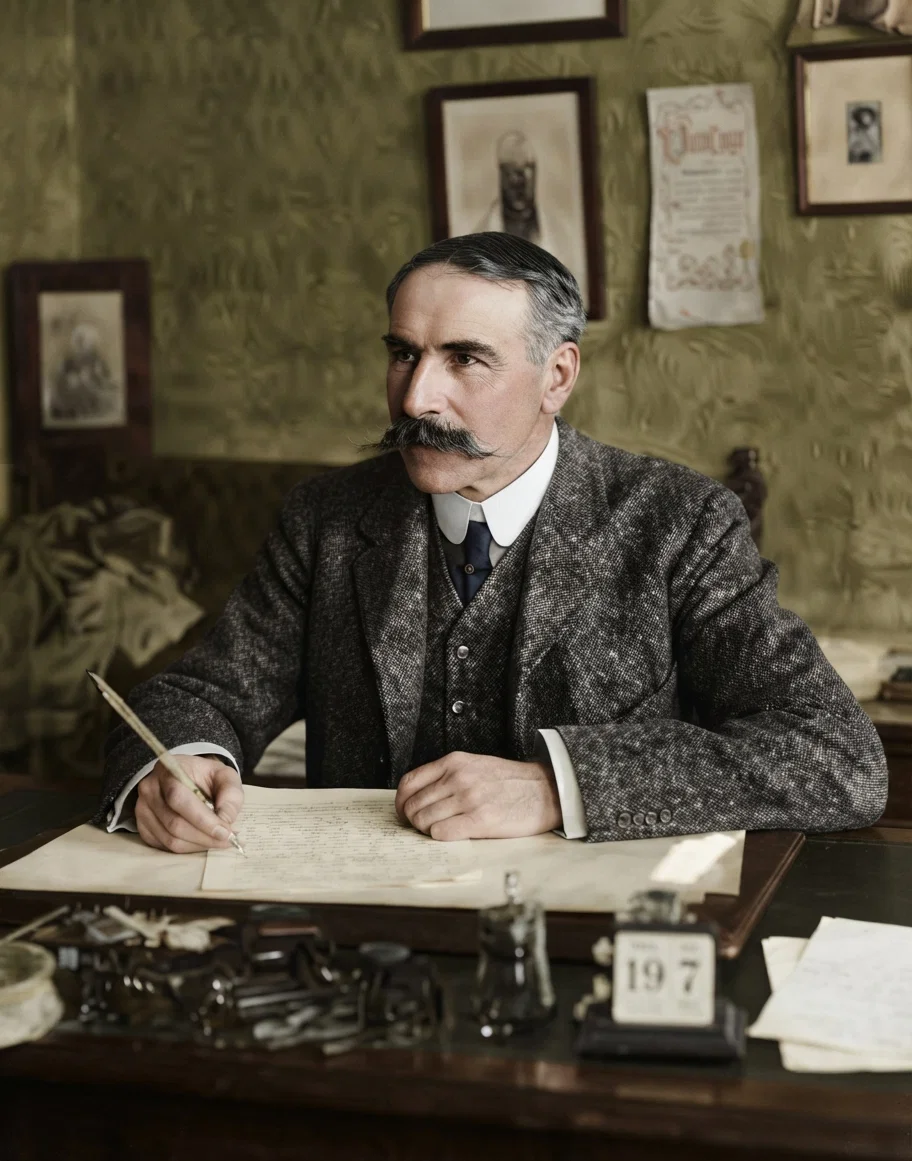
Sir Edward Elgar
A despatch from the Washington Bureau of the New York "Evening Telegram," date of April 13, states: "It is said by many that the President might possibly become the President or Chairman of the great 'World's Arbitration Court,' which is in the minds of many diplomats of many countries, if he would LEND THE INFLUENCE OF THE UNITED STATES at this time to the things in which Europe is concerned. It is AN ALLURING PROPOSAL that is being laid before the President, and his leadership of the world in international affairs, especially in movements for international peace, is said TO BE CONCEDED BY THE GOVERNMENTS OF EUROPE since his intervention to settle THE RUSSO-JAPANESE AFFAIR."
Ah, indeed, it is alluring—this offer of the supreme arbiter of world affairs to a SINGLE HUMAN BEING. For who can fail to see that to be the president of a WORLD'S COURT means to be THE PRESIDENT OF THE WORLD, and PERHAPS EVEN MORE THAN THAT! Already we have the United States of America, and rapidly do we see the formation of THE UNITED STATES OF SOUTH AMERICA; all see the UNITED STATES OF EUROPE swiftly assuming CONSTITUTIONAL SHAPE; and then with a world court, and a WORLD ARBITRATOR, we shall see
THE UNITED STATES OF THE WORLD!
And all this is federation, indeed. More than CHURCH FEDERATION; more than FEDERATION OF CATHOLIC SOCIETIES; more than CIVIC AND LABOR FEDERATION: IT IS ALL—THE FEDERATION OF THE WHOLE WORLD! The outcome of the universal peace movement, according to Bible prophecies and the trend of the times, WILL BE THE ESTABLISHMENT OF A CONFEDERACY MIGHTIER THAN THE WORLD HAS EVER YET KNOWN!
Mr. Stead, the great London editor, and one of the foremost advocates of peace among nations, is an authority for the insincerity of its best exemplars. He says:
"If you had attended as many peace conferences as I have, you would know how sick I am. They are the most impractical I ever saw. I sometimes think the Lord endowed them with so much goodness of heart that he didn't have anything left for common sense."
Theodore von Moeller, German Minister of State, who was at the dedication of the Carnegie Institute at Pittsburg, and guest of the steel manufacturer, says, as reported in an Associated Press Despatch, of April 16:11"I have attended a great many such conferences and nothing has ever resulted, and I do not think that this one will amount to any more than the others."
The fallacy and generally unpracticality of the idea is quite fully observed by the American press. In an editorial under the caption, "Pretenses of the Peacemakers," the "New York Press" says:
"Indeed, the prevailing note of the whole anti-war campaign is insincerity. We doubt if the most fanatic of the prophets of peace are really confident that the peoples of the earth ever will arrive at the federation of the poet's dream. A majority of the delegates to The Hague are practically pledged to decline even the mere discussion of the subject of putting a limit on the making and carrying of weapons."
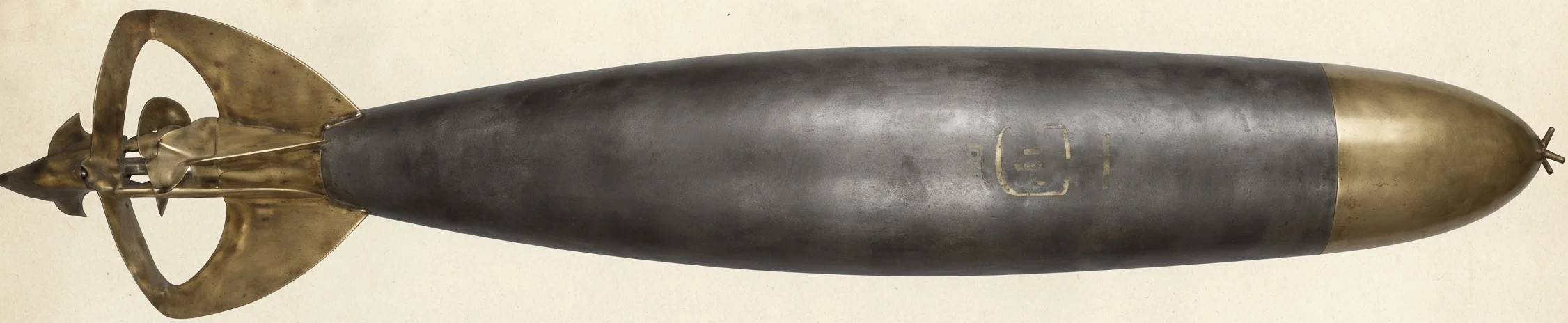
THE HOWELL AUTOMOBILE TORPEDO.
The New York "American" says:
"Corrupt Peacemakers Unable to Stop War.
"Coincident with the opening of the International Peace Congress in New York, Great Britain has launched, at Newcastle-on-Tyne, the Invincible, the greatest crusier afloat. Propelled by turbine engines, it is designed for a speed of twenty-five knots, and in powers of destruction is equal to two battle-ships.
"Since the first Hague conference there has been fought in the far East a naval battle, which, in the annihilation wrought, was unprecedented in the history of war. Almost an entire squadron of ironclads was destroyed.
"The Peace Conference in New York convening shortly before the second Hague Congress, at which nearly fifty nations are to be represented, is already provoking in Europe manifestoes from the Powers announcing that they will not permit their representatives officially even to discuss the proposal to limit armaments.
"It was significant of the unconscious recognition of the military strength of nations that the interior of Carnegie Hall yesterday was brilliant, not only with the Stars and Stripes, but with the flags of all countries.
"Every one of these emblems is a symbol of some kind of fighting strength. No flag of truce was there. That sign of surrender does not appeal to even the leaders of peace.
"And when the distinguished advocates of disarmament ceased speaking, the organ thrilled the large audience with strains of 'The Star-Spangled Banner.'
"To-day all the civilized powers are constantly improving their military equipment. The one great country that has not prepared itself for war is China, and it has paid dearly for its indifference. Even the Celestial Empire now is drilling a new army and creating an up-to-date fleet."
The New York "Globe" says:
"The complete working out of this plan, especially the idea of international coercion, is, of course, remote—is not a matter merely of decades, but probably generations, and maybe centuries. In the meantime, it will be necessary for the nations to be armed. . . . Those who assume that disarmament can be achieved first attack the problem from the wrong direction—are wasting time and effort. There must be law or armaments."
So much for the FALLACY. Peace Congresses are looking to kings and emperors, courts and legislators, presidents and counselors, and in the last analysis of the arrangements—TO A PERMANENT TRIBUNAL AT THE HAGUE—for the peace that after all, is not, and never has been, a subject of human legislation; for the peace that subdues hard hearts and takes away the spirit of strife, war, and oppression, comes alone from Him who had power to speak peace to the repentant soul, and to work such a transformation of character that the individual might reflect "the image of Jesus," in which there was no room for hatred, revenge, and war! The millennium can not be improvised. Universal peace can not be secured by any arbitrary, mechanical process, it must be the outcome of a gradual spiritual development. Nor could the arbitrary, mechanical act of universal disarmament EVER secure universal peace. If men's minds could be wiped clean of all military knowledge and experience, the cause of universal peace would not be forwarded one hair's breadth. Wars would not cease. Wars never can cease until that "new heavens and new earth," "wherein dwelleth righteousness," is here. ORGANIZED PEACE on earth is not a POSSIBILITY!
Two items of the New York press aptly illustrate the incongruity of the peace movement, that I must mention: A cartoon that appeared in the New York "Times," of Sunday, April 14, representing Mr. Carnegie seated upon an immense canon made out of U. S. steel (Mr. Carnegie's corporation) and drawn by the Angel of Peace heavily manacled and chained to the vehicle of death! And a humorous article on Mr. Dooley by F. P. Dunn that appeared in the New York "Times," and which in a few paragraphs describes the fallacy as books upon the subject might not. In closing, Mr. Dunn makes Mr. Hennessy and Mr. Dooley say:
"'Phwat is Carnegie Peace?' said Mr. Dooley. And upon learning from Mr. Hennessy what it was, Mr. Dooley continued:
"'Tis the gr-rand idea, Jawn. Tin years from now peace will be so sthrong that nothin' in th' wor-rld can shake it.' 'Ixciptin' war,' said Mr. Hennessy."
How true that humorous reply: "EXCEPTING WAR." Nothing ever has marred the peace in the past nor in the present EXCEPTING WAR—war in the home, in the community, in the nation, IN THE WORLD!
In interviews had by your correspondent with Mr. Carnegie, George S. Peabody, Mrs. Lucia Ames Mead, and others, we must conclude that no such thing as universal PEACE, or even universal DISARMAMENT, may be looked for in OUR GENERATION; the most that can be looked for is a permanent court of arbitration, a world tribunal of which the American Government shall be the head! This much they look for in our day, AND NO MORE. Then in view of these facts—that there is no probability of disarmament or real international peace—what may we conclude from the universal peace movement in which the nations and the creeds are one? With all nations engaged in the intellectual WAR for PEACE, working intently upon an abstract and futile proposition, with the "peace-and-safety" cry arising from a multitude of throats until a world stands and listens, and anxiously awaits the outcome of the second great conference at The Hague, may we not ask, with utmost propriety,
What Do These Things Mean?
Reader, IT MEANS the coming of Christ and the end of the world! It means, and presages NOTHING ELSE! The apostle Paul, in his very remarkable epistle to Timothy, relates the "peace-and-safety" cry of THE LAST DAYS to the coming of Christ. "For the Lord Himself shall descend from heaven with a shout, with the voice of the archangel, and with the trump of God; and the dead in Christ shall rise first: then we which are alive and remain shall be caught up together with them in the clouds, to meet the Lord in the air; and so shall we ever be with the Lord."
The Congress closed with banquets in two of America's most palatial hotels—the Astor House and the Waldorf-Astoria. A thousand souls, invited by Mr. Carnegie, sat down to eat and drink, and be merry, but not over prospective peace. In great ball-rooms with lavish and splendid surroundings, a magnificence unexcelled anywhere, all that untold wealth could procure, the guests of Mr. Andrew Carnegie feasted for the sake and for the success of UNIVERSAL PEACE! And the news went out to all the world—over land and under sea: "PEACE! PEACE! PEACE!" None saw the handwriting on the wall! Still it was there—on walls more enduring than those that enclosed the palaces of Belshazzar. The hand has been writing on the wall—in all languages, to all nations—"WHEN THEY SHALL SAY, PEACE AND SAFETY: THEN SUDDEN DESTRUCTION COMETH UPON THEM, . . . AND THEY SHALL NOT ESCAPE."
Belshazzar and a thousand of his lords, drank, too, from golden goblets, and they saw the handwriting on the wall—yet TOO LATE! TOO LATE! That night Belshazzar died, and his kingdom passed away.