To Virginia unquestionably — thanks to the influence and untiring efforts of Jefferson, Madison, the Baptists, Quakers, and Presbyterians — belongs the honor of first dis-establishing religion in America. But to which colony, Maryland or Rhode Island, belongs the honor of first establishing a commonwealth upon the principle of entire separation of church and state, is a mooted question.
Referring to Maryland's being founded by Roman Catholics, Bishop Spaulding, of Peoria, in the North American Review for September, 1894, says, "They founded one of the thirteen colonies, and were the first in the New World — the first, indeed, in all the world — to make freedom of conscience an organic part of the constitution of a state."
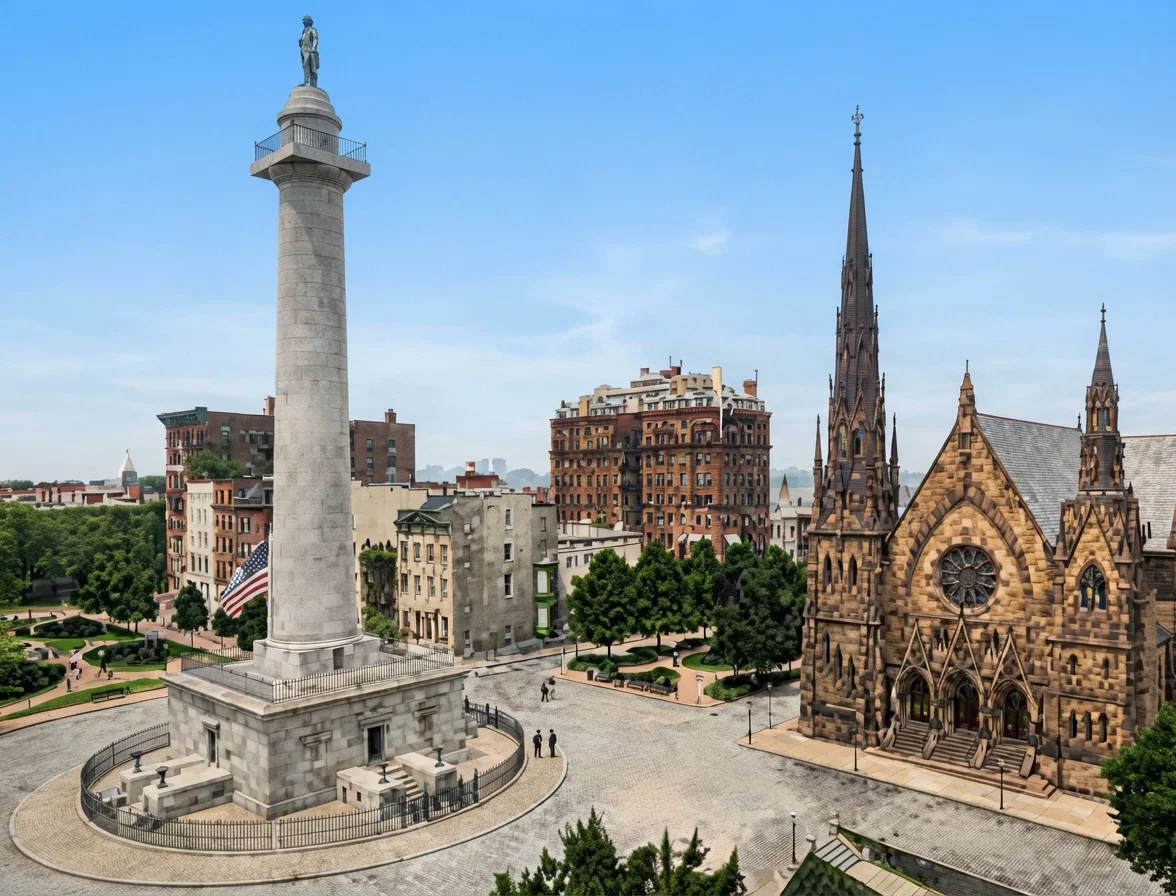
Mount Vernon Place, Baltimore, Maryland
On the other hand, Governor Hopkins, as quoted in David Benedict's "History of the Baptists" (1848), page 446, speaking for Rhode Island, says, "Roger Williams justly claims the honor of having been the first legislator in the world that fully and effectually provided for and established a free, full, and absolute liberty of conscience." And Sidney S. Rider, in his work "Soul Liberty Rhode Island's Gift to the Nation," page 85, styles Rhode Island "the first commonwealth in the New World, the first in the world, to make soul liberty the basis of a constitution for a state."
Conflicting and opposed as are these claims, Montgomery, in his "Beginner's American History," edition 1902, appears to sanction both. On pages 58 and 59 he says: "Maryland was different from the other English colonies in America, because
there, and there only, every Christian, whether Catholic or Protestant, had the right to worship God in his own way. In that humble little village of St. Mary's, made up of thirty or forty log huts and wigwams in the woods, religious liberty had its only home in the wide world;" while on page 65 of the same book he says, "Providence was the first settlement in America which offered a home to all men without asking them anything whatever about their religion."
So eminent an authority as Bancroft, in the earlier editions of his "History of the United States," stated that the Maryland proprietary "adopted religious freedom as the basis of the state," and said that here
"religious liberty obtained a home, its only home in the wide world," and "conscience was without restraint." (Edition 1837, Vol. 1, pages 244, 247, 254.) In later editions, however, while not denying that a wide and generous toleration characterized the early Maryland administration, these statements are omitted, and the declaration made that Roger Williams "was the first person in modern Christendom to establish civil government on the doctrine of the liberty of conscience." (Edition 1888, the author's last revision, pages 161, 162.)
What Are the Facts?
What are the facts, and how are we to understand these conflicting claims?
That there was large freedom in religion in the early history of the Maryland colony, and an absence of religious persecution from its founding in 1634, seems evident. That the proprietary, intent on advancing the interests of his colony, invited the Puritans of Massachusetts to Maryland, offering them lands and privileges, and "free liberty of
religion;" and that certain Puritans, expelled from Virginia for non-conformity to the established religion of that colony, found refuge in Maryland in 1649, are facts plainly stated by Bancroft. (Vol. 1, pages 165, 169.) "It is true," says Montgomery in his "Leading Facts of American History," edition 1902, page 105, "that Lord Baltimore, holding his charter, as he did, from the Protestant sovereign of a Protestant nation, could not have safely denied liberty of worship to Protestants; but it is also true that he evidently had no desire in his heart to deny such liberty. The fact that he invited Puritans into the colony and protected them from persecution, shows the man's true spirit."
Until 1625, or within nine years of the founding of the colony of Maryland, Lord Baltimore was himself a Protestant. ("Soul Liberty Rhode Island's Gift to the Nation," pages 11, 12.) He was "a man of such moderation," says Bancroft, "that all parties were taken with him." His chief object in founding the colony, it appears, was commercial and mercenary, rather than religious. From the first, there was a "mixed population," Bancroft informs us, and while "the administration was in the hands of Catholics," "the very great majority of the people were Protestants." (Vol. 1, page 166.) Under such circumstances it is not strange that toleration should exist.
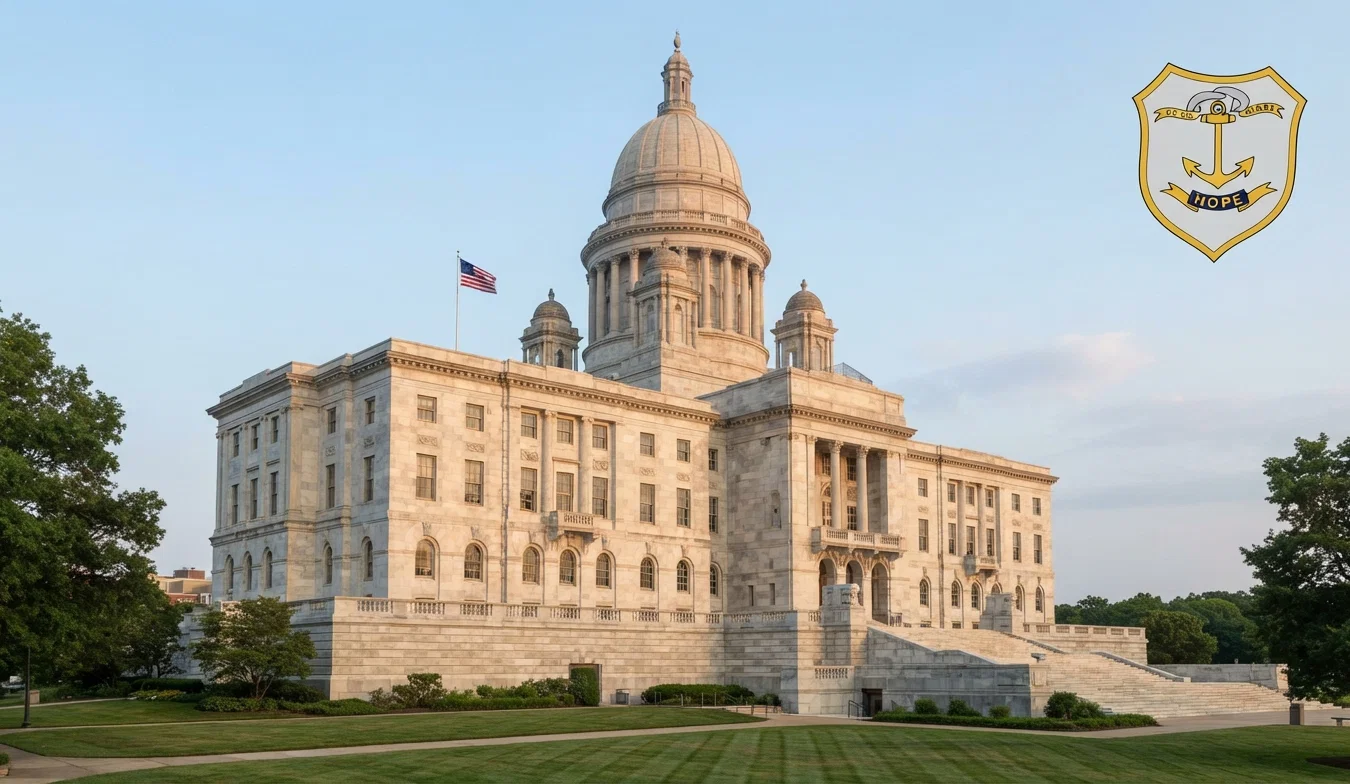
State Capitol, Providence, Rhode Island
Church and State Not Separate in Maryland
It is not true, however, that the colony was founded upon the principle of total separation of church and state and absolute freedom in matters of religion for all men, as was Rhode Island; or that the early laws of the colony were free from all religious interference and bias. The charter obtained by Lord Baltimore 1632, provided that "no interpretation be admitted thereof by which4God's holy and true Christian religion, or the allegiance due unto us, our heirs, and successors, may suffer any prejudice or diminution." (Hazard's "Historical Collection of State Papers," 1792, Vol. 1, page 327.) This would at least seem to imply or anticipate a favored, if not an established, religion, and state control or supervision of that religion. And one of the first acts of the Maryland Assembly of 1639, reads, "Holy church within this province shall have all her rights, liberties, and immunities safe, whole, and inviolable, in all things." ("Proceedings and Acts of the General Assembly of Maryland, 1637-1664," page 40.)
In 1649 an act containing the following provision, was passed by the Maryland Assembly:
"And whereas the enforcing of the conscience in matters of religion hath frequently fallen out to be of dangerous consequence in those commonwealths where it hath been practised, and for the more quiet and peaceable government of this province, and the better to preserve mutual love and amity among the inhabitants, no person within this province, professing to believe in Jesus Christ, shall be in any wise troubled, molested, or discountenanced, for his or her religion, or in the free exercise thereof."—Bancroft, Vol. 1, page 168.
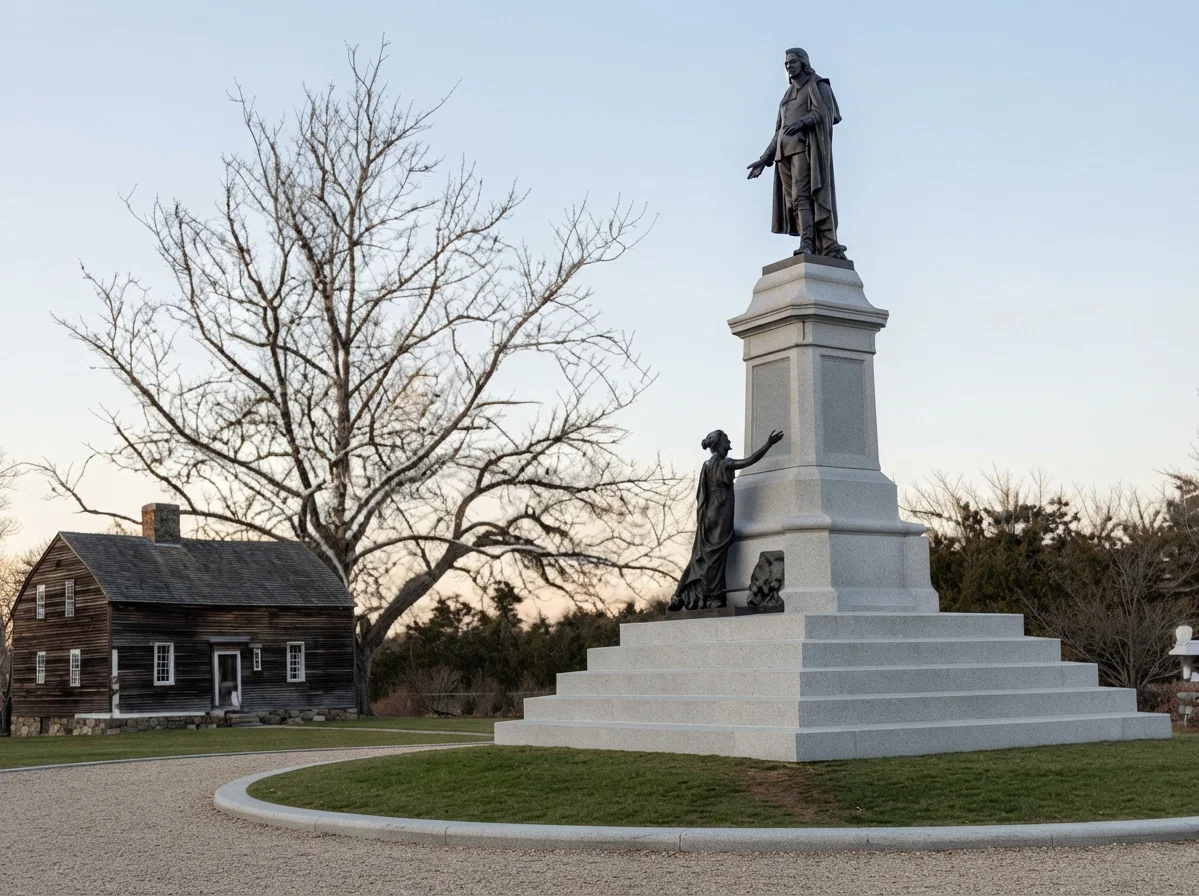
Roger Williams Statue, Providence, Rhode Island
While undoubtedly designed to protect freedom of conscience, Bancroft observes that this "clause for liberty in Maryland, which extended only to Christians, was introduced by the proviso that 'whatsoever person shall blaspheme God, or shall deny or reproach the Holy Trinity, or any of the three Persons thereof, shall be punished with death.'" Under the enforcement of such a law, Unitarians, Jews, and unbelievers generally, as well as the profane, would certainly fare hard.
The same law further provided that "whatsoever person or persons shall from henceforth use or utter any reproachful words, or speeches, concerning the blessed Virgin Mary, the mother of our Saviour, or the holy apostles, or evangelists, or any of them, shall in such case for the first offense forfeit to the said Lord Proprietary and his heirs, the sum of five pounds sterling." ("Proceedings and Acts of the General Assembly of Maryland, 1637-1664," page 244.) This sounds very much like a law of a religious establishment, and that, too, of the Roman Catholic Church.
Such provisions show beyond question that the government of Maryland did assume control over religious matters, and that however much toleration there was in the colony, freedom of conscience was not an organic part of its constitution.
How about Rhode Island?
But not so Rhode Island. There, says Montgomery:
"From the beginning entire freedom of conscience was given to every settler. Maryland had granted such liberty to all Christians, but the colony of Providence did not limit it,—not Protestants and Catholics only, but Jews—yes, unbelievers even were protected, and thus men of all religions and of no religion were safe from molestation so long as they behaved themselves. In all other colonies in America [Maryland included], as in every country of Europe, the government favored some particular worship, and in some
degree compelled people to maintain it and conform to it. But here there was nothing of the kind. Roger Williams first laid down and put in actual practise what we may call the American principle—that is, that government has nothing whatever to do with the control of religious belief."—"Leading Facts of American History," page 110.
In 1631, three years before the ships of Lord Baltimore left the shores of England for Maryland, Roger Williams, at Salem, Massachusetts, set forth the doctrine "that man is accountable to his Maker alone for his religious opinions and practises, and is en-
titled to unrestrained liberty to maintain and enjoy them." ("Memoir of Roger Williams," by James D. Knowles, page 48.) This is the doctrine for which he was banished from Massachusetts, and which he took with him to Rhode Island, in 1636, and made the Magna Charta of that colony. To state the matter plainly, religious liberty with Roger Williams was a principle; with Lord Baltimore, a matter of policy.
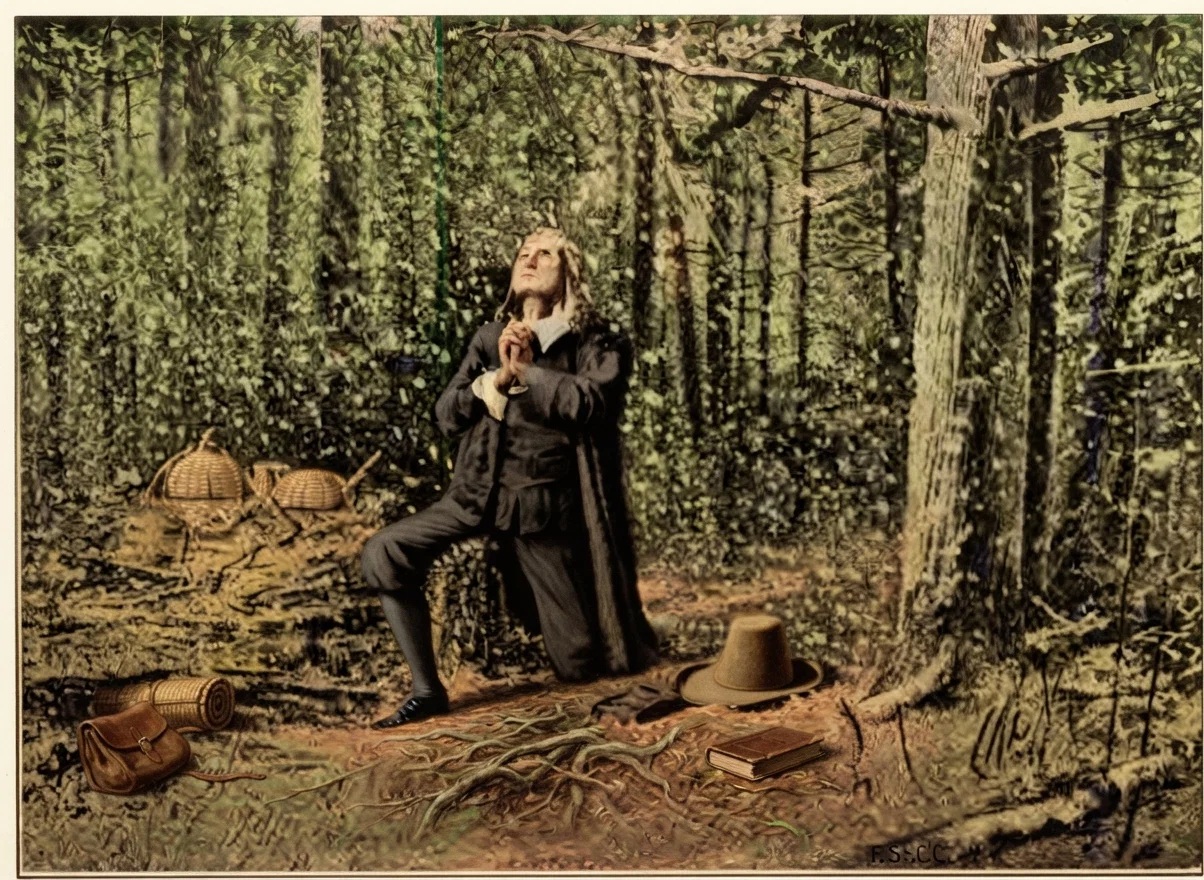
Roger Williams Praying in Rhode Island Forest
A "Lively Experiment"
In two petitions for a new charter, presented to Charles II in 1662, Mr. Williams stated that the people of his colony had it much in their hearts "to hold forth a lively experiment that the most flourishing civil state may stand, yea, and best be main-
tained, with full liberty in religious concernments." ("State of Rhode Island and Providence Plantations," by Edward Field, Vol. I, page 101.) It was Rhode Island, therefore, and not Maryland, that was making this "lively experiment."
The Rhode Island charter granted by King Charles the next year, in response to these petitions, said:
"Our royal will and pleasure is that no person within the said colony, at any time hereafter, shall be anywise molested, punished, disquieted, or called in question, for any differences in opinion in matters of religion, . . . any law, statute, . . . usage, or custom of this realm to the contrary hereof, in any wise, notwithstanding."—Ibid., page 104.
Rhode Island had gained what the mother country did not possess herself—religious liberty. No such petitions nor charter relation to any other American colony can be found.
And in "America Dissected" (Dublin, 1753), page 31, Rev. James MacSparran, complaining of Rhode Island, says:
"In all the other colonies the law lays an obligation to go to some sort of worship on Sunday; but here liberty of conscience is carried to an irreligious extreme."
This again singles out Rhode Island as the one and only colony in which there was perfect freedom in matters of religion.
Not a Catholic Doctrine
That there was a large measure of freedom in Maryland need not be denied; but that there was absolute separation of church and state there, or that this is a principle held or advocated generally by the Roman Catholic Church, is not true. Sixty-two years before the founding of the Maryland colony, in 1572, occurred the massacre of
St. Bartholomew, in which the attempt was made to extirpate all Protestants in France. Fifty-one years after the settlement of the colony, in October, 1685, the Edict of Nantes was revoked, and every Protestant who could leave Europe fled to America. And at the very time when the colony was being planted, thousands of men and women in Spain and elsewhere in Europe were sent to prison, banished, or burned at the stake solely for what the Catholic Church
pronounced "heresy" in matters of religion.
The strong claims made during recent years by Catholic writers concerning Maryland would seem to imply an endorsement on the part of the Roman Catholic Church of the principles of separation of church and state and religious freedom; but the utterances of the latest prelates of the Roman see, like those of more ancient times, convey no such impression. Thus, in his letter addressed to the bishops of France, dated February 11, 1906, Pope Pius X, the latest pope, says:5"That it is necessary to separate church and state is a thesis absolutely false,—a most pernicious error. Based in fact upon the principle that the state ought not to recognize any religious faith, it is, to begin with, deeply insulting to God; for the Creator of man is also the founder of human societies, and He maintains them as He does us. We owe Him therefore, not only private worship, but also a public and social worship in His praise." —"Readings in Modern European History," by Professors James Harvey Robinson and Charles A. Beard, of Columbia University, New York, page 229.
In his encyclical on "Human Liberty" (Libertas), of June 20, 1888, Pope Leo XIII said:
"Since the state ought to have a religion, it ought to profess that which is alone true and which in Catholic countries is especially recognizable. . . . It follows from what precedes that it is nowise permitted to demand, defend, or grant liberty of thought, or of the press, of teaching, or of religion, as well as many other rights which man may be supposed to have by nature."—"Life and Labors of Pope Leo XIII," by Charles de T'Serclaes, edited by Maurice Francis Egan, pages 184, 187.
And in his "Encyclical to France," of February 16, 1892, the same pope speaks of "the false principle of separation" of church and state. (Ibid., page 353.)
In the Syllabus of Pope Pius IX, issued December 8, 1864, the following, among the eighty propositions enumerated, were condemned as "errors of our time":
"15. Every man is free to embrace and profess the religion he believes true, guided by the light of reason."
"24. The church has not the power of availing herself of force or any direct or indirect temporal power."
"55. The church ought to be separate from the state, and the state from the church."
"57. Civil laws may and must be independent of divine and ecclesiastical authority."
"77. In the present day it is no longer expedient that the Catholic religion shall be held as the only religion of the state, or to the exclusion of all other modes of worship.
"78. Whence it has been wisely provided by law, in some countries called Catholic, that persons coming to reside therein shall enjoy the public exercise of their own worship."—"The Papacy and the Civil Power," by R. W. Thompson, pages 729-735.
These propositions are condemned as errors. Their opposites, therefore, must be the position and teaching of the church represented. And this is true even in the United States. In his work "Faith of Our Fathers," page 269, Cardinal Gibbons sets forth the following approvingly:
"Religious liberty may be tolerated by a ruler when it would do more harm to the state or to the community to repress it."
And he adds:
"This is the true Catholic teaching on this point, according to Bacanus and all Catholic theologians."
Think of an American talking about "tolerating" religious liberty?
In his book "Maryland the Land of Sanctuary," Rev. William T. Russell, while maintaining that in Maryland "religious liberty gained its first foothold among the nations of the earth" (page 1), and that "the glory of Maryland is derived from its generous custom of religious toleration" (pages 310, 311), nevertheless, in harmony with Cardinal Gibbons, teaches that "a Catholic ruler
is justified in granting a limited religious liberty . . . when to refuse religious liberty would be more injurious than to grant it" (page 7); and says that "the closer the union between the civil and religious authority, as long as each aids the other, and neither encroaches upon the domain of the other, the better will it be for both" (page 6). Think of an American citizen and author intimating that for a ruler to grant religious liberty would be "injurious"! And in a sermon on "Catholic Tolerance in America," delivered in St. Patrick's Church, Washington, D. C., May 4, 1910, Mr. Russell further said:
"The state can not afford to permit religious liberty. We hear a great deal about religious tolerance, but we are only tolerant in so far as we are not interested. A person may be tolerant toward a religion if he is not religious. . . . Intolerance means fervor and zeal. The best the state can do is to establish a limited religious liberty; but beyond a certain degree of tolerance the state can not afford to admit the doctrine."—Washington Post, May 5, 1910.
An editorial in the Western Watchman of August 25, 1910, a leading Catholic paper of the country, published at St. Louis, styles a union of church and state in any country, "the ideal relation." It further says:
"We have no union of church and state in this country for the simple reason that our state is not Christian; and the church can not be yoked to an unchristian commonwealth."
An Inconsistent Claim
There is little consistency, therefore, in the claim put forth by Catholic writers that to the Catholic Church is due the honor of first establishing in the world a state founded upon the principles of religious liberty, while the testimony, both ancient and modern, is so abundant that this is not and never has been a Catholic doctrine, and while these same writers themselves stand for a union of church and state and the right to be intolerant. If religious freedom was a good thing in Maryland, why would it not be a good thing in every land? If "the glory of Maryland is derived from its generous custom of religious toleration," why would not the exercise of this same kind of toleration bring glory to every other country in the world? And if placing all denominations upon anything like an equality before the law was a good thing in Maryland, and the Catholic Church really approves of this there, why would it not be a good thing in every other civil government in the world, and why does not the Catholic Church approve of it at the present time in France and Spain, for instance?
Inconsistent Protestants
Nor are Protestants who stand for religious legislation and state interference in matters of religion, less inconsistent. Largely through their influence, and contrary to one of the fundamental principles of Protestantism, there have been placed upon the statute-books of nearly every state in the Union, Rhode Island included, laws for the compulsory observance of Sunday. Says Rev.
W. F. Crafts, in the Christian Statesman of July 3, 1890:
"During nearly all our American history THE CHURCHES HAVE INFLUENCED THE STATES to make and improve Sabbath laws."
And they are now trying to "influence" the United States Government itself to make this same kind of laws. The inconsistency of their efforts in this direction was noted by Rev. Thomas F. Cashman, a Catholic priest of Chicago, a few years ago. He said:
"The position of coercion taken by so many of the Protestant clergy—the position that, altho they are admittedly in a hopeless minority of all the people of these United States, they would compel all the rest of us to accept of their Sunday dogmas by recourse to law and other methods—is a grievous departure from their old battle-cry of civil and religious liberty."—Chicago Evening Journal, April 8, 1893.
To the extent that Maryland declared for or practised religious freedom, let all due honor and credit be given; but to Rhode Island, rather than to Maryland or to any other of the thirteen original colonies, must we look for a state founded, from its very beginning, upon the principle of absolute liberty of conscience and separation of church and state. Speaking of Rhode Island, Montgomery says, "Not a single blot of religious persecution rests on the fair pages of the history of the colony." ("Leading Facts of American History," page 111.) This can not be said of Maryland. Within recent years, under its Sunday laws, have occurred numerous prosecutions of conscientious observers of the seventh day, with fines and imprisonments following.
While the statute-books of Rhode Island, even from an early date (1679, four years before the death of Roger Williams), have been blemished with laws against Sunday labor and "breakers of the Sabbath" (see present Sunday law), and an alleged law of 1663-64, excluding Roman Catholics from office,—tho this last has been declared an evident "interpolation" by those who have carefully investigated the matter, as it appears first in a code called the "Revision of 1745," and no record of its passage can be found when it was said to have been enacted (see Armitage's "History of the Baptists," pages 650-652),—the fact still remains that the colony was established upon right principles, and that, as yet, few if any prosecutions of men for conscience' sake have disgraced the state. To Rhode Island, therefore, rather than to Maryland, must be accorded the honor of first founding a commonwealth upon right principles.