About the Flying Man

5%

Pacific Press Publishing Association · Mountain View, California · Oct 25, 1910

FromSigns of the Times, Vol. 37, No. 42.

Read the full edition

About the Flying Man

Less than a century ago a desperate attempt was made to blaze a trail through forests, over mountains, and across lone sandy plains to the western coast with the ox train, later to be followed by the "iron horse."
To-day a desperate attempt will be made to blaze an aerial trail across the continent, and if successful leave in its wake the encouraging possibilities of aerial navigation in transcontinental tours. To encourage this initial attempt Mr. Hearst is offering a prize of $50,000 to the successful aeronaut. The offer is good for one year, and the flight is to be made from New York or from Boston to San Francisco or to Los Angeles, or vice versa. Any one may participate in this contest with any type of self-propelled aeroplane which is heavier than air. Stops may be made as often as desired en route, and any necessary repair of machine may be made. But the flight must be accomplished under the foregoing conditions within thirty days from the date of starting.
The variety of atmospheric conditions will be a severe test in the great cross-country flight of over 3,000 miles; and this prize of $50,000 is the highest ever offered to aviators in America.
The marvelous and rapid progress in aeronautics in the last two years is indicated in the following achievements: Glenn H. Curtiss, at the speed of fifty miles an hour, flew 140 miles from Albany to New York. A few days later Aviator Chas. K. Hamilton made a more daring flight from New York to Philadelphia, during which he carried a letter from Mayor Gaynor of New York to Governor Stuart of Pennsylvania. The route he took was 82 miles and he made a speed of 47 miles an hour.
Walter Brookins, a pupil of the Wright brothers, won the $10,000 prize offered by a Chicago newspaper for a successful flight between Chicago and Springfield, Illinois. He raced the entire distance of 185 miles with a special train, and had no trouble in beating it, making an average speed of forty miles an hour.
In England, Paulhan traversed the 148 miles between London and Manchester in an aeroplane. Le Banc, Auburn, and Weymann soared from Paris to Nancy on the German frontier and back to Paris again, a total of 500 miles.
Another notable flight was made by an American aviator from Paris to London. This feat was demonstrated because such a flight was challenged as impossible. Leaving Paris, the daring air-cleaver succeeded in bridging the channel and was well on his way to London before he was compelled to stop temporarily. Resuming his flight he alighted on the grounds of the Crystal Palace, London.
Another remarkable flight, which has cost the life of George Chavez, a French-Peruvian aviator, was his frigid journey by monoplane over the jagged and icy peaks of the Alps.
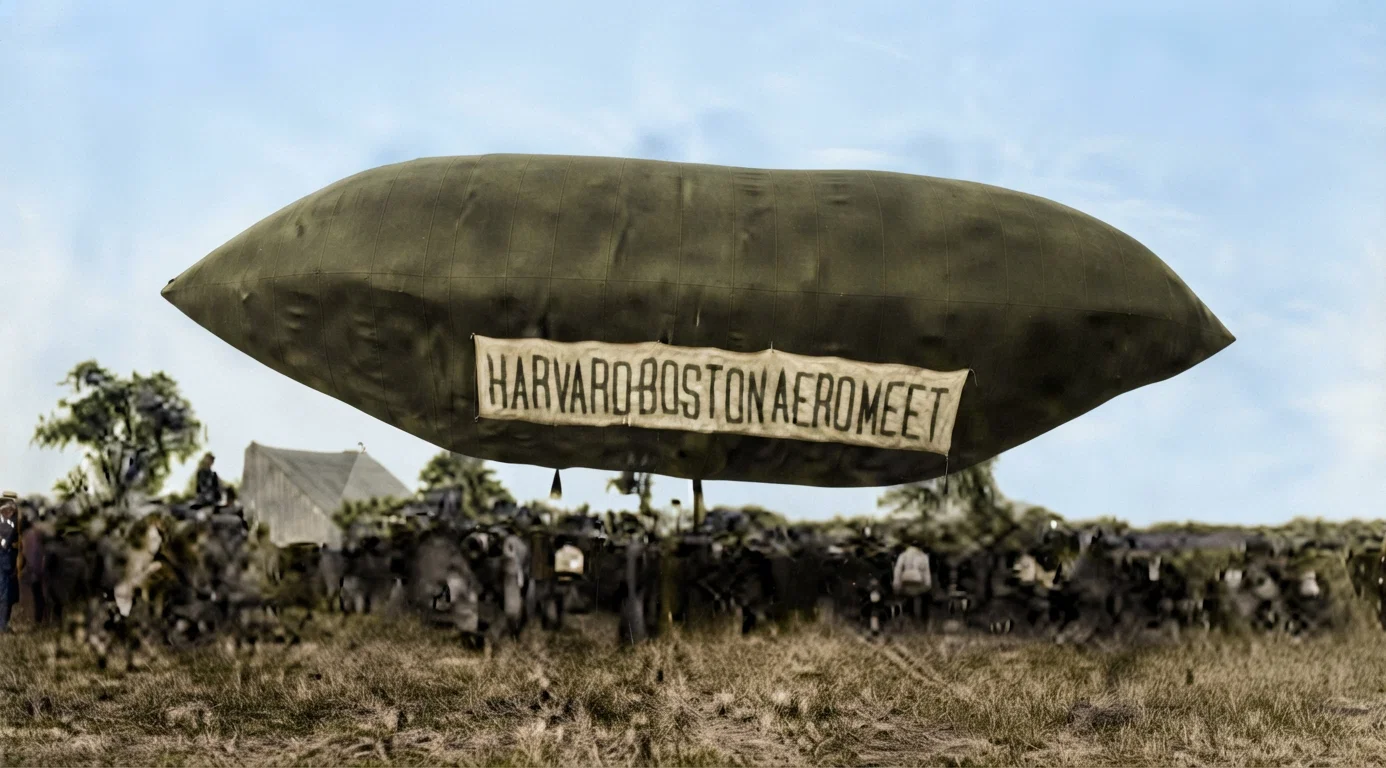
In an aeroplane meet at the Squantum Aviation Field, Boston, Massachusetts, 100,000 spectators witnessed some of the most remarkable aerial maneuvers that have ever occurred. Some of the "stunts" were—sharpshooting at a target two hundred and fifty feet below, hurling mimic bombs at an imaginary battle-ship, endurance and distance flying, biplane racing, and accurate landing. Surely the art of aerial navigation is making rapid strides, developed by the keen competitive interest of aviators.
Dixon ready for a flight in a dirigible, at Boston
At least one machine has been equipped with wireless apparatus, and the following message will suggest possible developments which our forefathers may have indulged in only as a fairy tale: "Horton: Another achievement is recorded in the sending of a wireless message from an aeroplane in flight.—McCurdy."
The Murray air-ship now building in San Francisco is said to be far and away ahead of the Zeppelin air-ship. It is not lighter than air, as is the Zeppelin air-ship; in fact it is a little heavier than air, but it has that connected with it which will enable it to rise from earth or water at any time. It can light where it will. It can remain stationary in the air for any length of time; and the men who have invested in its building, and military experts, expect more from it than from any other dirigible built, or from aeroplanes either. It really is a combination of the principles of aeroplane and dirigible. The air-ship which will soon be tried is 140 feet in length, 12 feet beam, 52 feet high, and 180 horse-power. One of its lifting powers is six helicopters.
Many have read or heard recited "Darius Green and His Flying-Machine." Darius said, "The birds fly, why can't I?" "Are the bluebird and the phoebe smarter than we be?" Darius, however, came to grief. But his dream is true. Our picture is of a meeting between Mr. J. Trowbridge, author of "Darius Green," and Grahame-White. We may be sure it was of interest.
In the question of aerial progress, England, France, Germany, and the United States have about the same standing, altho Germany seems to be in the lead in dirigibles, having established a passenger service and mail route. In both continents these daring air-cleavers outspeed express-trains, flying at an altitude of one mile. Mr. Walter Wellman, the well-known newspaper man, proposes to cross the Atlantic in a motor balloon which was tested in the Arctic region.
While aviation is still in its infancy, scientists are wondering what influence its development will have upon the tremendous preparations for war. It seems that every invention which science has made possible is being forced into military service, until the very forces of nature are arrayed against each other as mediums employed by men for the destruction of their fellows. And so as aeronautics develop, instinctively men begin experimenting in aerial warfare, each nation struggling for supremacy or equality in military power. New inventions call for new modes of defense, and so new guns must be specially constructed for the purpose of bringing down these angry war birds in times of battle. This in turn leads to the question as to what type of air-ship can be used to the best advantage in defending itself and at the same time be able to pour its fiendish fire on its enemies below.
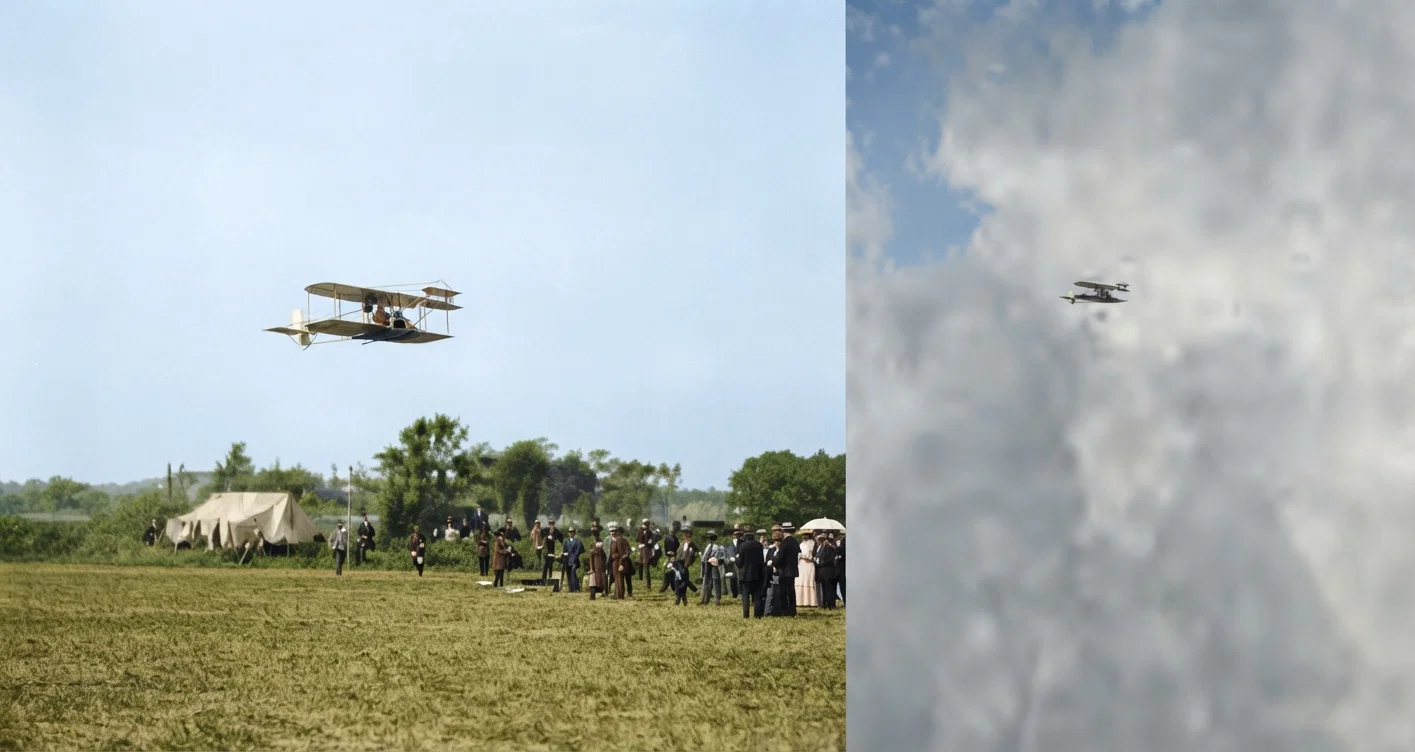
Ralph Johnson in the Wright biplane at Boston. The man bird in the clouds
An instance of smuggling by aeroplane presents a serious problem for the civil authorities to solve. It seems a pity that in the wonderful progress being made in aeronautics, some minds turn so instinctively to war and crime.