The Gospel by Royal Proclamation. A Troubled King—A Dream and Its Interpretation—Self-Exaltation—Humiliation and Humility—A Converted Soul.
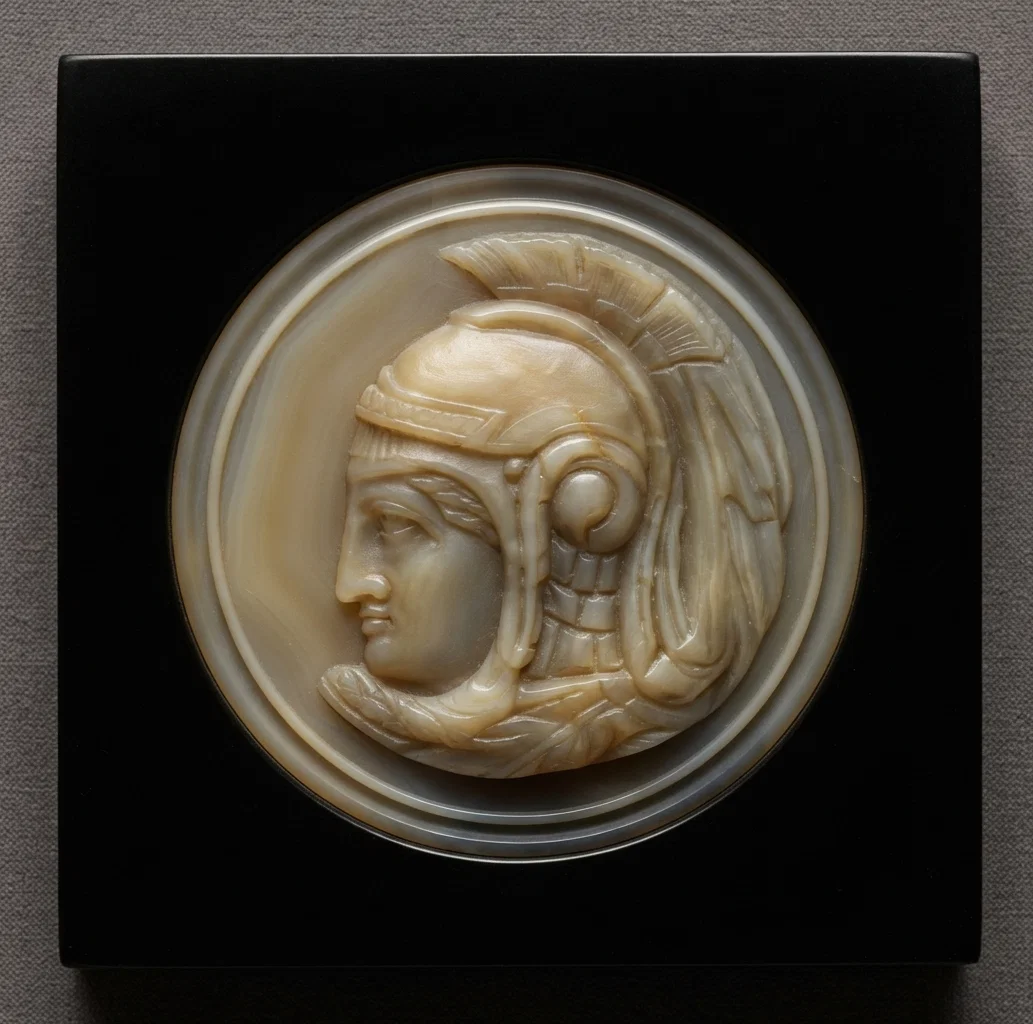
Cameo portrait of Nebuchadnezzar. A votive offering dedicated to Merodach. Engraved on a black stone.
IT is a wonderful lesson that the fourth chapter of Daniel opens before us. It is a lesson, which, if it had been learned by Nimrod, first king of Babylon, one of the earliest of earth's kings, and had been followed ever since, would have wrought out a far different story of earth's ages. It is worthy of profoundest study by the mightiest of earth; it is a lesson for these very days thru which we are passing; for let us repeat again, as we abundantly showed in the beginning of these studies, that the book of Daniel is pre-eminently God's instruction to statesmen, to nations, in these last days.
The story is set before us in the Scripture; read it. Note first of all that this chapter is a royal proclamation. It is not a story that Daniel tells himself; it is a story which the king of Babylon tells of himself and Babylon and Daniel and God. The story has not yet been found among the archives of Nebuchadnezzar by the archeologists. We doubt greatly if it ever will be found. Yet we believe that the king wrote it for all posterity. Daniel himself may have copied it from the clay tablets, or the black basalt slabs upon which the king caused it to be inscribed or engraved. But Babylon remained idolatrous, and it is easily understood how the devout pagans who succeeded Nebuchadnezzar, notably Nabonadius, aided by the priests of heathen cults, did their best to obliterate the knowledge and worship of the true God from Babylonian history. It would not have been flattering to their wisdom and position as teachers to let it remain, to reveal to future generations that their mightiest emperor had been humbled and taught by the God of a despised nation. But God has, thru Daniel, given us the faithful record.
It is a beautiful introduction with which the king opens his proclamation:
"Nebuchadnezzar the king, unto all the peoples, nations, and languages, that dwell in all the earth: Peace be multiplied unto you. It hath seemed good unto me to show the signs and wonders that the Most High God hath wrought toward me. How great are His signs! and how mighty are His wonders! His kingdom is an everlasting kingdom, and His dominion is from generation to generation." Dan. 4:1-3, A.R.V.
The Dream and Its Purpose.
Then follows the reason of the royal proclamation. In his highest prosperity, his kingdom at peace, Nebuchadnezzar again dreams, and the dream troubles him. He sends again for the magicians, the enchanters, the astrologers, the soothsayers, the men of learning, the men of experience, the men of craft. He this time tells them the dream; but they do not know the interpretation. He at last sends for Daniel, tells him the dream of the great, overshadowing tree, reaching in height to the heavens, seen by all the earth, beautiful in foliage, furnishing fruit and shade for all. He sees a holy watcher, who takes cognizance of things earthly, come down and command, "Hew down the tree, and cut off his branches, shake off his leaves, scatter his fruit; let beast and fowl flee for safety, but do not destroy utterly. Leave of his roots in the earth, bound as with iron and brass; let him be humiliated to the utmost, till seven times pass over him." This is the substance of the dream. The purpose is thus stated:
"The sentence is by the decree of the watchers, and the demand by the word of the holy ones; to the intent that the living may know that the Most High ruleth in the kingdom of men, and giveth it to whomsoever He will, and setteth up over it the lowest of men." Dan. 4:17.
The Interpretation.
Reluctant was Daniel to tell the interpretation to the king. He informs the king that he could wish that the dream and its interpretation referred to the king's enemies, but he tells it as God gave it.
1. The great tree referred primarily to Nebuchadnezzar, the great ruler of Babylon. He had "grown and become strong." Everywhere among earth's nations his power and greatness were acknowledged.
2. God also had seen the king. Heavenly watchers had noted his sins—pride, arrogance, and oppression of the poor. His continuance of rule in that way could not be suffered. In the face of the light hitherto given of God and acknowledged by the king, he could not be permitted to go on in transgression. God would make one more effort. The king would not walk in humility; God would humiliate him. Read verses 24-26. This was the decree: He had chosen the natural selfishness of the beasts; he would be driven out to dwell with them, to eat as did they, be separated from his kingdom and friends,—a practically insane man,—till seven times should pass; till he knew that the Most High ruled in the kingdom of men, and gave it to whom He would. The word rendered "times" means a set period. Josephus tells us that Nebuchadnezzar thus suffered seven years, tho there are those who hold that it means months. Yet the word indubitably refers to years in Dan. 7:25.
3. Daniel told it all as a warning to the king that he might escape the evil, according to the instructions of Jeremiah (18:7-10). He therefore pleads with the king to break off his sins by righteousness, and his iniquities by showing mercy to the poor.
How to Break Off Sin.
This appeal not only shows Nebuchadnezzar's sins, but reveals the true secret of co-operation with God in successful character-building. "Break off thy sins by righteousness." There is no other way. "Nature abhors a vacuum." There is no righteous idle soul. There is no righteous empty life. The character which God requires is positively righteous, bearing the fruits of righteousness. Righteousness—right being, right doing—must take the place of sin. Mercy must reign where lawlessness oppressed the poor. Mighty temples erected to the gods would avail naught if their material came from the sweat and blood of the needy.
It was Nebuchadnezzar's privilege to save his humiliation by humility. God desires to humble no man. He wishes man to see and know and recognize by faith his true condition,—a creature of a moment, dependent on God for every breath he draws. Realizing this, man will be humble. He will acknowledge God as Ruler, himself as servant. This was the privilege of Babylon's proud king. Great as he was in human comparison, he was nothing in God's sight. But Nebuchadnezzar had not yet learned humility; so God in His love for the man, and generations to follow, humbled him.
The Spirit of Babylon.
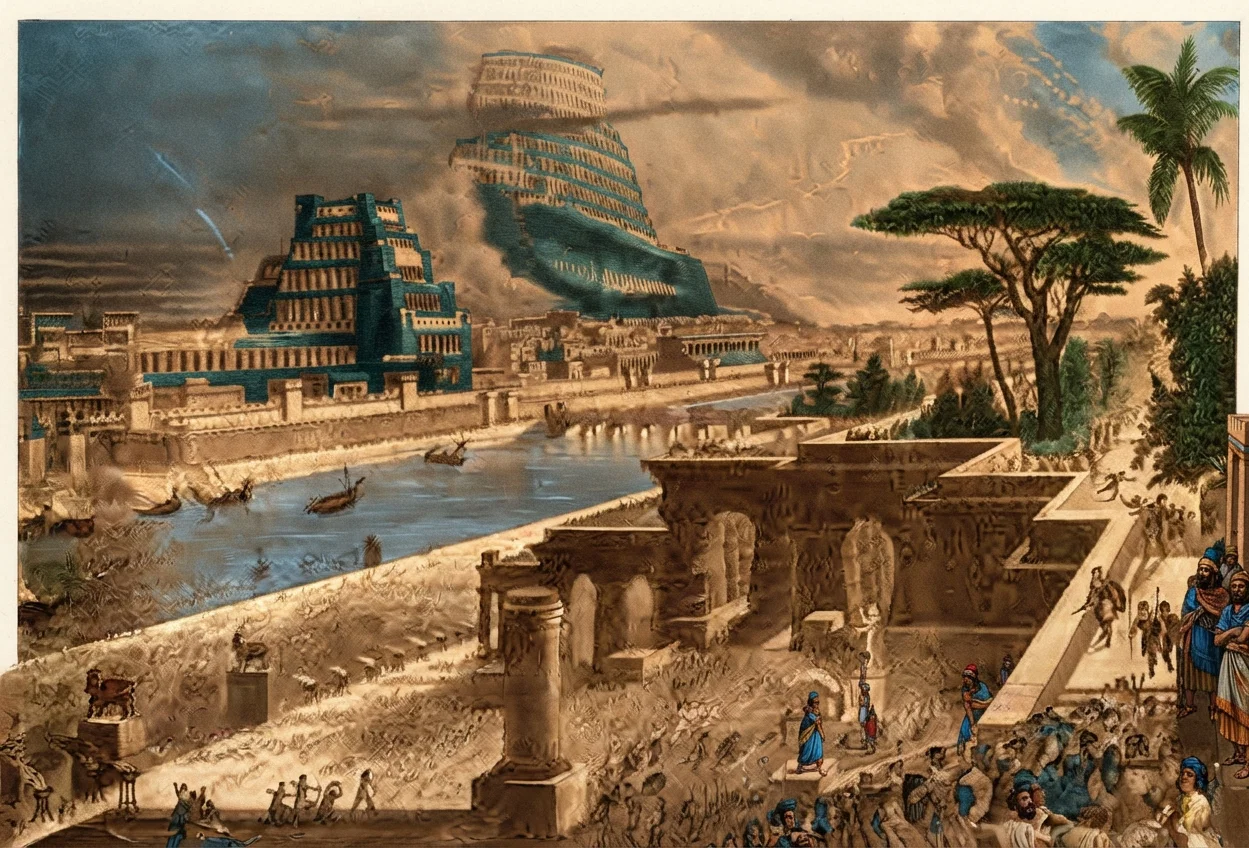
Not willing to learn thoroly by faith, the king must learn by experience. For a time he walked more softly before God,—a year the record tells us,—pursuing his great work of building; and then, ascending the top of his gold-plated palace, he looked over the magnificent city which he had been so instrumental in enlarging, embellishing, and beautifying;—he saw its walls, its temples, its palaces, its canals, its bridges, its hanging gardens, and his heart swelling with the pride of his own greatness, he exclaimed: "Is not this great Babylon, which I have built for the royal dwelling-place, by the might of my power and for the glory of my majesty?" Verse 30.
It was the spirit of Babylon's founders: "Let us build us a city, and a tower, whose top may reach unto heaven, and let us make us a name; lest we be scattered abroad upon the face of the whole earth" (Gen. 11:1-9), altho God had told them to multiply and fill the earth (Gen. 9:1). It was the spirit of Babylon's original king, who, in the beginning of all rebellion, rebelled against high Heaven, and said: "I will ascend into heaven, I will exalt my throne above the stars of God; and I will sit upon the mount of congregation, in the uttermost parts of the north; I will ascend above the heights of the clouds; I will make myself like the Most High." It was rebellion against the instruction of God thru Daniel, "The Most High ruleth in the kingdom of men." And this is a characteristic of Babylon in all ages.
The Fulfilment.
Perhaps Nebuchadnezzar had persuaded himself that the sentence of the dream would not come true. But he could no longer deceive himself. No sooner were his boastful words uttered than the voice came from heaven:
"O King Nebuchadnezzar, to thee it is spoken: The kingdom is departed from thee: and thou shalt be driven from men; and thy dwelling shall be with the beasts of the field; thou shalt be made to eat grass as oxen, and seven times shall pass over thee; until thou knowest that the Most High ruleth in the kingdom of men, and giveth it to whomsoever He will."
The same hour it was fulfilled. The king was driven out from among men, ate grass as the oxen, his body unsheltered, and his hair grown coarse and long like lion's hair (so the Septuagint), and his nails as birds' claws.
But God did not leave him. During all the time, doubtless, the cause of his humiliation was with him; and the proud king learned the lesson, and thus he records it:
"And at the end of the days I, Nebuchadnezzar, lifted up mine eyes unto heaven, and mine understanding returned unto me, and I blessed the Most High, and I praised and honored Him that liveth forever; for His dominion is an everlasting dominion, and His kingdom from generation to generation; and all the inhabitants of the earth are reputed as nothing; and HE DOETH ACCORDING TO HIS WILL IN THE ARMY OF HEAVEN, AND AMONG THE INHABITANTS OF THE EARTH; and none can stay His hand, or say unto Him, What doest Thou? . . . Now I, Nebuchadnezzar, praise and extol and honor the King of heaven; for all His works are truth, and His ways justice; and THOSE THAT WALK IN PRIDE HE IS ABLE TO ABASE." Dan. 4:34-37.
This is the burden of the converted king's message to all people—GOD RULES; we are at the most and best but instruments, suffered to remain for our testing and salvation, for His glory. The king's insanity passed away; his clearness of intellect returned; the kingdom and all its glory was restored to him; his counselors and lords sought him; he was established in his kingdom; and more excellent majesty was added. He learned that man could rule better under the great God of heaven than to trust in himself.
The Lesson for the Ages.
For the last days it is written, "THE MOST HIGH RULETH," God is Governor over the nations. He suffered earth's true original prince, Adam, to rebel, and yield his dominion to Satan. He has for thousands of years suffered the usurper Satan to exercise his limited control; God has made a portion of the usurper's wrath to praise Him, the remainder He has restrained. He permitted Babylon to come to the throne of empire; He gave into her power the kingdoms; but the Most High did not abdicate. When Babylon could be used no longer to God's glory, Medo-Persia followed; but the Most High ruled. After Medo-Persia came Grecia; but the Most High ruled. After Grecia came the iron imperial kingdom of Rome,—came the intermingling of the principles of democracy and socialism, the clay; but the Most High ruled.
To-day Great Britain, France, Germany, the Great Bear of the North, and the Great Eagle of the West, are talking proudly and arrogantly and boastfully of their prowess, their deeds, their culture, their wealth, as tho they reigned by right of themselves; and never did Babylon need more than they to know the truth of our lesson,—"THE MOST HIGH RULETH IN THE KINGDOM OF MEN, AND GIVETH IT TO WHOMSOEVER HE WILL." Their tenure of stay is their recognition of God, not in words, but deeds, the glory to Himself which will accrue from their existence. When the time comes that they fail, as it certainly will, according to the "more sure word of prophecy," the everlasting kingdom of God will succeed all earthly rule and dominion, and the temporal kingdoms of men will have passed away forever.
Babylon in the Time of Nebuchadnezzar.
The Most High rules. He permits sin to work out its own evil fruit, that the unbelieving may be forever satisfied, that His own word may be forever demonstrated to be true, even on its negative side. Its positive side will, to the children of faith, be an eternally unrolling demonstration of the truth, the righteousness, and love of Him who alone has the right to reign.