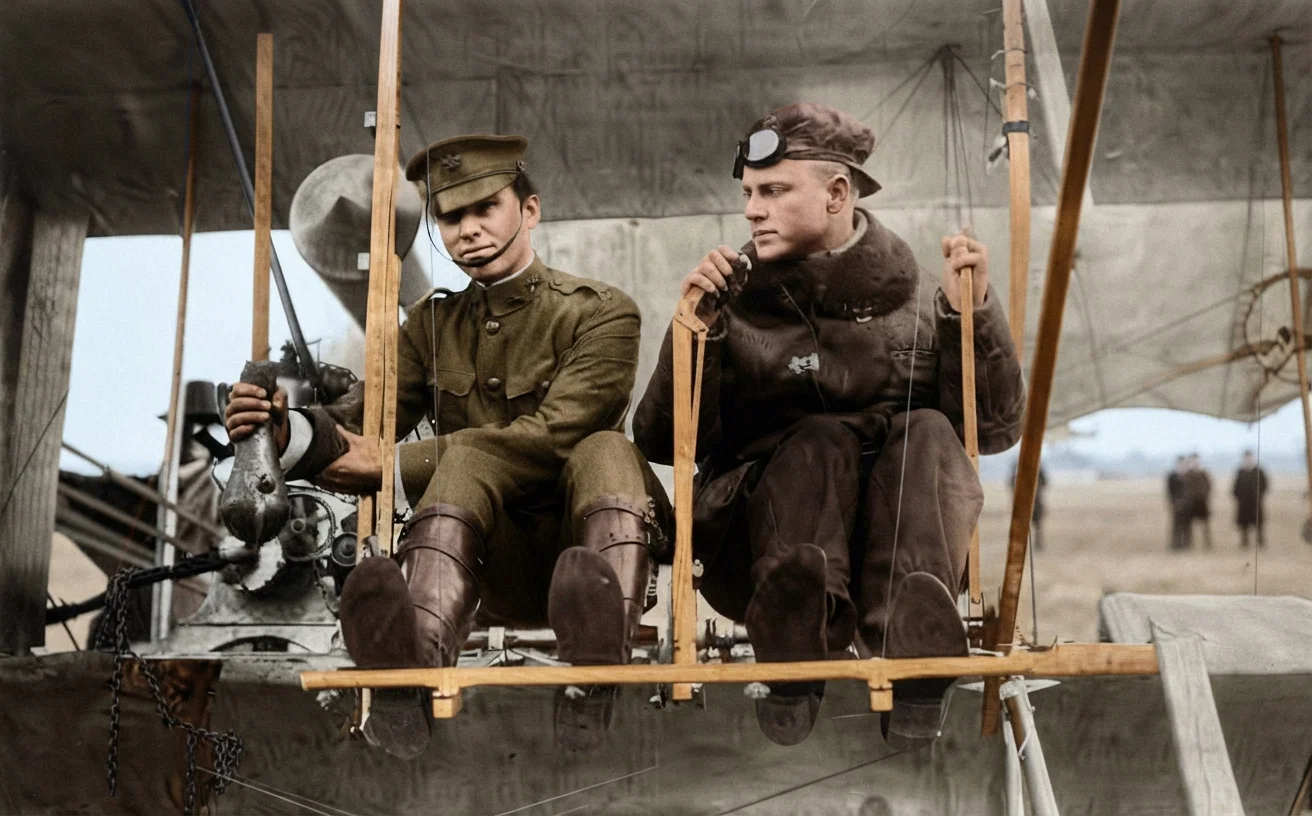
The First One to Throw a Bomb from a Flying-Machine
"It was a great experience, and it demonstrated a great reality," said Lieut. Myron S. Crissy of the Coast Artillery, speaking of his successful trip with Philip Parmalee in the Wright machine, on January 15, at Selfridge field, near San Francisco, when for the first time in the history of the world an explosive projectile was dropped from an aeroplane at a given spot.
Lieutenant Crissy and Mr. Philip Parmalee about to start on their experimental bomb-throwing ride, January 15, 1911. The above is from the original photograph, kindly loaned us by the lieutenant. January 17 the same officer dropped two bombs from the same aeroplane. The first hit the water and failed to explode; the second, dropped from an altitude of 680 feet, at a silhouette target, missed it by only eight yards. It dug a hole 2½ feet in diameter by 2½ feet deep, scattering mud and pieces of the bomb over a circle 100 yards in diameter. Several pieces hit the target. On his next ascent Lieutenant Crissy will drop a 12-pound shrapnel bomb from an altitude of a thousand feet or more. Lieut. Paul W. Beck believes these experiments to be epochal.
"It proved without doubt," he said, "that the aeroplane is to be an important factor in the warfare of the future.
"For reconnoitering and scouting its practicability has been demonstrated; but not until this trip has an actual bomb been carried up in the machine, a percussion shrapnel, and the spot designated and aimed at, hit.
"I was not expecting to go up at that time," said Lieutenant Crissy to the "Signs" representative, "but the opportunity presented itself, and I availed myself of it. Mr. Parmalee consented to try, and I took my small bomb, as shown in the photograph, and decided to demonstrate if possible its usefulness in relation to the aeroplane in war."
"Were you frightened by the height, or did the experience of flying inconvenience you at all?" Lieutenant Crissy was asked.
"No! the ride in the machine was delightful, the sensation novel. I was not at all frightened, and it didn't even occur to me to hold on. After the rise it was smoother than an automobile on a good road, with an occasional dip very much like the rise and fall on a very smooth sea.
"After we had climbed to an altitude of about 550 feet, and far enough away from the crowd below to make it perfectly safe, we picked out the spot below, and, leaning forward, I threw the projectile.
"Previously, nothing larger than oranges and similar objects had been used, and of course with unsatisfactory results,—for their center of gravity varies and their sections and weights vary so that anything like accurate experimental work was impossible. But this bomb was built of iron, with a pear-shaped body, the short cylindrical part containing the
percussion fuse, and two thin strips of wood fastened to it to insure its dropping right end down, as in a sky-rocket. I devised it for firing data rather than for destruction."
"Many thought it rather dangerous to take even such a projectile aloft, because were it exploded in mid-air—"
"Yes," said the lieutenant, "but that is really a very slight consideration."
"And could you observe it as it descended?"
"We leaned forward slightly and watched it as it moved in a long arc of a parabola, rotating slowly at first. It struck the ground within four or five inches of the spot designated, burying itself about two feet, from the accelerated speed, before exploding. Then with a puff of smoke and splashing of mud it tore a hole about three feet deep and as big as a wash-tub." (See photo on next page.)12
"What do you consider the future importance of this feat, and the skill displayed in accomplishing your object?" he was asked.
He smiled. "It will be the greatest and the biggest argument for peace, and the most effective in case of war. It would be impossible to calculate the future advantages that will accrue to the nation using such defenses as aeroplanes. With time and percussion bombs of greater destructive force, the possibilities are innumerable."
"But in this war game there must be some limit to the advancement and the expense. The price of peace compels a great sacrifice."
"Yes, of course," he hesitated, "the people must decide that."